
Best in-game vault levels, ranked by how much time we lost there
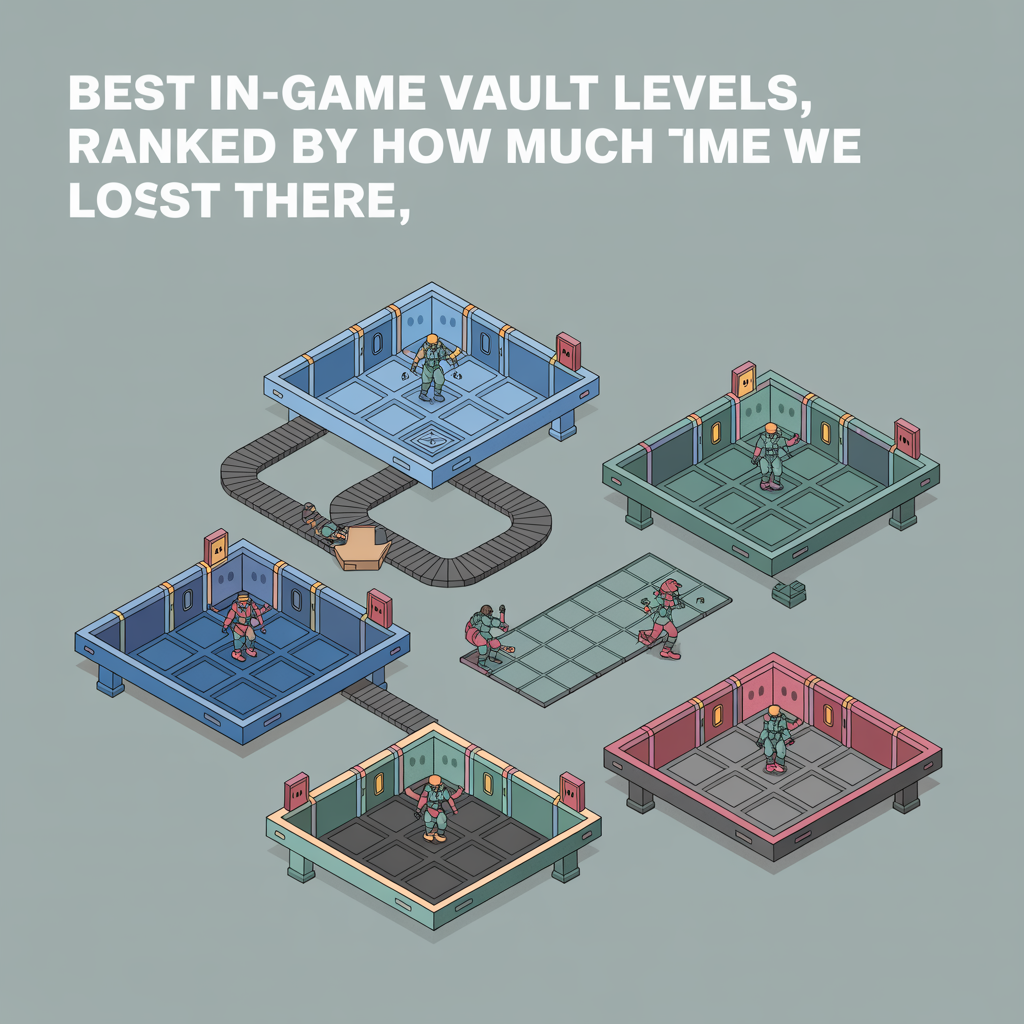
There is a particular kind of weekend that heist games eat whole. You sit down on a Saturday morning with the vague intention of clearing one mission, and by the time you look up the sky outside is a different colour and you have memorised the patrol route of every guard in a fictional building you have never physically entered. The heist subgenre does this better than almost any other category in games — not because the gunplay is usually exceptional, but because the best entries build a kind of cognitive ownership over their levels. You learn the space. You internalise it. Then you watch it collapse around a plan that made perfect sense until the moment it didn't.
What follows is an attempt to rank the in-game vault levels and heist set-pieces that have most reliably consumed unreasonable amounts of time — not through friction or artificial padding, but through genuine systems depth, replayability, or that specific genre pleasure of watching a complicated plan come together. The selection leans into the heist subgenre's relationship with Ocean's Eleven-style venue infiltration and the cinematic tradition that game designers have been borrowing from since at least 2003, when Payday's spiritual ancestors were still being sketched in pitch documents.
5. Payday 2 / Payday 3 — The persistent case for tedious rehearsal
Payday 3's the venue vault scenario takes inspiration from cinematic heist films in a way the original game only gestured at. The earlier game's Golden Grin Caper, a multi-day vault infiltration across a sprawling Nevada venue, was mechanically dense but prone to tipping into chaos the moment a player's stealth discipline slipped. Payday 3 refined the geometry of the problem — tighter stealth windows, more granular camera logic — and the result is a set-piece that genuinely rewards the player who treats it like a puzzle rather than an action corridor.
 Editorial illustration of the scene.
What makes these missions absorb time is less any single clever idea and more the accumulation of interdependent variables: power circuit locations, bag-relay routes, the exact timing window before a guard's eyeline sweeps back. Overkill's design team has always been better at constructing systemic spaces than at writing reasons to care about them narratively, but in a co-op context that trade-off lands differently. Four people coordinating a silent extraction through a building they have collectively failed to clear eight times in a row is, functionally, the same collaborative satisfaction that Larian found in Baldur's Gate 3's most elaborate encounters — the planning session is half the product.
4. Watch Dogs 2 — The Nudle campus and what it understands about modern architecture as a heist target
Watch Dogs 2 gets undersold because its combat feels loose and its protagonist Marcus Holloway was never as tonally interesting as the studio seemed to think. The level design is a different matter. Ubisoft San Francisco built the Bay Area into a playspace that treats corporate campuses, server facilities, and private marina complexes as heist environments with meaningful layering — you can case a location via drone before you commit to an approach, and the game rarely locks you into a single method. The Nudle HQ infiltration in particular sits in a tier of level design that Ubisoft's larger Assassin's Creed operation rarely reaches: vertical, legible, full of routes that feel discovered rather than prescribed.
It also benefits from one of the more underappreciated risk-vs-reward systems in the genre. Sending a small drone into a secure area while Marcus loiters outside a fence is lower-commitment than going in physically, but it gives you less information and you lose equipment if the drone is found. Most players will eventually just vault the fence anyway, but the choice architecture matters. It shapes how you read the space before you enter it, which is the design instinct that separates a good heist level from a corridor with a safe at the end.
3. Fallout: New Vegas — The Strip as a hub zone, and the vault beneath it
The New Vegas Strip operates as a hub-zone with branching faction quests, and Obsidian's writers understood something about that arrangement that most open-world designers miss: the venue itself should feel contested. Every major building on the Strip has a claim on it — Mr. House, the NCR, Caesar's Legion — and walking through the Lucky 38's lobby or the Tops' performance hall carries ambient political weight that the moment-to-moment gameplay doesn't always earn but the writing consistently supports. The slot machines as level decoration, the card game subgame tables as character-beats between quests — these aren't minigame diversions so much as environmental texture telling you this place matters to people who run it.
The vault infiltration narrative — the entire final arc, really — lands here because Obsidian laid the groundwork over forty hours of you absorbing what the Strip costs to maintain and what it means to control it. Heist fiction works when the prize has weight; New Vegas earns that weight slowly. It is, frankly, a better constructed long-game heist narrative than most games that would actually describe themselves as heist titles, and it cost Obsidian eighteen months and a development structure that the publisher treated as a cost-reduction exercise. That it holds together at all is its own kind of design miracle.
2. Red Dead Redemption 2 — Saint-Denis, the bank, and the cost of a plan
The Saint-Denis bank job in Red Dead Redemption 2 arrives roughly two-thirds through the game, and Rockstar has by that point spent so long establishing what the Van der Linde gang stands to lose that the set-piece functions more like a Heat (1995) sequence than a mission in a traditional action game. The vault interior itself is not especially complex by the standards of later entries on this list. What makes it irreplaceable is context: Dutch's plan already has visible cracks, the city's police presence has been seeded through ambient storytelling, and the player has enough relationship capital with the supporting characters that the extraction sequence — chaotic, expensive, irreversible — hits with narrative momentum that the mechanics alone could not generate.
Rockstar deserves credit for understanding that a heist set-piece in a story-driven game doesn't need deep systemic options to be effective. It needs consequence architecture. RDR2's bank job reverberates across the remaining chapters in ways that constrain your relationships and reshape the camp's internal dynamics. Plenty of games give you a vault to crack. Fewer give you a vault that means something once you've cracked it.
1. GTA V — The Diamond Casino Heist mission and the problem of too many good options
The Diamond Casino Heist mission in Grand Theft Auto V is, by a measurable margin, the entry in this genre that has consumed the most collective hours — Rockstar's own engagement data, shared in various earnings contexts, has placed it among the most-replayed structured content in GTA Online's lifespan. The reason is not that it is the most elegant design. It is that it is the most complete one. Three distinct approach methods, each with its own branching prep mission tree. Variable support crew that affects cut percentages and competence levels in ways that matter. A vault interior whose contents change across runs. The whole thing is built like a puzzle box that shuffles its own internals between attempts.
What's easy to overlook is how much the heist arc borrows structurally from the Ocean's Eleven template — the planning board, the dry run, the moment everything goes sideways in act three — and how well that cinematic scaffolding holds up across fifteen or twenty attempts because the mission variables keep the runs from feeling identical. Avi Schwartzman's hacking minigame, the fingerprint scanner puzzle, the degree to which a panicked loud approach still requires real co-ordination: these are systems that reward investment without punishing entry. It is a design trick that most studios who have attempted comparable heist structures — including Payday's team at their most ambitious — have not quite managed to replicate at this scale.
The Mafia trilogy's narrative includes mob-owned venues that drive the story arcs with more dramatic precision, and Yakuza's arcade and cabaret club subgames demonstrate Sega's commitment to side-content depth in ways GTA Online doesn't attempt. But for raw time-loss, for the specific experience of looking up at 2am and realising you have been optimising a crew loadout for four hours, Rockstar's flagship heist arc sits in a category of its own. Not because it is the most artistically interesting design on this list. Because it is the one that understood, better than anyone else in the subgenre, that the planning is the game.
Reader Q&A
What's the standout set-piece in this game like?
Mission-driven and well-paced. Multiple approach angles — stealth or loud — and consequences depend on enemy AI and scripted triggers. Most players settle into a rhythm by the second attempt.
How long is the major mission arc in this game?
Around 4-8 hours depending on how thoroughly you scout. The full campaign is significantly longer; this arc is one set-piece among many.
Do I need prior series knowledge before playing this game?
Most entries in this lineage stand alone. Helpful context if you've played the predecessors, but not required. Each title resets the player's frame of reference.
What makes a heist-style sequence land?
Sightline clarity, NPC density, audio cues, set-piece pacing. When all four align, the sequence is memorable. When even one's off — say, flat NPC behaviour — it falls flat.
Is this game accessible to newcomers to the genre?
Generally yes. Systems are introduced gradually and difficulty is forgiving on default. Veterans will get more from the deeper systems, but the surface layer welcomes new players.
Which films influenced this design lineage?
Soderbergh's Ocean's Eleven, Mann's Heat, and Scorsese-era crime films are the obvious roots. Designers from this subgenre have cited those films in interviews going back twenty years.
Reader comments