
The complete guide to Red Dead Redemption 2 poker — every variant, every showdown
A single oil lamp. Four strangers around a felt-topped table in a back room of a Valentine saloon, coats still damp from the rain outside. That image — unhurried, faintly menacing — is the first thing Red Dead Redemption 2's poker system puts in your head, and Rockstar earns it. The card game subgame in RDR2 is not a throwaway distraction bolted onto the open world. It is a sharply observed piece of period design that rewards patience, basic probability sense, and a willingness to read the room before you commit a single chip.
The heist-and-villainy subgenre has always had an appetite for card rooms and felt tables. The Diamond Casino Heist mission in Grand Theft Auto V wraps an entire multi-stage operation around a venue's security architecture. The New Vegas Strip operates as a hub-zone with branching faction quests that treat the poker tables as social currency, not just pastimes. Rockstar's own Red Dead franchise handles this differently — poker here is woven into character beats, story missions, and a side-hustle economy that can meaningfully change how much money Arthur Morgan carries into chapter four. Understanding the system properly means knowing where to sit, how much to bring, and what the AI is actually doing when it hesitates.
Where the tables are — a location breakdown
There are five poker locations across the map in RDR2's story mode: Valentine, Flatneck Station, Tumbleweed, Blackwater, and the riverboat that features in a scripted story mission during Chapter 2. Not all of them are available at all times. The Blackwater table, inside the Parlor House on the main street, is locked behind story progress — you cannot sit down there until late Chapter 5 at the earliest, and the heightened wanted status that covers the region in the mid-game makes the trip feel appropriately tense. Valentine's saloon is the obvious starting point: accessible early, low minimum stake of ten cents, and packed with players who telegraph their hands with the subtlety of a cattle drive.
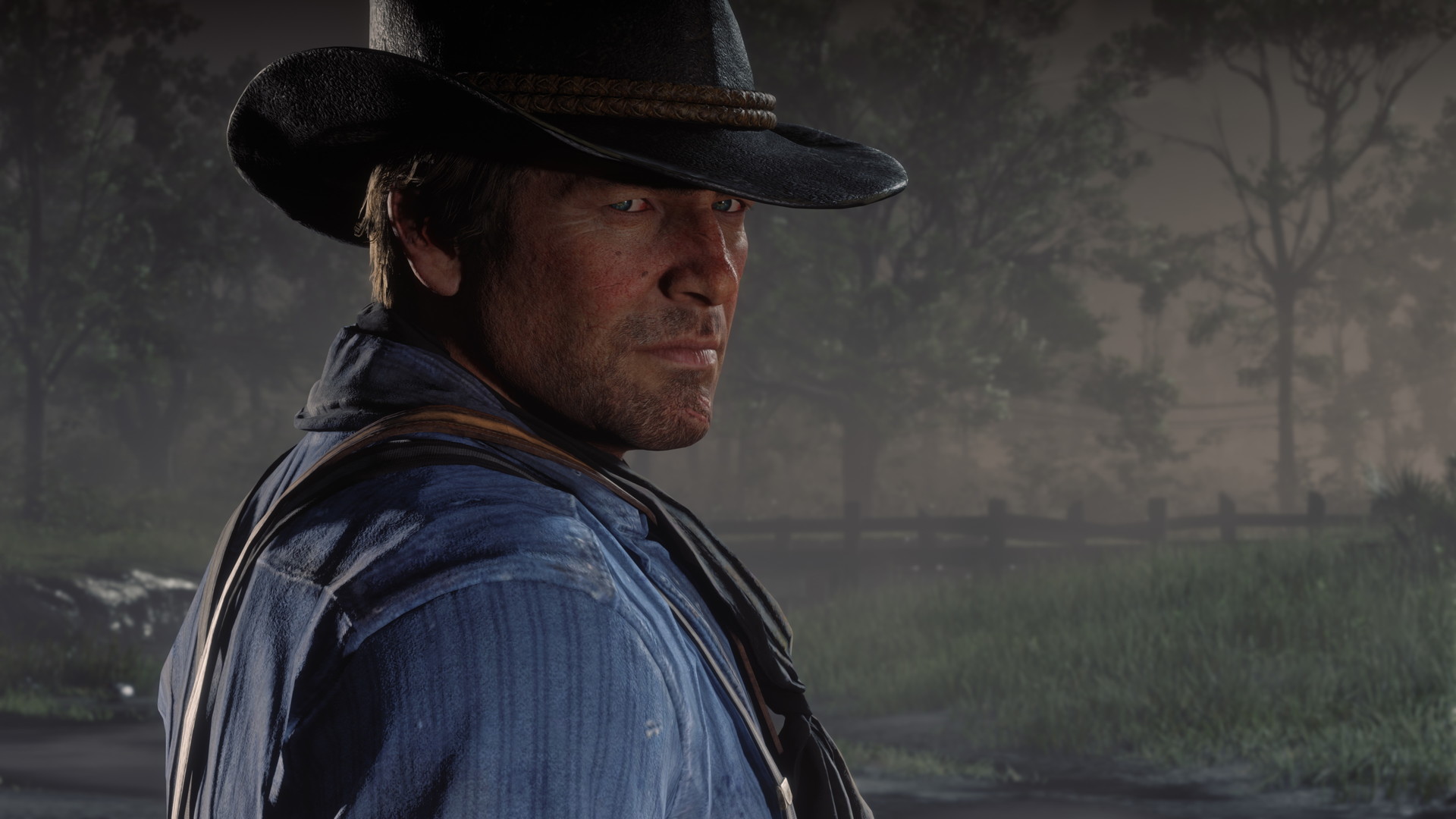 Atmospheric detail in Red Dead Redemption 2.
Flatneck Station is worth mentioning for mechanical reasons rather than narrative ones. The table runs a marginally higher minimum than Valentine and tends to attract a slightly tighter AI pool, which means pots grow more slowly but the players fold less erratically. For grinding Honor or testing reads, it is more useful than Valentine once you have the basics down. Tumbleweed, way out west in New Austin, opens in epilogue and runs the highest routine stakes of any accessible table — the maximum buy-in climbs to five dollars per hand, a meaningful sum given the economy Arthur and later John operate inside.
The rules — Texas Hold'em, nothing else
RDR2 plays a single variant: Texas Hold'em. No five-card draw, no stud, no split-pot variations. Each player receives two hole cards, five community cards come out across three streets (the flop, the turn, the river), and the best five-card hand from any combination of hole and community cards wins. If you have played Hold'em in any other game — GTA V's in-game card game subgame, the mini-games in Yakuza 0, or even Prominence Poker on Steam — the mechanics transfer exactly. The difference is Rockstar's pacing and the way the AI is scripted to behave.
One thing the game does not explain at all is hand ranking hierarchy, which it presumably assumes you already know. If you do not: Royal Flush sits at the top and you will almost never see one. The hands you will regularly be deciding between are Two Pair, Three of a Kind, Straights, and Flushes. In RDR2 specifically, the AI will frequently chase Straights on the turn, so any board with three connected cards (7-8-9, for example) should raise immediate flags about what the sitting opponents might be holding. The game does not visualise odds, does not offer a helper mode, and does not explain pot odds. You are expected to track this yourself.
Reading the AI — what the tells actually mean
Rockstar implemented a visual tell system that is easy to miss on a first playthrough but becomes obvious once you know it exists. NPCs have four distinct physical animations when they are deciding how to act: neutral (no read available), a micro-hesitation where the character glances down at their chips before checking, a forward lean that correlates with strong holdings, and a visible tell — a slight twitch or adjustment — that fires specifically when an AI opponent is holding a weak hand and considering a bluff raise. These are not named in any tutorial. You have to sit for several sessions before the pattern becomes readable.
The lean-forward animation is the most reliable. When an NPC leans slightly toward the table before calling a raise, they typically hold at minimum top pair with a reasonable kicker. It is not a guarantee of a strong hand — Rockstar's AI is not that deterministic — but folding into that animation with a marginal two-pair is usually correct. The hesitation-glance is the opposite: it fires when the AI holds a drawing hand with no made value yet, meaning if the board does not improve for them on the river, they will check-fold. Identifying that pattern turns the turn and river streets into reasonably predictable reads rather than guesswork.
The story missions that use poker as set-pieces
The riverboat sequence in Chapter 2 — 'A Quiet Time' adjacent, following 'Magicians for Sport' — is the standout mission. Arthur and a contact board the Clemens Cove ferry and play what is framed as a friendly game that predictably escalates. Rockstar uses the confined space smartly: exits are limited, the social dynamics shift mid-hand, and by the time the sequence tips into confrontation, the card table has done real narrative work establishing power relationships between the men involved. It is the heist-film move, borrowed from Rounders and Heat (1995) both — use the card table as a pressure chamber, not just a scene.
There is also a stranger mission, the 'Duchesses and Other Animals' chain, which intersects tangentially with the Valentine poker crowd. More relevant for Honor completionists is the fact that winning at poker without resorting to cheating cards — which requires the appropriate outfit and risks immediate ejection and wanted status if spotted — counts toward 100% completion. The cheat mechanic is deliberately unreliable. Rockstar gave it a meaningful detection system precisely so the straightforward approach remains the more useful one for most of the run.
The cheating system — high risk, specific use cases
To cheat at poker in RDR2 you need the Elegant Suit, purchasable from the tailor in Blackwater or Saint Denis. Equipping it unlocks a secondary action at the table that lets Arthur deal from the bottom of the deck. The catch is that other players and nearby NPCs will call it out if your Honor is low enough that suspicion follows you into the room, or if you use the mechanic too frequently in a single session. Caught cheating means an immediate confrontation — usually at gunpoint — and in some locations triggers a broader wanted response.
The system is worth exploring once for the narrative texture it adds, and there is a specific achievement (Times Have Changed) tied to winning a hand by cheating. But as a consistent strategy for building funds, it is simply less efficient than learning the tell animations. The AI at Tumbleweed in the epilogue is beatable through straight play inside two hours of focused sessions. The cheating route adds friction without meaningfully improving the rate of return.
Bankroll management inside the game economy
Arthur's general expense load in Chapters 3 and 4 — camp contributions, ammunition, fast travel upgrades, horse bonding items — runs somewhere between fifteen and thirty dollars depending on playstyle. The Valentine table's ten-cent minimum means you can sit with two dollars and play conservatively for forty minutes without going broke on variance alone. The Flatneck and Tumbleweed tables justify higher buy-ins but also punish loose play harder. The practical recommendation is to arrive with ten times the table minimum and treat any session where you double that as a success worth walking away from.
One underused mechanic: you can leave a poker table mid-session without penalty. If you are up significantly and the next hand feels marginal, standing up and walking out costs nothing. The game does not punish this. Most players do not use it. Knowing when to stop is the actual skill the system is testing, and RDR2 gives you full agency there — a small but considered design choice that makes the card game feel like it was built by people who thought about it, rather than patched in as a trophy unlock.
Poker in RDR2 is not the deepest card game simulation in the medium — that distinction probably belongs to something like Balatro's mechanical abstraction or Yakuza's mahjong subgame in sheer complexity. What it does instead is tie a functional Hold'em engine to believable period atmosphere and readable NPC behavior, then scatter the tables across a world where getting to them is itself a small adventure. The Tumbleweed table at dusk, New Austin stretching out flat and orange through the saloon windows, is one of the better ambient compositions in Rockstar's catalogue. Getting good enough at the game to sit there comfortably is worth the time it takes.
Reader Q&A
What's the standout set-piece in Red Dead Redemption 2 like?
Mission-driven and well-paced. Multiple approach angles — stealth or loud — and consequences depend on enemy AI and scripted triggers. Most players settle into a rhythm by the second attempt.
How long is the major mission arc in Red Dead Redemption 2?
Around 4-8 hours depending on how thoroughly you scout. The full campaign is significantly longer; this arc is one set-piece among many.
Do I need prior series knowledge before playing Red Dead Redemption 2?
Most entries in this lineage stand alone. Helpful context if you've played the predecessors, but not required. Each title resets the player's frame of reference.
What makes a heist-style sequence land?
Sightline clarity, NPC density, audio cues, set-piece pacing. When all four align, the sequence is memorable. When even one's off — say, flat NPC behaviour — it falls flat.
Is Red Dead Redemption 2 accessible to newcomers to the genre?
Generally yes. Systems are introduced gradually and difficulty is forgiving on default. Veterans will get more from the deeper systems, but the surface layer welcomes new players.
Which films influenced this design lineage?
Soderbergh's Ocean's Eleven, Mann's Heat, and Scorsese-era crime films are the obvious roots. Designers from this subgenre have cited those films in interviews going back twenty years.
Reader comments