
Baldur's Gate 3 gives you a god's power and a goblin's consequences
There is a moment in Baldur's Gate 3, probably somewhere around Act Two, where you realize the game has been quietly keeping score this whole time. A throwaway conversation you had forty hours ago — some remark you made to a tiefling refugee, a deal you cut in the dark with a creature whose motives you never fully understood — resurfaces with weight you did not anticipate. Larian Studios has made a sixty-to-one-hundred-hour game that behaves like it was built by people who actually believed you would read the item descriptions.
Released in August 2023 after a lengthy early access period, BG3 arrived carrying the expectations of one of the most beloved RPG lineages in the medium's history. The Baldur's Gate name means something specific to people who spent hours in BioWare's Forgotten Realms in the late nineties and early 2000s. Larian — a studio that had spent a decade refining reactive co-op RPG systems in the Divinity: Original Sin series — came to this project not as custodians but as architects with their own agenda. What they built is enormous, exhausting in the best stretches, genuinely frustrating in others, and unlikely to let you go.
The mechanical core holds up to scrutiny
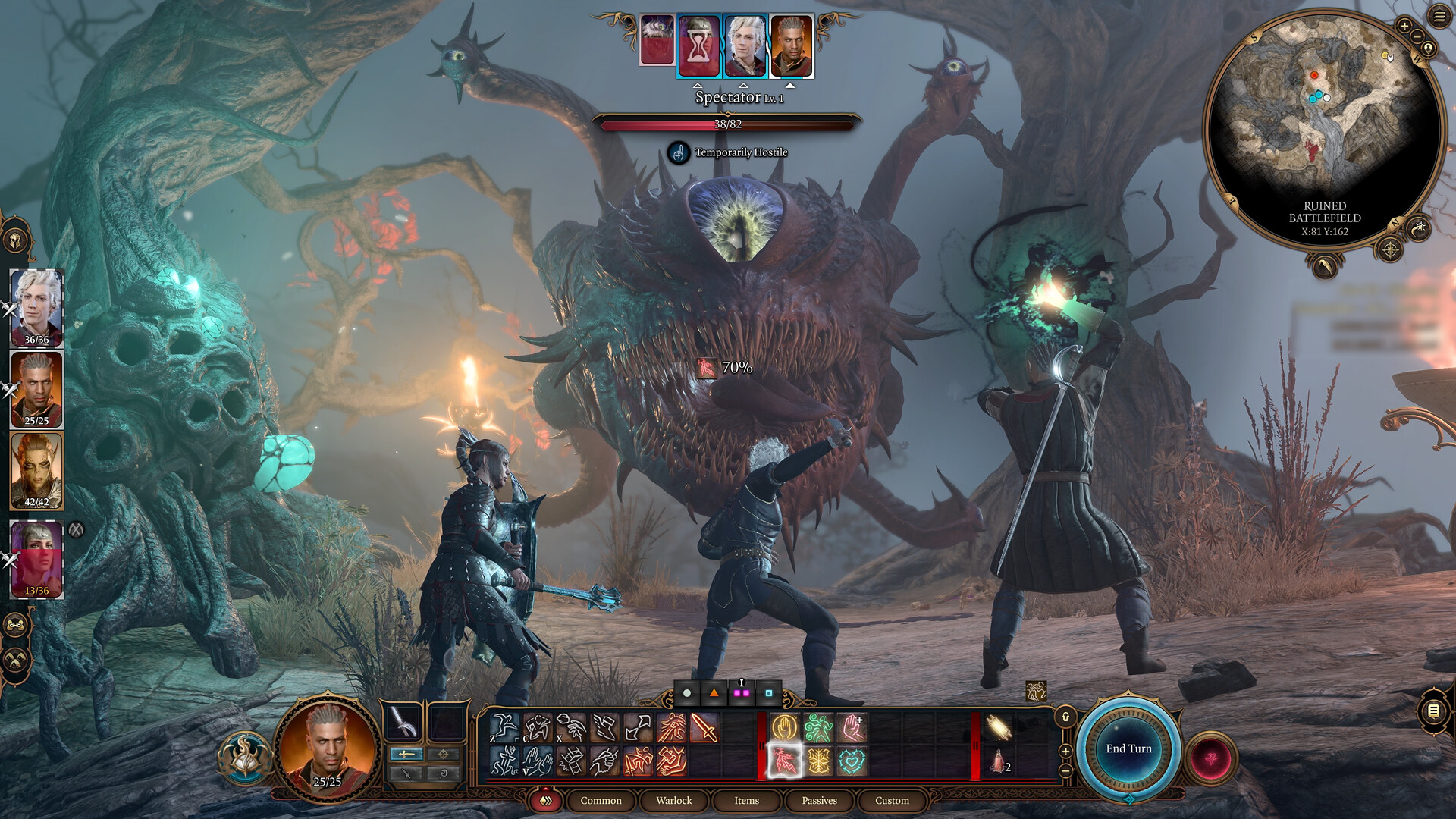
Combat is turn-based and leans heavily on the fifth edition Dungeons & Dragons ruleset, which means a lot of the decision-making sits in character creation and party composition before a fight ever begins. The surface interactions — oil ignites, water conducts electricity, grease persists on the ground and trips enemies who rush through it — give each encounter a physical logic that rewards attention. Shoving an enemy off a ledge does not feel like an exploit; it feels like something you worked out.
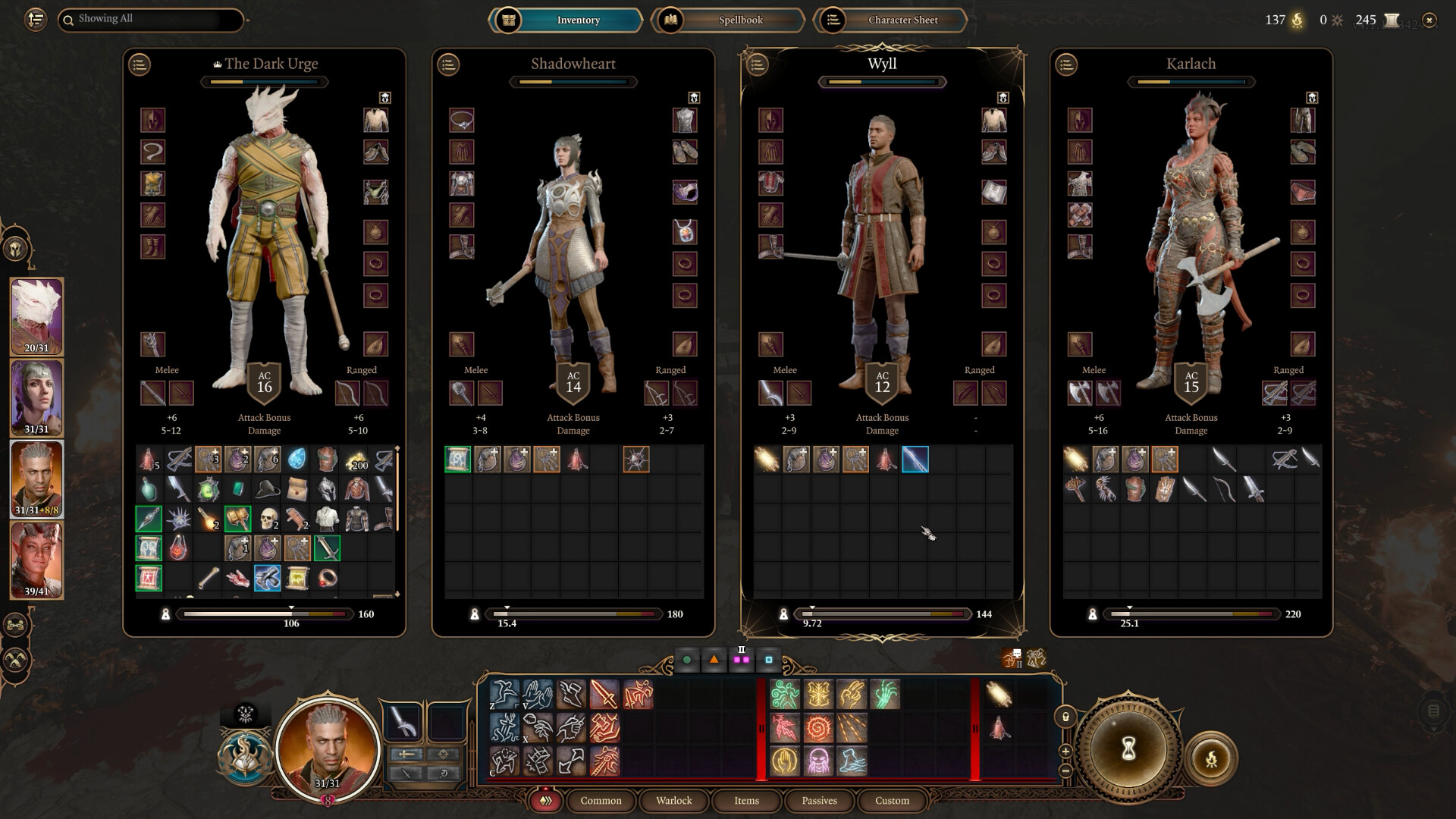 Atmospheric detail in Baldur's Gate 3.
The dice rolls are visible. When you attempt a persuasion check or try to disarm a trap, the game shows you the number, the modifiers, the difficulty class. This is either enormously satisfying or quietly maddening depending on temperament. Roll a seventeen with bonuses that push you to twenty-three and pass the check cleanly; roll a three and watch your character fumble a conversation they should own. Some players reload. Others lean into the chaos and find that failed rolls often produce stranger, more memorable outcomes than successes do. The game does not punish either approach, which is a meaningful design decision.
The class variety is deep enough that two playthroughs with different builds feel structurally distinct. A Wild Magic Barbarian generates random magical effects when raging, which makes them unreliable and fascinating in equal measure. An Arcane Trickster Rogue can use mage hand to trigger environmental traps from across a room without entering combat at all. The game does not spell out all of these interactions; it expects you to read tooltips, experiment, and occasionally discover that the ability you ignored for twenty levels is quietly extraordinary.
The companions earn their reputation
Astarion, the vampire elf rogue, is probably the character that caught the widest attention — sharp-tongued, initially self-serving, with a backstory that unfolds slowly and lands harder than it should by any reasonable measure. But Shadowheart's arc is more structurally interesting: her relationship to memory, identity, and faith is built into her dialogue options in ways that make her approval system feel less like a scoring mechanic and more like a genuine ongoing negotiation. She will push back on you. Whether that changes things depends entirely on the choices you have already made.
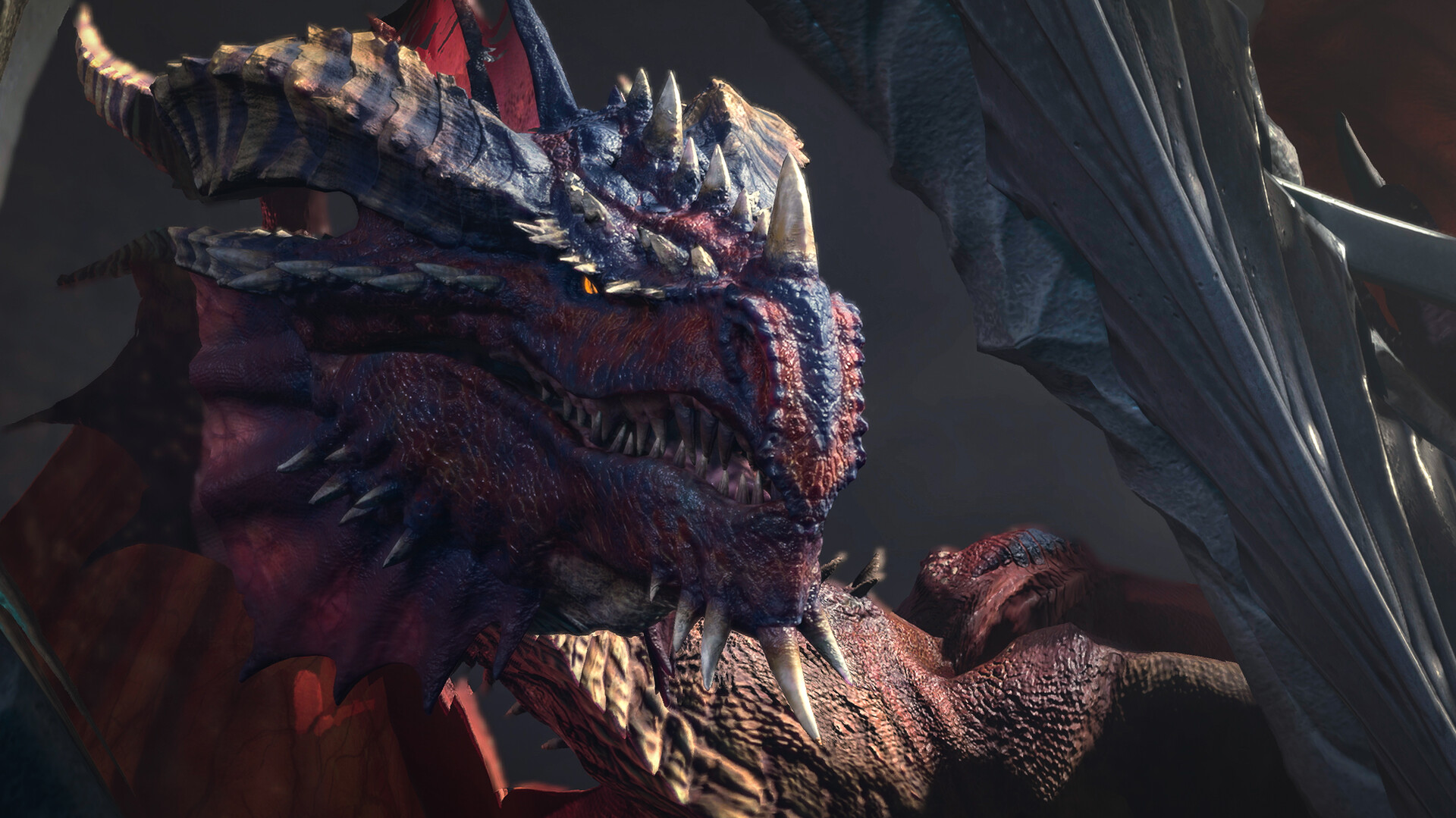 Combat encounter in Baldur's Gate 3.
Not every companion hits. Halsin, the druid who joins later in Act Two, has a backstory that the game treats as significant without quite giving him the narrative real estate to justify the weight. Wyll's writing is uneven — his personal quest involves interesting stakes but the pacing of his character revelations is oddly compressed compared to the rest of the cast. These are not disasters; they are simply less refined pieces in an otherwise carefully assembled ensemble.
Act Three is where the seams show
The first act — set largely around the Emerald Grove, the Underdark, and the surrounding region — is genuinely excellent RPG design. The geography is dense with optional content that ties back to the main thread, the faction dynamics are clearly established, and the pacing allows you to move at your own rate without the narrative pressure becoming irritating. Larian clearly spent the most time here, and it shows in how organically one objective bleeds into another.
Act Three, set in Baldur's Gate city proper, is where the construction becomes visible. The city is large, the quest density is high, and several plotlines arrive at their conclusions in ways that feel slightly rushed — as though the team ran out of development time to give certain threads the final act they deserved. The Gortash and Orin storylines, which should be a dramatic escalation, sometimes feel administratively procedural. You are completing quest steps rather than experiencing consequences. The gap between what Act One sets up and what Act Three delivers is not catastrophic, but it is real.
There are also performance and bug considerations that, depending on platform and patch version, range from minor annoyances to genuine progression problems. The game has been substantially patched since launch — Patch 7 in late 2024 added modding support and addressed a number of longstanding issues — but reports of pathfinding failures, companion AI misbehaving in exploration, and cutscene triggers breaking under unusual player choices persist in corners of the community. Most players will finish the game without hitting anything serious. Some will not.
The co-op dimension changes the calculus
Up to four players can share a campaign, each controlling their own character, with the game tracking individual approval ratings, conversation choices, and even item ownership separately. This is a technically impressive feat given how reactive the writing is. Playing with someone who makes systematically different moral choices than you do creates genuine tension — not of the artificial, designed variety, but the kind that comes from actually disagreeing with a friend about what to do next.
The co-op mode is not without friction. The game was clearly designed around a single-player experience first, and some of the pacing and narrative beats feel slightly awkward when distributed across four people with different levels of investment in the lore. Split-screen is available but cramped. Still, for groups who commit to it fully, the co-op is one of the more genuinely interesting shared RPG experiences available on PC or console right now.
Who this is actually for
BG3 demands patience in a way that many recent RPGs do not. The tutorial is functional rather than generous. The itemization vocabulary assumes some familiarity with D&D mechanics; if you do not know what a spell slot is, the game will explain it technically but not intuitively. Players who bounced off Divinity: Original Sin 2's combat will likely bounce here too — the systems are different but the underlying philosophy, that positioning and preparation matter more than reaction speed, is identical.
For people who engage with that philosophy, the returns are substantial. The game is long enough to sustain a completionist run at well over one hundred hours, and different origin characters — playing as Astarion or Karlach rather than creating a custom character — provide structurally distinct experiences of the same events. There is a version of this game you finish once and feel satisfied. There is another version you return to obsessively, building a Shadow Monk and trying to break the Underdark encounters in new ways.
The score it deserves
Baldur's Gate 3 is not a perfect game. Its final act underdelivers relative to its opening, a handful of companions feel like they received a smaller fraction of the writing budget than others, and the sheer density of systems creates a genuine entry barrier for players new to the genre. These are real criticisms, not hedges.
What Larian managed, though, is rarer than polish: a game that actually trusts you. Trusts you to read, to explore, to make choices that are not telegraphed as right or wrong, to accept that a failed dice roll might produce something more interesting than a success. In an era when open-world RPGs routinely sand down their edges to reduce friction, BG3 keeps the edges and asks you to respect them. Whether you find that liberating or exhausting will tell you most of what you need to know about whether it is the game for you.
The fact that it landed this well — with all the weight of a storied franchise on its back and the complexity of a tabletop ruleset underneath — is genuinely surprising. Not because Larian lacks ambition, but because ambition of this scale usually collapses somewhere critical. Here, it mostly does not. The places where it stumbles are visible precisely because the surrounding design is good enough to make you notice them.
Editorial scoring
Reader Q&A
How long does it take to finish Baldur's Gate 3 gives you a god's power and a goblin's consequences?
Main story runs around 60 hours depending on how thoroughly you explore. Completionists can spend 2-3× that.
Is Baldur's Gate 3 gives you a god's power and a goblin's consequences good for newcomers to Tactical RPG?
It depends. The systems are deep but the tutorial does a fair job. Veterans of Tactical RPG will feel at home faster.
Which platform should I play Baldur's Gate 3 gives you a god's power and a goblin's consequences on?
Console version is the most stable on launch. PC version benefits from the modding scene long-term.
Was Baldur's Gate 3 gives you a god's power and a goblin's consequences worth the launch-day price?
Depends on backlog. The replay value justifies the price for genre fans; casual players should wait for a 40%+ discount.
Are there DLCs or expansions worth picking up?
The base game is complete; expansion DLC adds 10-15 hours of additional content if you want more.
What did Larian Studios get right (and what could be better)?
Larian Studios nailed the moment-to-moment loop and the world-building. Pacing in the mid-game and inventory UX have room for improvement.
Reader comments