
Celeste knows the mountain isn't the hard part
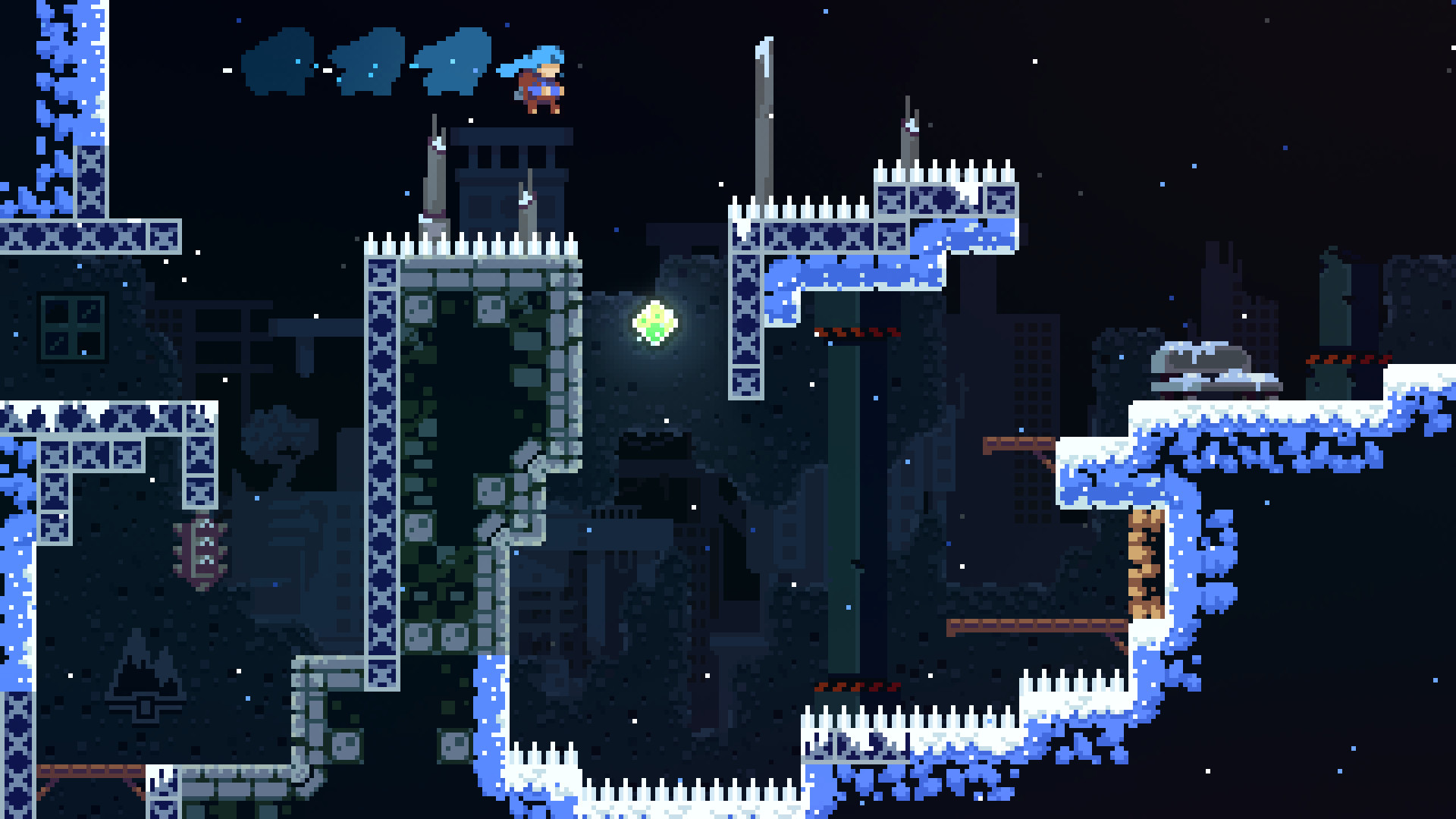
Celeste does not announce itself as a game about mental illness. It shows you a mountain, hands you a dash, and asks you to die a few hundred times before you reach the summit. The subtext arrives on your own schedule — which is, frankly, the right way to handle it. Maddy Thorson and Noel Berry released the original in January 2018 to the kind of critical reception that makes you suspicious until you actually play it. After 24 hours, most of that suspicion is gone.
What sets Celeste apart on a crowded shelf of precision platformers is not the jump physics, though those are excellent. It is the architecture of difficulty — how the game builds failure into its emotional argument without feeling manipulative about it. The mountain is hard. The point is that Madeline already knows it is hard, and climbs anyway. That distinction does a lot of work across eight chapters.
What the movement actually does
Madeline has a jump, a midair dash, and the ability to cling to and climb walls until a stamina meter runs out. That's the entire toolkit for most of the game. No double-jump unlocks, no parachute, no upgrade tree. Celeste is one of the few platformers since Super Meat Boy that trusts a minimal moveset to carry full mechanical complexity. The dash resets on contact with certain crystals and on landing — so rooms become puzzles about when you spend it, not whether you have it.
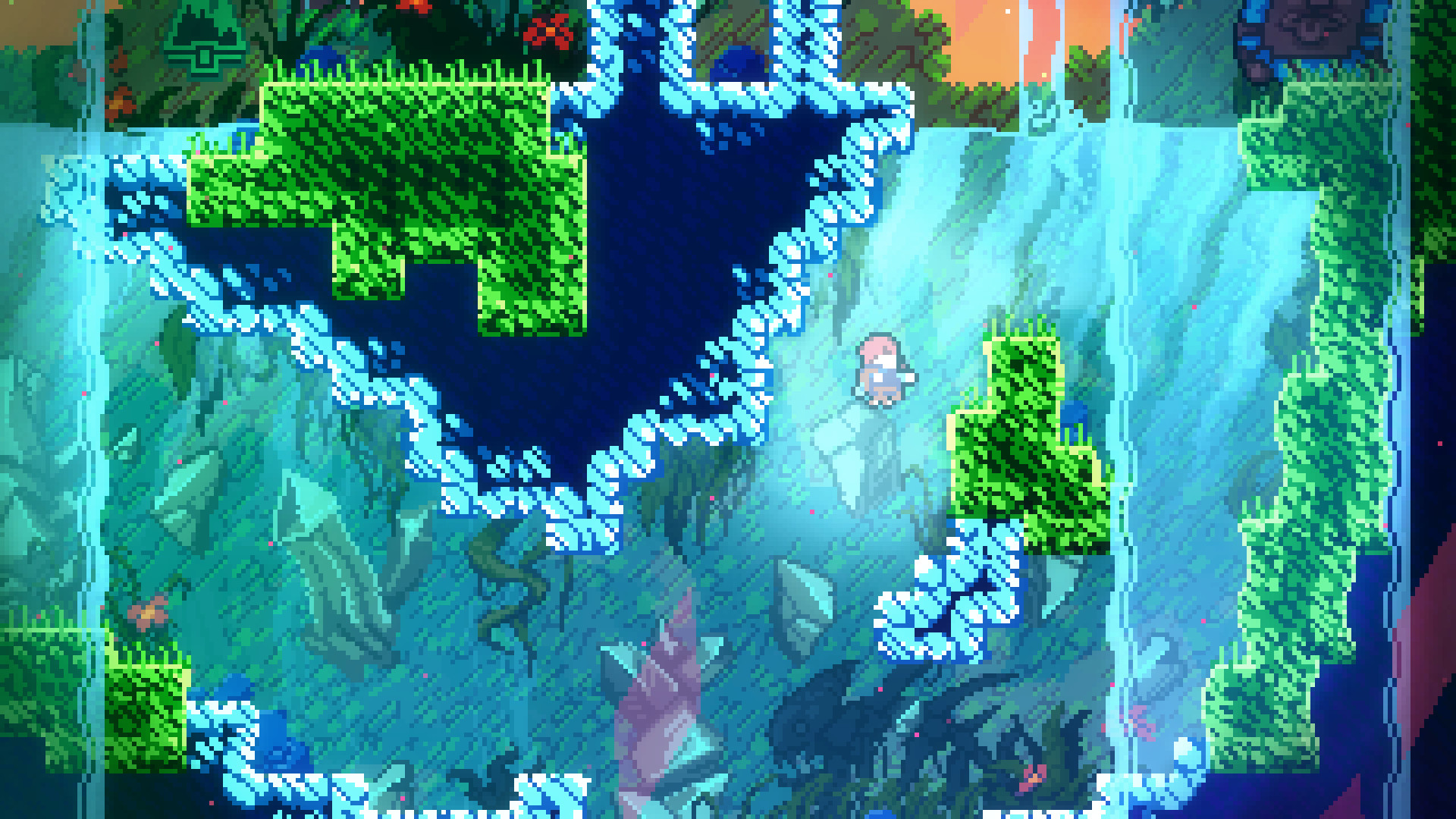 Scene from Celeste.
The wall-climb stamina is the detail most players underestimate early. It forces you to read walls as timed resources, not safety nets. Chapter 2's hotel remixes this by introducing dream blocks that let Madeline phase through surfaces, which sounds like it would break the existing tension. It doesn't — it recontextualizes it. Thorson and Berry keep introducing new objects that interact with the core movement rather than replacing it, which is exactly how good platformers sequence their ideas.
Compare this to, say, Hollow Knight's movement expansion, which steadily grants new verbs over twenty hours. Celeste is doing the opposite: one verb, many inflections. Neither approach is wrong. But Celeste's method means every room tests the same fundamental skill, refined rather than expanded. Some players will find that limiting. Those players might also be wrong.
The death counter and what it actually measures
Celeste shows you a death count on the chapter select screen. Mine read 847 after clearing the main story. The game does not editorialize about this number — no grade, no rating, no nudge toward a lower figure. It just sits there, a record of attempts rather than failures. That framing is deliberate. Each death resets you instantly, a few seconds back at most. There is no loading screen. There is no penalty. There is only the next try.
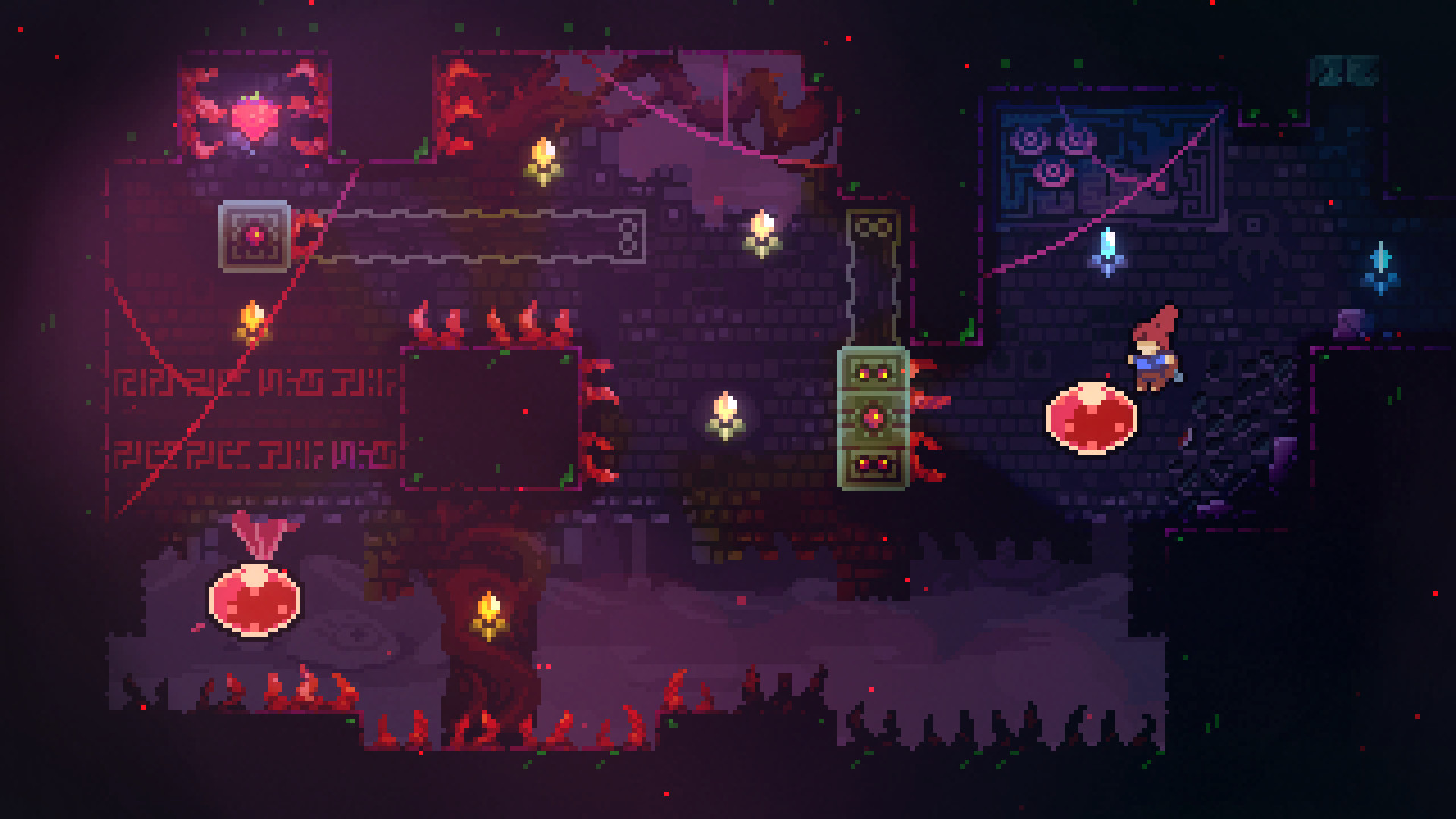 Scene from Celeste.
This is where Celeste earns its reputation as accessible without being easy. The Assist Mode — available from the start, no shaming required — lets you adjust game speed, grant extra dashes, or toggle invincibility. These are not "baby mode" options buried in a settings menu. They are presented straightforwardly, with a short explanation that frames them as tools for enjoying the game at your own pace. Studios like Supergiant have done something similar with God Mode in Hades, but Celeste got there first and made it feel less like a concession.
What the death counter actually measures is investment. By chapter 6, the Sky Factory, rooms that would have broken me in chapter 1 feel tractable because I have internalized the movement language. The number going up is the number of times I learned something. That is not a metaphor the game forces on you — it just emerges from the structure.
Chapters 6 and 7 are where the design peaks
Chapter 6 is the point where Celeste stops being a good precision platformer and becomes something more specific. It introduces a mechanic where Madeline must manage a second version of herself — Badeline, the shadow figure who has been trailing her since the mountain's foot — in cooperative movement sequences. These sections require timing two characters simultaneously, with Badeline mimicking or countering Madeline's dashes depending on context. On paper this sounds like the game overextending. In practice it's the tightest the mechanics ever get.
Chapter 7, the summit push, pulls back from that complexity and asks you to do the climb straight. No new mechanics. Just everything you have learned, applied cleanly, with the narrative paying off overhead. It is a confident move — the kind of restraint that developers with shorter production histories tend not to manage. Maddy Makes Games had made Towerfall before this, so there was prior craft to draw on, but Celeste's final chapter still feels like it required nerve to design this way.
The B-Sides are a separate game
Each chapter has a cassette tape hidden in it. Finding and completing a tape unlocks a B-Side — an alternate, brutally remixed version of that chapter's rooms. These are not for everyone. I say that without irony. The B-Sides exist at a difficulty level that makes the main game feel like a tutorial. Chapter 1's B-Side alone took me longer than the entirety of chapters 1 through 4 combined.
They exist for a specific kind of player: one who has already absorbed the movement system so thoroughly that standard rooms no longer offer resistance. For everyone else, they are optional content with no narrative attached, and skipping them costs nothing. The C-Sides, unlocked after completing all B-Sides, go further still — shorter gauntlets, each one a concentrated distillation of a chapter's hardest ideas. I cleared one. I respect the others from a distance.
What the B- and C-Sides reveal is that Celeste was built with a range of players in mind from the start, not retrofitted with accessibility after the fact. The difficulty ceiling is very high and entirely opt-in. That is harder to design than it sounds.
Where it doesn't quite hold
Chapter 5, the Mirror Temple, runs long. The mechanic there — a dark environment where Madeline must find and follow light sources while avoiding chase sequences — is the least satisfying the game gets. The chase portions remove player agency in ways that feel at odds with Celeste's usual rhythm, which is about repeated, self-paced attempts. Being chased means the failure state changes from "you misjudged the dash" to "the thing caught up with you," which is a different and less interesting kind of failure.
The story's dialogue is earnest to a fault in places. Celeste's themes — anxiety, self-acceptance, the gap between how you talk to yourself and how you'd talk to someone you love — are handled well structurally, but some of the spoken exchanges between Madeline and Badeline verge on therapeutic monologue rather than character conversation. Theo, the other climber Madeline meets partway up, functions partly as comic relief and partly as exposition, and the seams occasionally show.
Where it sits on the precision platformer scale
Super Meat Boy defined a genre template in 2010: meat-grinder difficulty, instant respawn, momentum-based movement, tight level design. Celeste inherits all of that and reshapes it around a slower, more deliberate player rhythm. The dash is not Super Meat Boy's sprint — it is a considered action, spent rather than held. That changes the feel substantially. Celeste is harder to rush. You can try, but the design resists it.
Against more recent entries like Neon White or even the demanding sections of Ori and the Will of the Wisps, Celeste holds up cleanly. Neon White's card-based mechanics add a layer of resource management that some players will find more engaging. Ori's movement is more fluid but the level design is less precise in its demands. Celeste sits in the middle: mechanical precision without the deck-building complexity, emotional weight without the spectacle-first approach.
After 24 hours, the mountain has been climbed. The B-Sides have not all been climbed. Chapter 5 was endured. The death counter is at 847 and will go higher. Celeste is not a game that resolves cleanly — Madeline's anxiety does not cure itself at the summit, and the game knows better than to say it does. What it offers instead is the argument that trying, failing, and trying again is its own kind of answer. For a precision platformer, that is an unusually honest thing to be about.
Editorial scoring
Reader Q&A
How long does it take to finish Celeste knows the mountain isn't the hard part?
Main story runs around 24 hours depending on how thoroughly you explore. Completionists can spend 2-3× that.
Is Celeste knows the mountain isn't the hard part good for newcomers to Precision Platformer?
For total newcomers, expect a 5-8 hour ramp-up. Once you internalize the loop, it clicks.
Which platform should I play Celeste knows the mountain isn't the hard part on?
PC version offers the highest fidelity if your rig can handle it. Console versions are polished out of the box.
Was Celeste knows the mountain isn't the hard part worth the launch-day price?
Released in 2018, and as of writing it holds up. Wait for a sale if you're price-sensitive — major discounts arrive within 6 months.
Are there DLCs or expansions worth picking up?
Wait for the Game of the Year edition — it bundles everything at a fair discount.
What did Maddy Makes Games get right (and what could be better)?
Maddy Makes Games nailed the moment-to-moment loop and the world-building. Pacing in the mid-game and inventory UX have room for improvement.
Reader comments