
Civilization VI will eat your evening and call it progress
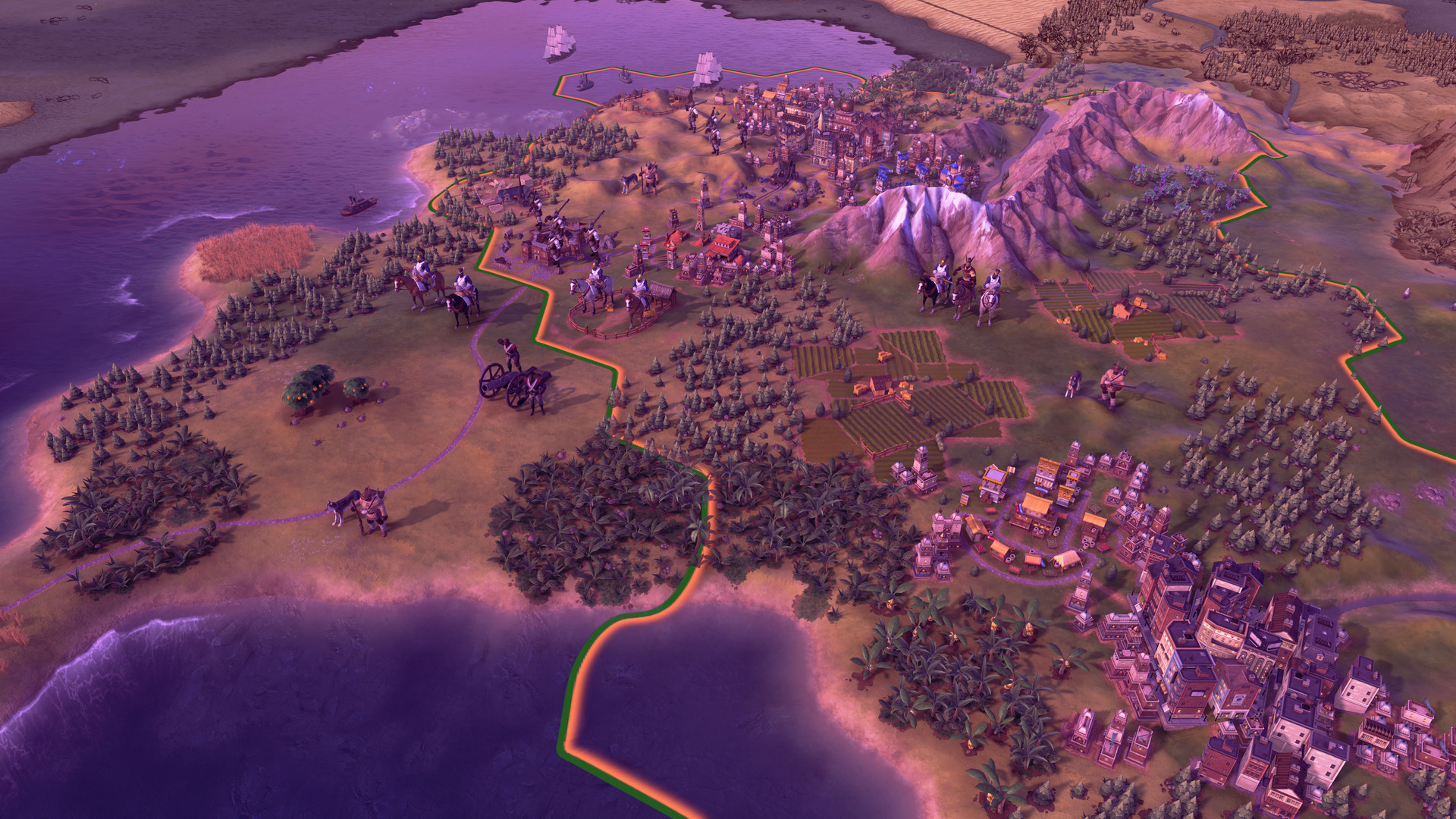
Civilization VI was released in October 2016, which means it has had roughly eight years to refine its ability to steal your Thursday night and return it to you, bleary-eyed, somewhere around 3 a.m. on a Friday. After eighteen hours across three full campaigns — one as Teddy Roosevelt on a pangaea map, one as Cleopatra racing a neighbor toward Stonehenge, one as Japan's Hojo Tokimune because district adjacency bonuses deserved a stress test — the game has not lost the fundamental quality that made the original Civilization series so durable: it makes the passage of time feel earned.
That said, earned is doing some work in that sentence. Firaxis shipped a genuinely different game from Civilization V, not simply an incremental one, and some of those differences are contentious in ways that have not fully resolved even with expansions and patches. The district system is the centerpiece around which most other changes orbit, and whether it improves the experience depends almost entirely on how patient you are with opportunity cost as a design philosophy.
The district system is the game's real argument
In Civilization V, city tiles were largely decorative — you built wonders and improvements on them, but the city center handled most of the mechanical heavy lifting. Civilization VI pulls that apart. Science, culture, religion, production, and commerce now each require a dedicated district placed on the map, occupying a tile, consuming a citizen slot, and costing production time that could have gone to something else. A city can't do everything; it has to become something.
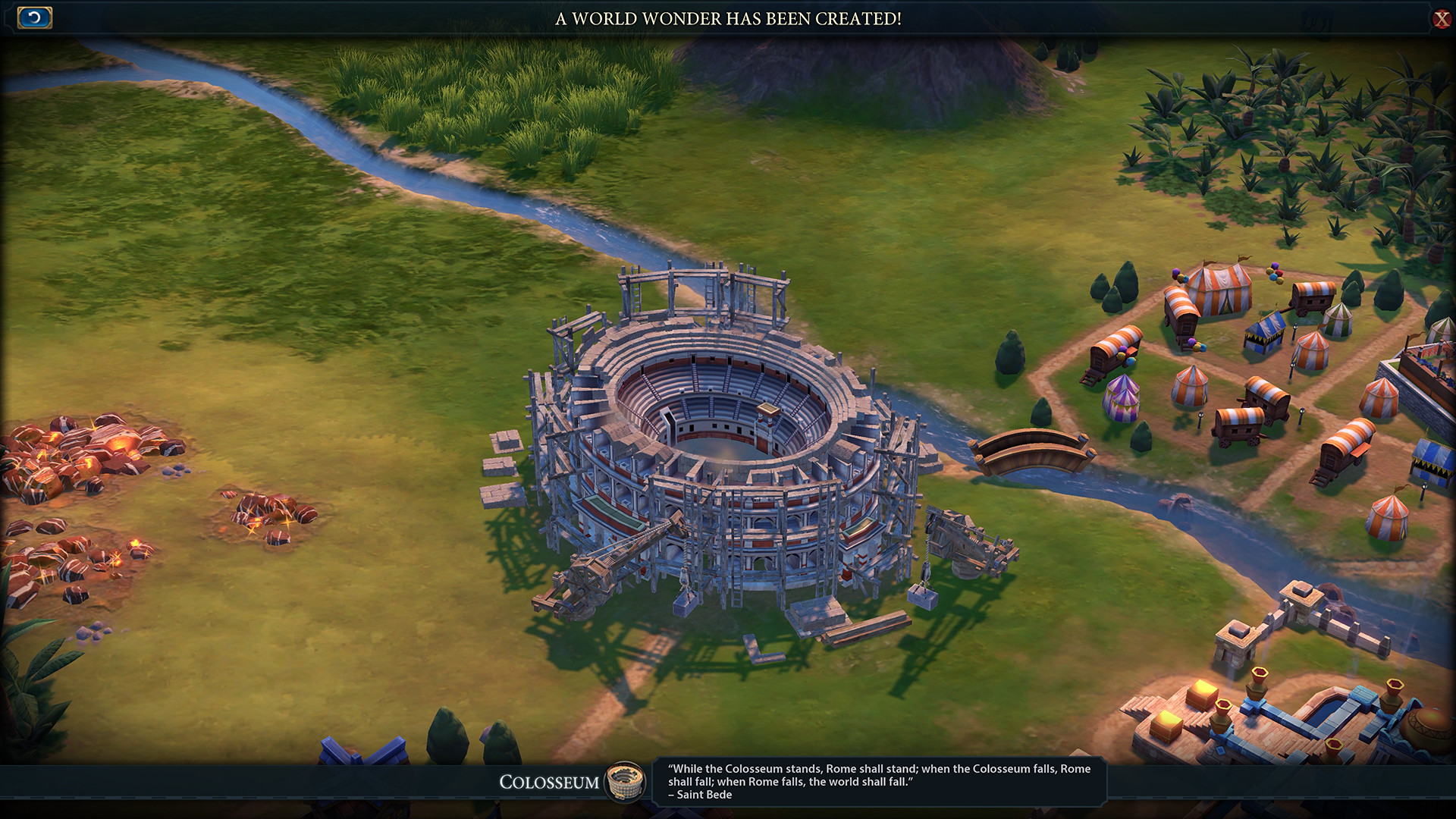 Atmospheric detail in Civilization VI.
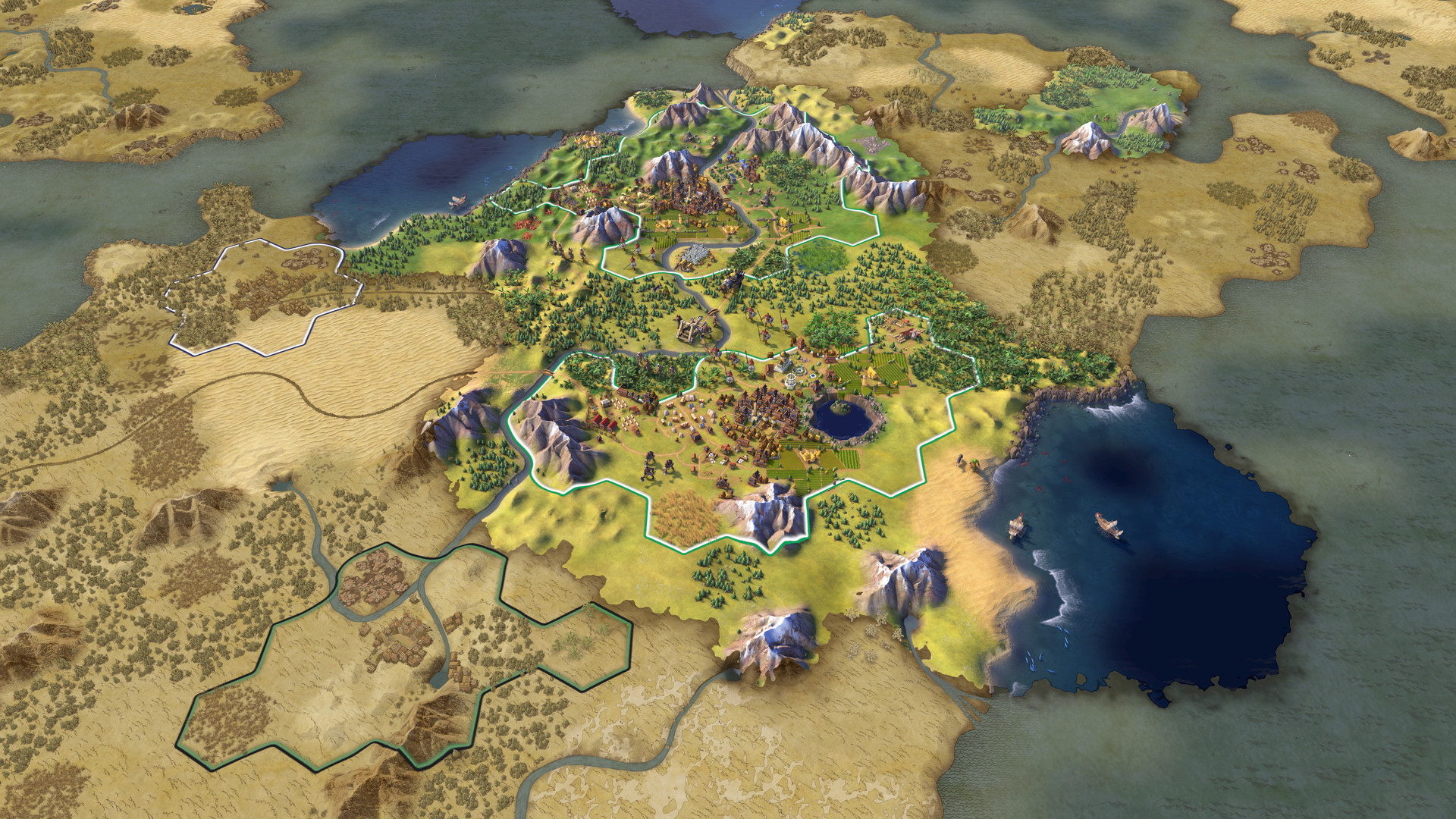
The elegance here is that adjacency bonuses tie district placement to geography in a way that actually makes individual tiles matter. Campuses adjacent to mountains and rainforests generate more Science per turn; Holy Sites next to rivers and natural wonders accumulate Faith faster; Harbor districts must be coastal. This sounds fussy in description but plays out as a set of small spatial puzzles every time you found a new city — you're reading terrain for potential rather than just clicking the next building in a queue. For those who've played Endless Legend or even the later Anno games, where map positioning has always carried real weight, the system will feel like Civilization finally catching up.
Where it gets complicated is the time investment. Districts are expensive. Early game, building one can consume ten to fifteen turns in a fledgling city, turns that are not going to housing, settlers, or military units. For the first thirty or forty turns of any campaign, you are making tradeoffs that only pay off much later, and the game does not always communicate whether those choices were correct until it's too late to change course without significant pain. That delayed feedback loop is either the system's most interesting quality or its most aggravating one, depending on your tolerance for ambiguity.
Leaders as mechanical differentiators, not historical portraits
Civilization has always used historical leaders as its primary interface between the player and the game's systems, but VI commits more thoroughly than any previous entry to making each leader a meaningfully different gameplay proposition. Hojo Tokimune's Japan gets a faith and culture bonus from Holy Sites adjacent to Entertainment Complexes, which means you're actively trying to build those districts in proximity to each other — the map planning changes. Wilhelmina of the Netherlands generates extra yields from rivers. Indonesia's Gitarja can purchase naval units with Faith. These are not just stat bonuses; they redirect what you're optimizing for.
 Combat encounter in Civilization VI.
The flip side is that this specificity can make early game choices feel constraining. If you pick Kupe of the Maori, who begins the game at sea without a starting land tile, you are committing to a particular style of play — high culture and production, heavy ocean focus — that won't suit everyone and will definitely confuse anyone used to the standard land-settling rhythm. This is a feature, not a design flaw, but it is worth naming honestly. Civilization VI rewards picking a leader whose bonuses align with how you already want to play, rather than teaching you flexibility.
Diplomacy is still the weakest pillar
This is not new information, but eighteen hours makes it fresh again. AI leaders in Civilization VI have agendas — publicly stated priorities that are meant to make their behavior legible — but in practice those agendas produce AI that feels erratic rather than principled. Peter of Russia will declare himself furious at you for building too many cities when he himself is sitting on twelve; Tomyris of Scythia will forward settle your borders and then denounce you for militarism when you respond. The hidden agendas, which you can only discover through espionage, compound the problem by introducing a layer of opacity that rarely produces satisfying reveals.
The Governors system, added in the Rise and Fall expansion, does genuinely improve internal city management; assigning Magnus to a city that needs production or Liang to one you're trying to develop as a cultural hub adds a layer of specialization that fits neatly into the district logic. But the World Congress in Gathering Storm, Civ VI's second major expansion, introduces diplomatic victory conditions that feel grafted on — a series of voting sessions where you accumulate Diplomatic Favor as a currency and spend it to win resolutions. It functions, but it doesn't feel like diplomacy so much as a separate resource management minigame that happens to involve other leaders.
The climate system deserves more credit than it gets
Gathering Storm introduced climate change as a late-game consequence of heavy industrial development, and it is one of the more quietly ambitious things any mainstream 4X game has attempted. Coastal tiles flood. Droughts reduce food yields. Hurricanes damage improvements. None of this is cosmetic; if you've been burning coal and oil for two hundred turns, your low-lying coastal cities will start losing tiles to sea level rise in the modern era. The first time it happened in my Roosevelt campaign — a harbor city in what had been a productive fishing region slowly swallowed by rising water — it landed with actual weight.
The system is imperfect. The AI does not respond to climate consequences in any coherent way, industrializing freely while occasionally building a Solar Farm for reasons that seem decorative. And because the impact is heavily concentrated in the late game, players running shorter sessions or playing on smaller maps may never encounter it at meaningful scale. But for players who do reach the modern era, climate change functions as a genuine pressure on the game's economic logic — suddenly those lush coastal districts you've been developing are liabilities, and the decisions you made three hours ago are reshaping what's available to you now.
On pace and the texture of progress
The thing Civilization VI does better than almost any contemporary 4X game — better than Endless Space 2, considerably better than Humankind, arguably better than Stellaris at sustained mid-game engagement — is make each turn feel like a small completion. Research finishes, a eureka moment triggers, a great person is born, an improvement is built; the screen is consistently returning small signals that things are moving. This is by design and it is very effective. The classic 'one more turn' quality is not accidental; it is an engineered response to a game that understands how to pace reward at the level of individual decisions rather than only at milestone moments.
What that pacing obscures is how thin the mid-game can feel once your districts are established and you're waiting for the tech tree to catch up to your ambitions. There's a stretch — roughly turns 150 to 200 on a standard speed game — where the early urgency has passed and the late-game crises haven't arrived, and you are essentially clicking end turn while your queues fill themselves. Civ V had the same problem; Civ VI has not solved it, though the district adjacency puzzles give you more to think about during those quieter stretches than the older game did.
What eighteen hours actually tells you
Eighteen hours is enough to finish one campaign comfortably and get deep into two others; it is not enough to see everything Civilization VI has to offer across its base game and both major expansions. The game's design is calibrated for sessions that expand to fill whatever time you allow them, and the player who invests fifty hours will understand the tech and civic trees at a level of fluency that changes the game's texture entirely. What eighteen hours does confirm is that the district system is a genuine structural contribution to the 4X genre, that the climate mechanics are more substantive than they appeared at launch, and that the AI diplomacy remains the game's most persistent embarrassment.
Civilization VI is not a perfect game. It is a deeply considered one, built around systems that reward sustained attention and punish impatience, and it does something that very few strategy games manage: it makes long-term planning feel like authorship rather than calculation. The evening it ate was worth it. Probably. Ask me again after turn 300.
Editorial scoring
Reader Q&A
How long does it take to finish Civilization VI will eat your evening and call it progress?
Main story runs around 18 hours depending on how thoroughly you explore. Completionists can spend 2-3× that.
Is Civilization VI will eat your evening and call it progress good for newcomers to 4X Strategy?
It depends. The systems are deep but the tutorial does a fair job. Veterans of 4X Strategy will feel at home faster.
Which platform should I play Civilization VI will eat your evening and call it progress on?
Steam Deck handles this title well — verified compatibility on most recent patches.
Was Civilization VI will eat your evening and call it progress worth the launch-day price?
If you're a fan of Firaxis, yes. If you're new to the studio, a sale price is more comfortable.
Are there DLCs or expansions worth picking up?
The base game is complete; expansion DLC adds 10-15 hours of additional content if you want more.
What did Firaxis get right (and what could be better)?
Strongest: art direction, audio design, set-piece variety. Weakest: late-game balance and a few persistent quest-log bugs.
Reader comments