
Cult of the Lamb Makes You the Monster You're Running From
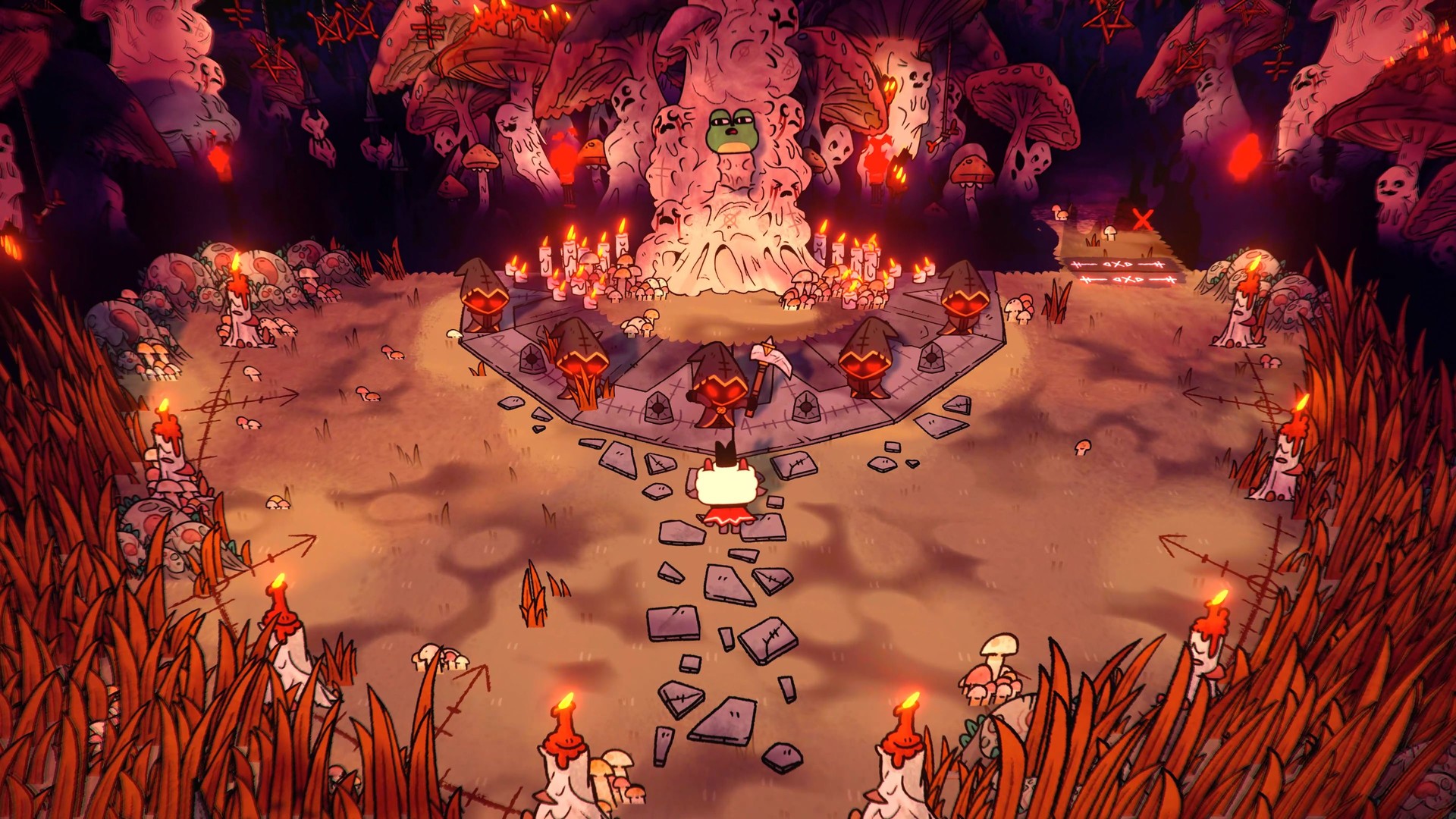
There is a specific kind of discomfort Cult of the Lamb is engineered to produce, and Massive Monster leans into it with enough self-awareness that it almost feels like a dare. You are a sacrificial lamb — small, white, enormous-eyed — rescued from execution by a chained god named Narinder who tasks you with building a cult in his name. The framing is cheerful. The pixel art is warm. The music, composed by River Boy, has a hymnal sweetness that sits oddly against the fact that you will, before the end of the first hour, ritually sacrifice one of your followers on an altar to gain a blessing.
The game released in August 2022 from Devolver Digital, and it has since received two substantial free updates — Relics of the Old Faith and Unholy Alliance — which added co-op, new weapons, new follower traits, and a reworked progression structure. That version is the one worth discussing here, because the launch build had friction points that have genuinely been addressed. Some problems remain. But there is enough holding this together that the conversation about whether it works is worth having rather than just dismissing.
Two Games Stapled Together
The central tension in Cult of the Lamb is that it is two distinct loops that were bolted together and told to get along. The dungeon-crawl half — four themed biomes, each culminating in a bishop boss you need to defeat to weaken Narinder's chains — plays as a competent but not exceptional roguelite. You clear rooms, earn Tarot cards that function as run modifiers, collect resources, die or succeed. The combat is dodge-heavy, relies on a small but functional weapon roster, and draws obvious comparisons to Enter the Gungeon or The Binding of Isaac, neither of which it quite matches for mechanical depth.
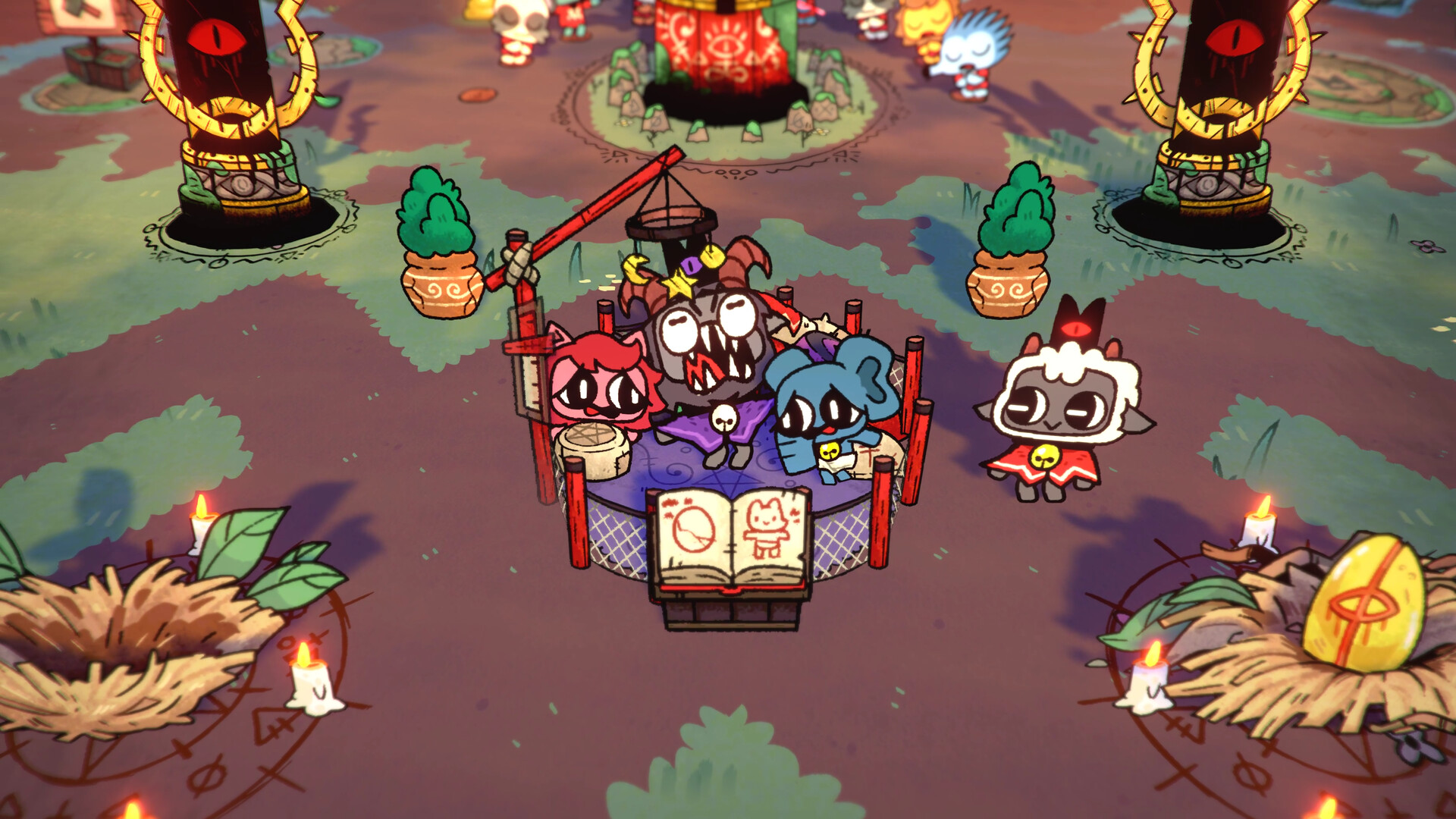 Atmospheric detail in Cult of the Lamb.
The cult-management half is stranger and more original. You return from each run to a patch of land where your followers live, get sick, age, and die. You build structures, assign tasks, perform sermons to top up collective devotion, and unlock doctrines — essentially the moral laws your cult operates by. Should followers be allowed to eat full meals, or rations? Can they speak ill of the faith, or are dissenters silenced? The doctrine system is the most interesting writing in the game; it makes you feel the specific banality of institutional control without hammering you over the head with a thesis.
Whether the two halves actually enhance each other is the real question. Early on, they do. Resources from dungeon runs unlock building blueprints; devotion from cult rituals unlocks new Tarot cards; follower deaths feel costly when you have invested time in their traits. Later, the loops start to diverge in pacing. The combat scales faster than the base-building rewards it, and you reach a point around the third biome where the cult is running adequately on autopilot while the dungeon is asking more from you mechanically. The connective tissue loosens.
What the Combat Gets Right (and Where It Stays Safe)
The combat is not bad. It is genuinely not bad, which sounds like faint praise but matters here because the roguelite is a genre where bad combat is immediately legible and Massive Monster avoided that. Weapons have distinct handling — the axe is slow and satisfying, the daggers fast and risky, the hammer punishing in both directions — and the Tarot card system produces runs with a legible identity. A run built around the Ritual of the Harvest card, which kills low-health enemies for resource drops, plays differently from one stacking curse damage through Dark Inspiration.
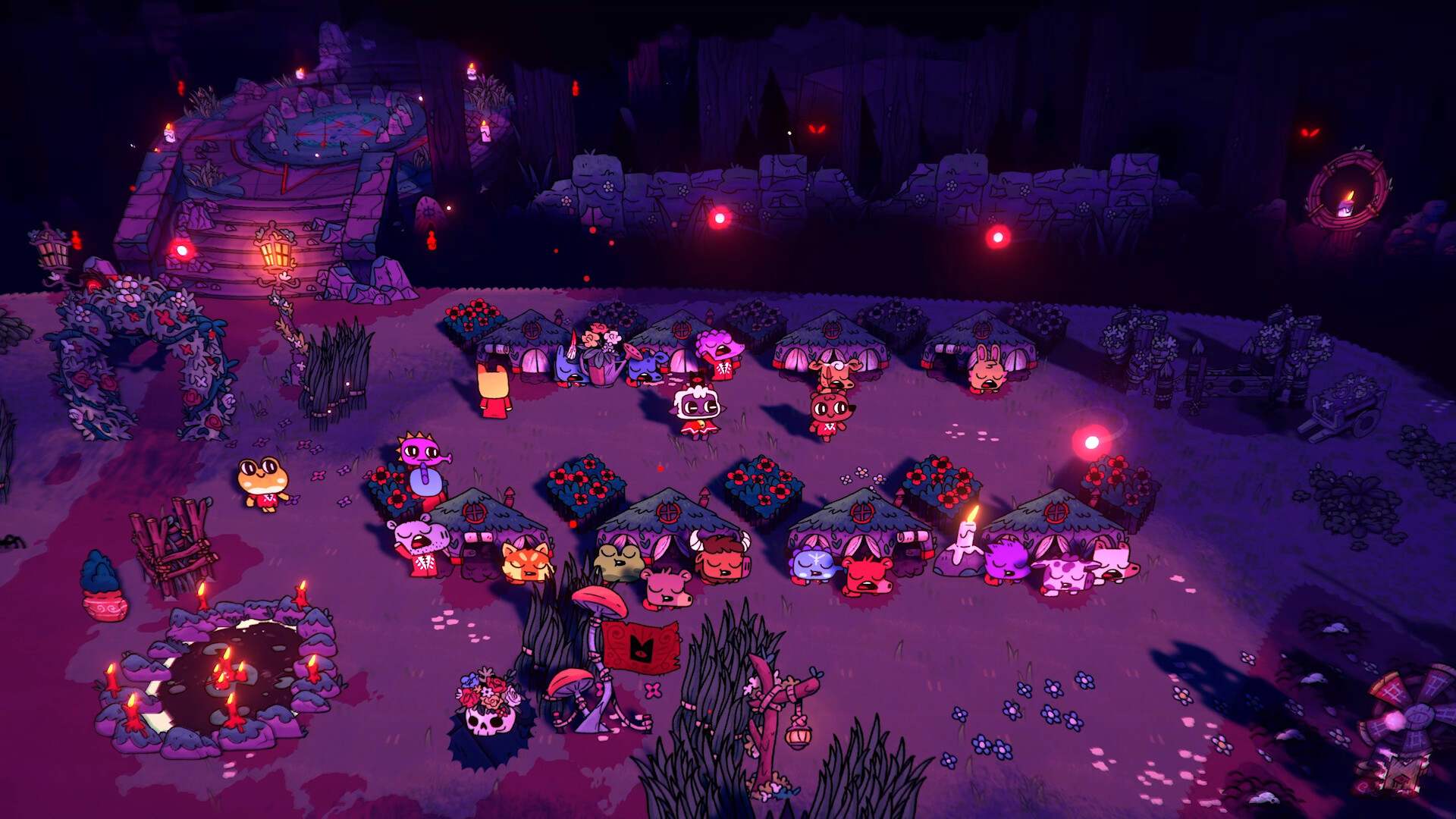 Combat encounter in Cult of the Lamb.
The problem is ceiling, not floor. The Binding of Isaac: Repentance, to pick the genre's peak, is a game where the interaction space is enormous enough that players are still discovering viable build archetypes years after release. Cult of the Lamb does not try to reach that ceiling, and there are moments — particularly in the fourth biome, Silk Cradle — where you become powerful enough that individual room design stops mattering. The game does not punish mastery the way the best roguelites do. The Unholy Alliance co-op update helps here, because two players navigating the same dungeon introduces variables the solo game can't generate, but it is not a fix for the solo experience.
The Doctrine System Is Doing Serious Work
The doctrine tree, unlocked through sermons and structured in paired moral choices, is where Massive Monster's design instincts are sharpest. Each doctrine tier forces you to pick between two options that are not simply good and evil — they are practical tradeoffs with ideological flavoring. Permitting cannibalism among followers saves resources and increases food options, but follower loyalty becomes harder to maintain once they watch their neighbor get eaten. Enabling work-cults (assigning followers to tasks without rest) accelerates building but degrades health and triggers dissent spirals.
What makes this work is that the game does not moralize at you. There is no alignment meter, no judgment from a narrator. The consequences are systemic — a doctrine you chose comes back in your follower's behavior and your colony's stability, not in a cutscene that wags its finger. Games like Frostpunk do something adjacent with survival governance, but Cult of the Lamb's tone is weirder and funnier, which keeps the grimmer implications from feeling self-congratulatory.
The follower trait system reinforces this. Followers spawn with personality traits — Faithful, Glutton, Enlightened, Shameless — that affect their upkeep and behavior. A Glutton follower consumes more food but generates more devotion during sermons. An Enlightened follower is resistant to faith drains but more likely to question doctrine. These traits mean the colony composition matters strategically, and it makes sacrifice a genuine cost-benefit calculation rather than a button you push for an altar reward. When you send an old, sick Glutton to the sacrificial altar, you feel it differently depending on how long you kept them alive.
The Mid-Game Sags, and the Map Knows It
The biome structure — Darkwood, Anura, Anchordeep, Silk Cradle — follows the boss-gate progression standard for the genre, but the second and third biomes are where the game starts testing your patience rather than your engagement. Anura and Anchordeep have distinctive enemy sets and reasonable boss designs (Heket is a frog demigod, Kallamar a paranoid crustacean deity, both with readable but not trivial attack patterns), yet the dungeon-to-cult pacing imbalance mentioned earlier is most visible here. You have done enough sermons. Your followers are spiritually compliant. You are grinding dungeon runs to unlock the next building tier, and the runs themselves are not pulling their weight as the primary reward.
The Relics of the Old Faith update inserted new side content and the fishing minigame hub at Smuggler's Sanctuary, which helps with resource variety but does not solve the structural drag. The fishing mechanic is fine — a timing-based catch system with species that unlock new recipe ingredients — but it reads as padding more than as a substantive system. It gives you something to do when your colony is running autonomously and you are waiting for a timer to expire. That is a utility, not a design achievement.
Narinder and What the Story Actually Says
The narrative resolve in the final stretch is better than the middle sections deserve. Narinder's arc — chained god, patron of your cult, increasingly sinister presence as your power grows — lands somewhere interesting because the game has been quietly arguing all along that you and he are not so different. The Old Faith bishops you kill are not cartoonish villains; they each represent a form of control you are also exercising over your followers. By the time the final confrontation arrives, the game has earned its thematic payoff, even if it did not always earn the hours that preceded it.
The ending options — there are several, gated behind endgame choices — do not all land with equal weight, but the default outcome is pointed enough. You built something monstrous by incremental decisions, each of which felt reasonable at the time. That is what the doctrine system was quietly setting up from the first sermon. It is not subtle, but it is coherent, which is more than most games with this premise manage.
Who This Is For, and Whether It Is Enough
Cult of the Lamb is a game with a clear audience — players who bounced off pure roguelites because the persistence felt missing, or who bounced off pure colony sims because the action loop felt too slow — and it serves that audience reasonably well. The hybrid format works better than it should given how different the two halves are. The art direction is exceptional throughout, Jen Zee's influence is not here, but the character design team produced a visual vocabulary that holds across wildly tonal swings from adorable to grotesque.
Where Massive Monster has room to grow — if the obvious sequel arrives — is in the dungeon's depth and the colony's late-game friction. Both systems plateau too early. The doctrine choices stop feeling consequential once the colony is established, and the combat stops demanding improvement once the weapon familiarity sets in. These are solvable problems. The foundation is strong enough that you wish the builder had pushed harder.
What Cult of the Lamb leaves you with is a game that made you complicit in something, and did it with enough craft that you kept going anyway. That is the specific thing it was trying to do, and it did it. The bones of something genuinely great are visible here — buried under mid-game filler and a combat system that runs out of surprises — and that makes it more interesting to argue about than a clean success would be.
Editorial scoring
Reader Q&A
How long does it take to finish Cult of the Lamb?
Main story runs around 32 hours depending on how thoroughly you explore. Completionists can spend 2-3× that.
Is Cult of the Lamb good for newcomers to Roguelite Cult Sim?
Yes — Cult of the Lamb is a great entry point. The early hours teach the systems gradually and the difficulty curve is reasonable.
Which platform should I play Cult of the Lamb on?
PC version offers the highest fidelity if your rig can handle it. Console versions are polished out of the box.
Was Cult of the Lamb worth the launch-day price?
If you're a fan of Massive Monster, yes. If you're new to the studio, a sale price is more comfortable.
Are there DLCs or expansions worth picking up?
The base game is complete; expansion DLC adds 10-15 hours of additional content if you want more.
What did Massive Monster get right (and what could be better)?
Massive Monster nailed the moment-to-moment loop and the world-building. Pacing in the mid-game and inventory UX have room for improvement.
Reader comments