
Death Stranding: walking simulator, world-builder, masterpiece?
Picture Sam Porter Bridges, played by Norman Reedus, standing shin-deep in a river with a tower of cargo strapped to his back. He is not fighting. He is not solving a puzzle. He is watching the current, figuring out where the riverbed drops, and choosing between a safer crossing that adds eight minutes to a delivery or a direct line that might topple everything. That image — the lone figure doing thankless logistics work in a beautifully bleak landscape — is basically the whole pitch. Hideo Kojima spent five years asking whether that could be a game. After 24 hours with the Director's Cut on PC, the answer is yes, with some caveats that deserve honest attention.
Death Stranding released in 2019 to the predictable split: critics who found it meditative and quietly radical, players who called it a walking simulator with delusions of grandeur, and a second wave of converts who came around eighteen months later once the concept had time to settle. The Director's Cut adds a handful of new facilities, a firing range, a racetrack, new story missions with Hideo Kojima and Geoff Keighley appearing as in-game characters, and some quality-of-life refinements to cargo management. None of that fundamentally changes what the base game is. What it does do is give a sharper edge to what already worked and smooth over some of the friction that didn't.
The Strand Concept, Actually Explained
Kojima coined the phrase "Strand Game" to describe Death Stranding's design philosophy, which is either visionary branding or extremely elaborate marketing depending on your tolerance for auteur self-mythologizing. Strip the terminology away and what you have is a game where the social system is the core mechanic. Other players' structures — ladders, bridges, safe houses, zip lines — appear in your world asynchronous-style, much like messages in Dark Souls, except instead of leaving cryptic hints you're leaving a fully functional rope bridge across a chasm. You can like someone's bridge. They get notified. The loop is cooperative without ever requiring you to be in the same session.
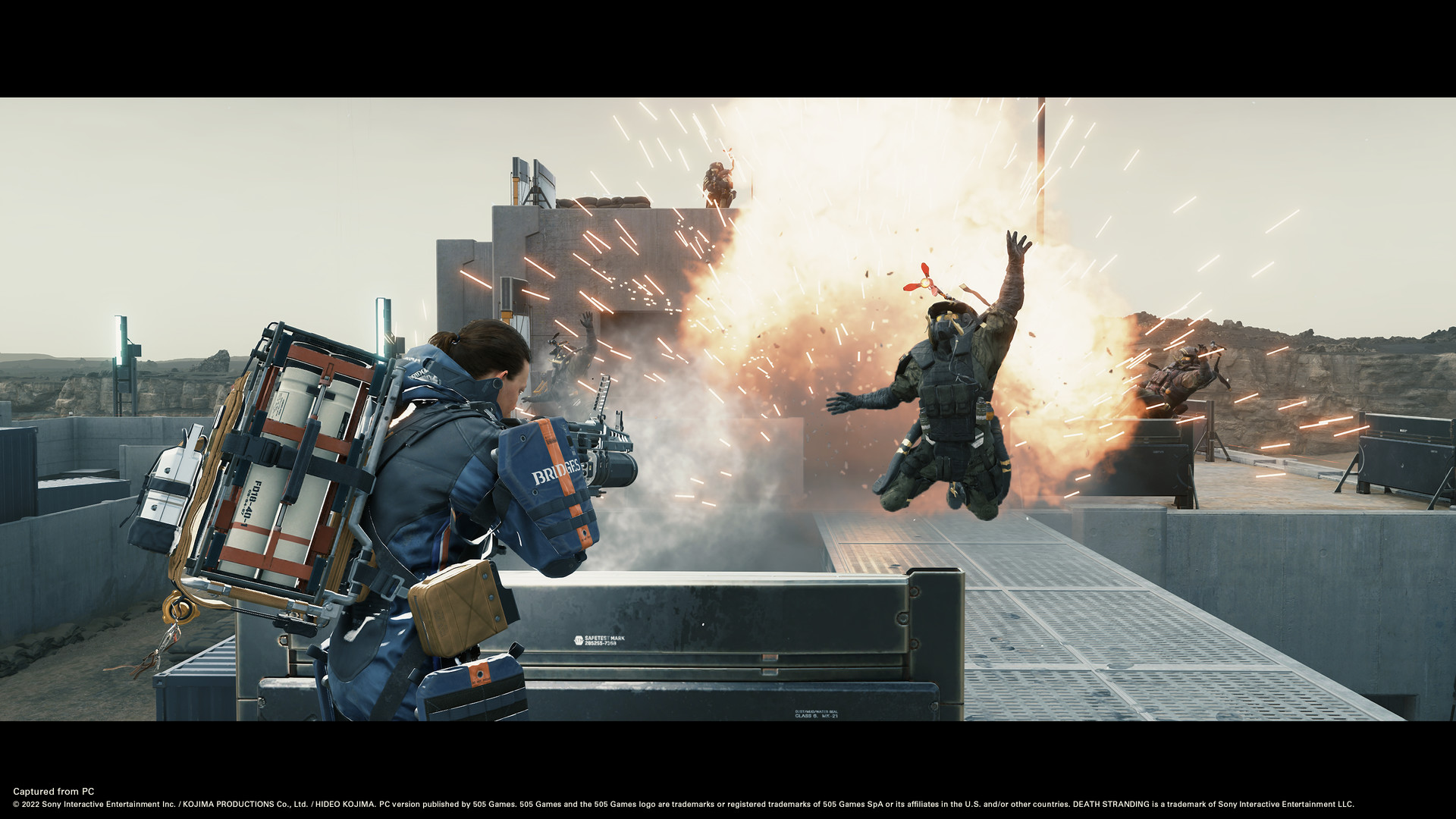
 Scene from Death Stranding Director's Cut.
This matters because it reframes the entire lonely-delivery premise. You are not isolated. You are part of a supply chain built by strangers who never met. Crossing a ridge and finding a well-placed ladder that saves you twenty minutes of scrambling feels genuinely good in a way that's hard to explain without sounding precious. It is the design equivalent of someone leaving an umbrella outside a coffee shop in the rain. FromSoftware's asynchronous systems have always worked on a smaller, combat-adjacent scale — bloodstains, notes, summoning. Kojima blew the concept out to infrastructure and that is, whatever else you think about the game, a legitimate design contribution.
Where the Traversal Actually Shines
The terrain is the antagonist. Sam's stamina, his balance, his cargo distribution — all of it is modeled with enough fidelity that crossing the Central Region's mountain range in a thunderstorm feels like a genuine logistical problem. You choose routes based on gradient, not distance. You weigh whether a BT-infested shoreline is worth avoiding by going uphill with a full load. The Terrain Scanner, which you unlock early, becomes one of the most used tools in the game not because it has flashy function but because reading topography becomes a skill you actually develop.
The Director's Cut adds a Buddy Bot, an AI carrier that follows Sam and takes some cargo. It sounds like a convenience feature and it is, but it also changes some of the balance calculus — particularly in early-game stretches where players were dropping off. Whether that dilutes the intended experience is a reasonable debate. The original game's difficulty curve was part of its point: it wanted you to feel the weight of every delivery. Softening that slightly for retention is a pragmatic call Kojima Productions clearly made consciously. It does not ruin the game. It does shift it toward accessibility in ways purists will note.
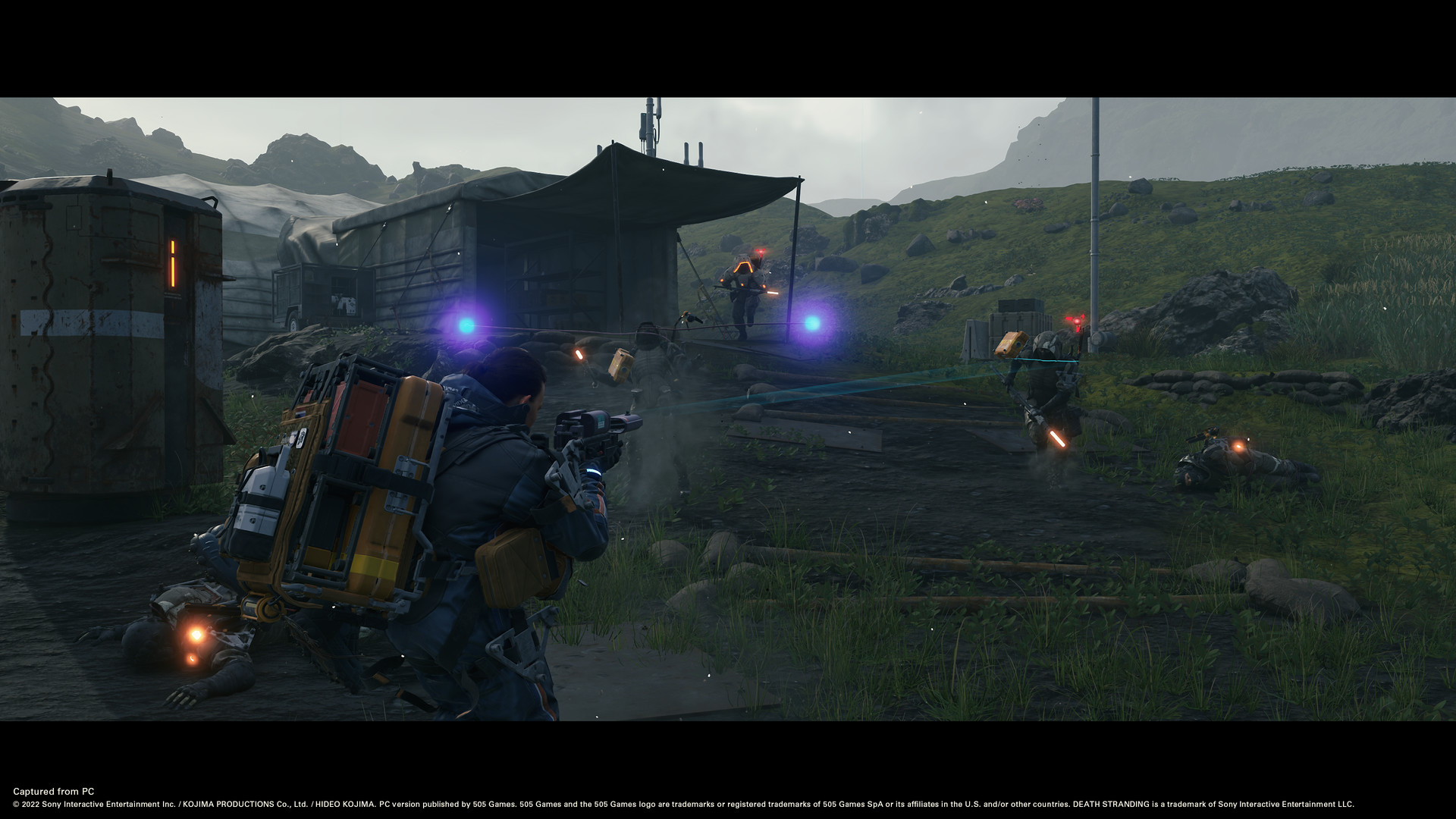
 Scene from Death Stranding Director's Cut.
The Narrative: Sincere to a Fault
Kojima's writing has always operated at a frequency that rewards patient generosity. Metal Gear Solid 4 spent fifteen minutes on a microwave corridor cutscene to make a point about endurance that a lesser writer would have handled in dialogue. Death Stranding does something similar with its structure: the plot is scaffolded around delivery missions so that story revelations arrive as earned rewards after long stretches of physical work. When the game finally explains what the Beach is, or what Higgs actually wants, the information lands differently because you have physically traversed the space those ideas inhabit.
The problem is the exposition delivery system. Emails. So many emails. Sam receives documents — written in that distinctive Kojima fashion, which oscillates between genuine philosophical curiosity and technobabble self-indulgence — that are optional but contextually important. Skipping them leaves gaps. Reading all of them makes the pacing collapse between major beats. This is not a new problem in Kojima's work. It was present in MGS2's codec calls and MGSV's cassette tapes. The Director's Cut does not address it, and that absence is noticeable when the momentum is otherwise tighter than the original release.
What the Director's Cut Actually Adds
The new content splits into two categories: mechanical additions and fan-service. The firing range and racetrack fall clearly in the second category — competent diversions, nothing that changes how you understand the game. The new story missions are brief but give Fragile, played by Léa Seydoux, more to do, and her character was underserved in the base game. The expanded cargo management UI is the quiet MVP of the whole update: sorting and optimizing what you carry is a surprisingly deep system, and removing some of the menu friction makes it feel less like administration and more like strategy.
The repatriation mission structure, which tasks Sam with recovering his own body after death, has also been refined. In the original, the back end of these sequences could feel punishing in a way that broke flow rather than building tension. The tuning here is subtle — enemy placement adjustments, slightly more forgiving timer windows — but it adds up. If you bounced off the base game specifically at these sections, the Director's Cut is worth revisiting on that basis alone.
The Thing About Playing It in 2024
There is a version of this argument where Death Stranding predicted something. Post-pandemic, the idea of a game built around isolation, mutual infrastructure, and the emotional weight of showing up for strangers carries different freight than it did pre-2020. That reading is easy to overstate — Kojima was not a prophet, he just found a compelling metaphor for disconnection and ran it to its logical endpoint — but the resonance is real. Playing it now, the cooperative layer feels less like a novelty feature and more like a considered response to something the medium had not tried to address.
The game has also aged better mechanically than some expected. Supergiant's Hades showed the same year that tight systemic design and heavy narrative investment can coexist, but Death Stranding was never trying to be that kind of game. It has more in common with something like Journey, scaled to forty hours and given a corporate thriller skin. That comparison is not an insult. It is a framework for understanding what Kojima was actually building.
The Verdict
Death Stranding Director's Cut is not for everyone, and Kojima Productions would probably accept that with a shrug. The emails are still too many, the mid-game pacing still sags around the tar belt region, and the combat remains the weakest part of the design — functional but clearly secondary, a concession to player expectation rather than a genuine commitment. Against all of that: the traversal system is one of the most original things a major studio has shipped this decade, the cooperative infrastructure loop is simple enough to ignore and rewarding enough that you won't want to, and the emotional climax earns its weight in a way that very few 30-hour games manage.
If you played it in 2019 and found it interesting but unfinished-feeling, the Director's Cut tightens enough screws to warrant a return. If you have never touched it, this is the version to start with — not because it is perfect, but because a game that asks you to carry things for strangers and feel good about it deserves at least the attempt.
Editorial scoring
Quick facts
How long does it take to finish Death Stranding: walking simulator, world-builder, masterpiece??
Main story runs around 60 hours depending on how thoroughly you explore. Completionists can spend 2-3× that.
Is Death Stranding: walking simulator, world-builder, masterpiece? good for newcomers to Strand Game?
It depends. The systems are deep but the tutorial does a fair job. Veterans of Strand Game will feel at home faster.
Which platform should I play Death Stranding: walking simulator, world-builder, masterpiece? on?
Console version is the most stable on launch. PC version benefits from the modding scene long-term.
Was Death Stranding: walking simulator, world-builder, masterpiece? worth the launch-day price?
Released in 2021, and as of writing it holds up. Wait for a sale if you're price-sensitive — major discounts arrive within 6 months.
Are there DLCs or expansions worth picking up?
Wait for the Game of the Year edition — it bundles everything at a fair discount.
What did Kojima Productions get right (and what could be better)?
Kojima Productions nailed the moment-to-moment loop and the world-building. Pacing in the mid-game and inventory UX have room for improvement.
Reader comments