
Disco Elysium lets you fail beautifully, and means it

Forty-seven hours in, I failed a check that I didn't know I was taking. My detective — a wreck of a man with his skill points sunk deep into Rhetoric and Empathy, because I had romantic ideas about what kind of cop I wanted to be — said something so catastrophically self-righteous to a union delegate named Evrart Claire that an entire branch of the investigation quietly closed behind me. No warning. No retry screen. The world just adjusted itself around my mistake and kept going. That's not a design quirk. That's the whole philosophy.
Disco Elysium, developed by ZA/UM and released in October 2019 before its Final Cut expansion arrived in March 2021, is a game that has been written about extensively enough that adding another voice to the pile requires some justification. Here's mine: most coverage either collapses into reverence for the prose — which is genuinely extraordinary — or gets distracted by the skill-check system as a mechanical novelty. Neither framing gets at what makes the design coherent. What ZA/UM built is a failure engine. Not in the pejorative sense; in the sense that the game is specifically, deliberately architected around the productive consequences of being wrong.
The Skill System Is Not About Succeeding
The surface structure looks familiar enough. You distribute points across 24 skills arranged into four broad stats — Intellect, Psyche, Physique, Motorics — and those skills then either pass or fail checks depending on your investment and a two-dice roll. Easy to summarize. But the actual texture of play is stranger than that summary implies, because ZA/UM has built a system where failing a check frequently generates more interesting content than passing it. Fail a Perception check and you miss a clue. Fail a Rhetoric check and you argue yourself into an embarrassing position in front of witnesses. Fail Endurance and Harry Du Bois — your amnesiac detective — collapses from a heart attack mid-conversation. The failure states are not absences of story. They are story.
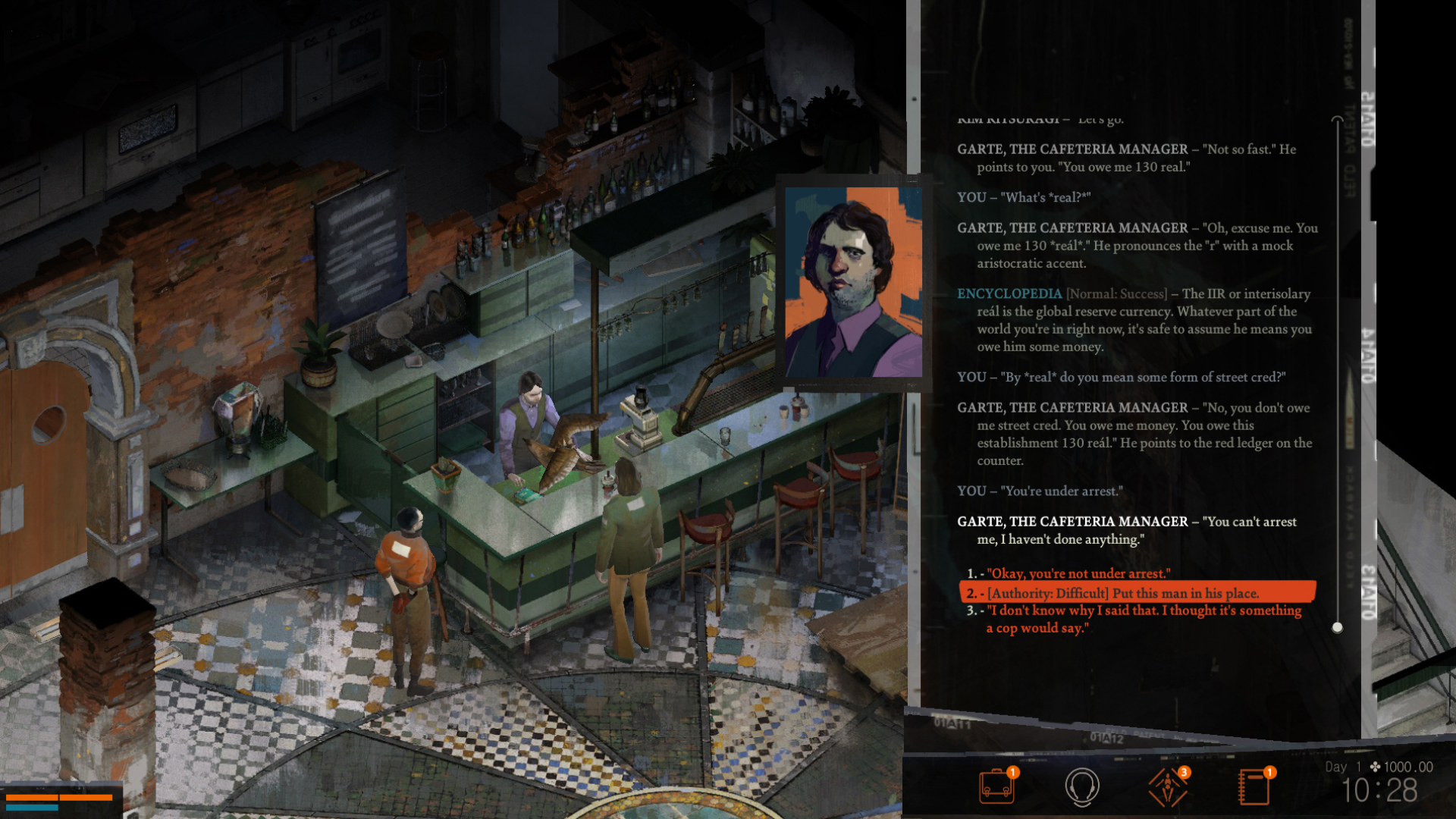 Atmospheric detail in Disco Elysium.
What makes this work rather than simply frustrating is the way the skill-point economy forces character commitment early. You cannot build a balanced generalist without spreading your points thin enough that you fail constantly; you cannot specialize without accepting that whole categories of interaction are going to be read as noise by Harry's broken brain. My Rhetoric-heavy playthrough meant that my character had strong opinions about ideology and could argue those opinions — sometimes to devastating effect, sometimes to ruinous effect — but would routinely humiliate himself in physical confrontations or miss environmental details that a more observationally gifted detective would catch immediately. That's not the game being difficult. That's the game being honest about what it means to be a particular kind of person.
Crucially, the 24 skills all speak to Harry directly inside his head. Inland Empire pitches surrealist hypotheses. Drama catches lies. Half Light threatens violence when Harry feels cornered. Each skill has a distinct voice and a distinct agenda, and they argue with each other in Harry's inner monologue in ways that create a genuinely strange portrait of how a consciousness functions under stress. Compare this to something like Pillars of Eternity, which used skills primarily as gating mechanisms — either you have enough points to proceed or you don't. ZA/UM's approach treats skills as perspectives rather than permissions.
Martinaise as a Designed Space
The setting — the waterfront district of Martinaise in the fictional city of Revachol — is geographically modest. You are not covering vast territory. The whole playable area could be mapped on a couple of printed pages, and you will cross the same streets and alleys dozens of times across a full playthrough. This is a choice that pays off in a specific way: Martinaise accrues meaning through repetition. The first time you pass the fishing village you barely notice it. By hour thirty you know exactly who lives there, what they want, how they have been ground down by the city around them, and the ground itself feels different underfoot.
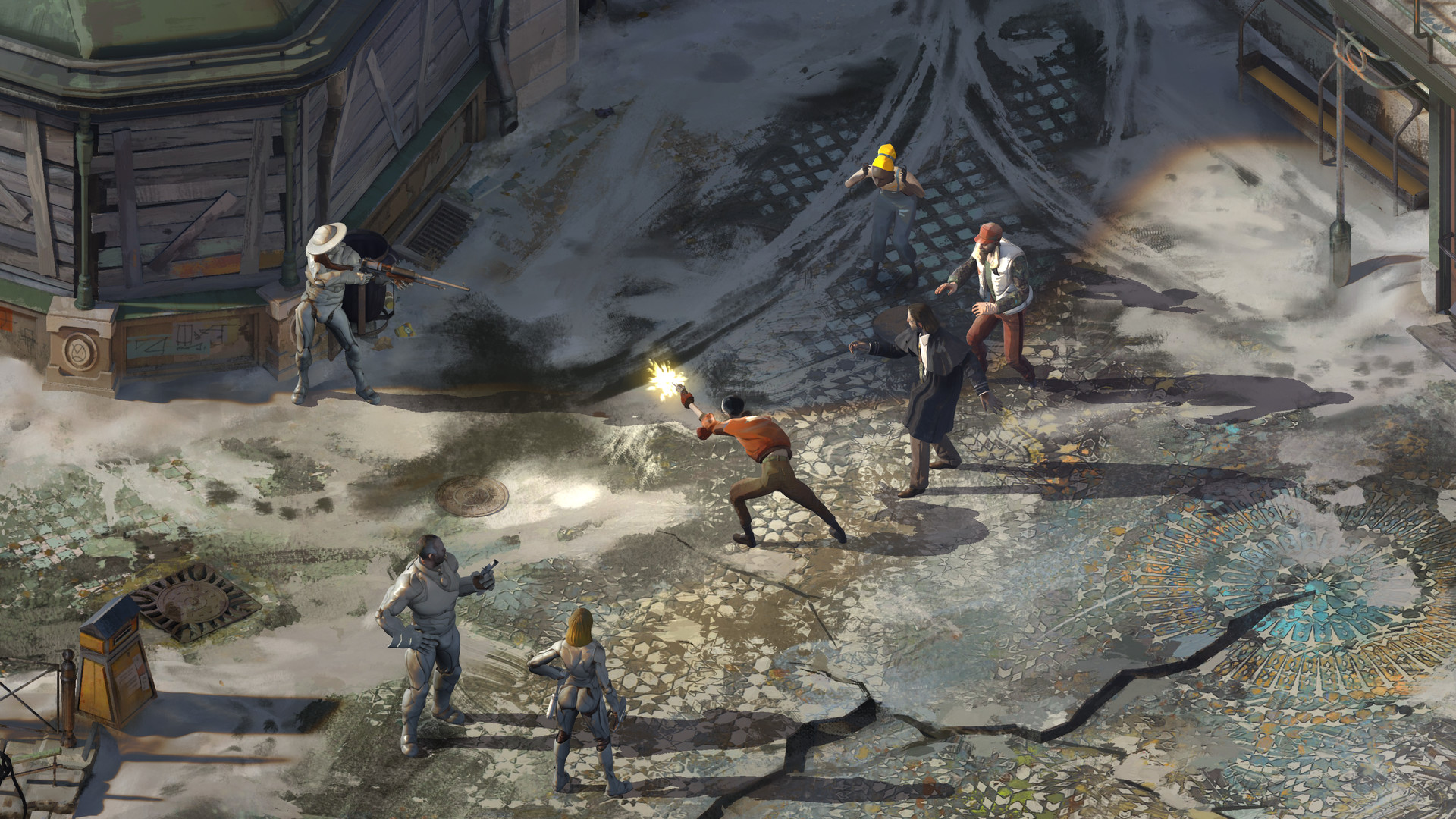 Combat encounter in Disco Elysium.
The murder investigation that anchors the plot — a hanged man in a courtyard, a union strike, a history of violence that predates Harry's arrival by weeks — is structured less like a mystery genre exercise and more like an archaeology. You are not racing toward an answer. You are excavating layers of a place, and the case is the excuse the game uses to justify why Harry is poking into every corner of every building. Several of the most significant conversations in the game have no immediate bearing on the case whatsoever; they are just people, living in the aftermath of a failed revolution, trying to explain to themselves and to you how things got this way.
The Writing, Specifically
The prose has been praised widely enough that hedging feels dishonest, so: it is frequently remarkable. What distinguishes it from other games that aspire to literary status is tonal control. Disco Elysium can be genuinely funny — the bit in which Harry can attempt to retrieve his jacket by wearing another piece of clothing so objectionable that the jacket becomes the less embarrassing option has a comic precision that holds up across multiple rereadings — and it can be genuinely desolate within the span of a single dialogue tree. The team at ZA/UM did not confuse earnestness with depth or irony with sophistication; they used both as tools.
The political texture is worth addressing directly, because it is where some players bounce off the game. Disco Elysium is not subtle about the fact that Revachol's present misery is downstream of capitalism, colonialism, and the crushing of a communist revolution half a century before the game begins. Characters will discuss this at length and with genuine intellectual rigor. Harry can be positioned along a political spectrum that runs from Fascist to Communist, and the game will engage seriously with whichever position you stake out while also, eventually, subjecting that position to pressure. This is not the both-sides neutrality of a game unwilling to commit; ZA/UM have clear sympathies and let them show. Whether that enriches or alienates the experience will depend on the reader, and the game knows it.
What the Thought Cabinet Actually Does
The Thought Cabinet is the mechanic most likely to be misread as flavor. Harry can internalize ideas — economic theories, personal philosophies, conspiracy frameworks, grief responses — by spending in-game time 'processing' them, after which they become passive modifiers to his stats and his dialogue options. Equip the Mazovian Socioeconomic Dynamics thought and you get bonuses to certain political arguments; equip the Coupris Kineema thought, which is basically just Harry becoming obsessed with a specific model of car, and you get something stranger and sadder and more specifically human.
The design function here is to make Harry's worldview malleable and visible simultaneously. Unlike most RPGs where character build is a set of combat stats that rarely inflect the fiction, the Thought Cabinet shapes how Harry reads the world and how the world reads Harry. An NPC will respond differently to a Harry who has internalized centrist pragmatism versus one who has committed to ultraliberalism — not dramatically differently, not always in plot-relevant ways, but with the small friction of someone who senses they are talking to a different kind of person. After 47 hours I had a Harry who believed in the pale, was haunted by a doomed romance, and had developed a detailed theory about the apocalyptic significance of lorry drivers. The game had built that out of the choices I made, without a cutscene to announce it.
Where the Design Wobbles
Nothing here functions as a complete dismissal of the game, but some friction points deserve honest accounting. The dice-roll system, while philosophically coherent, occasionally produces outcomes that feel arbitrary in the moment rather than earned; there are checks you can fail repeatedly not because your build is wrong but because the variance in a two-dice roll is high enough that probability occasionally betrays you in ways that read as unfair rather than as character revelation. The option to retry failed checks by raising your stats addresses this somewhat, but the grind to raise a specific skill by a single point mid-case can create pacing dead zones.
The final act — which takes Harry off the Martinaise mainland to Pale Ship island — has been noted by many players as a shift in tempo that feels slightly ungainly after the slow, deeply local rhythms of the main investigation. It is not bad; there is a confrontation there that lands with genuine weight. But the spatial grammar changes in a way that briefly disrupts the logic the game has spent thirty-plus hours establishing. It is the one moment where you can feel the seams.
The Harder Question
Games ask you to be competent. That is the default contract: learn the system, improve at it, feel rewarded for improvement. Disco Elysium proposes something different — that being specifically, characterfully incompetent in the right directions is its own form of meaning-making. Harry Du Bois is a mess, and the game does not ask you to redeem him through tactical mastery. It asks you to understand him, and through him, to sit with the particular shape of how a person's damage intersects with the world they're embedded in.
Whether ZA/UM can sustain the studio through its very public and ongoing internal conflicts — the legal disputes, the departures of the original creative leads including Robert Kurvitz and Helen Bach — remains an open and genuinely troubling question for anyone who cares about what this game represents. But the object itself, the 47-hour experience sitting on the drive, doesn't need those anxieties projected onto it. It is already finished. It already knows what it is. Most games spend enormous resources trying to make you feel powerful. This one spent those resources making you feel implicated — and that distinction is rarer than it should be.
Editorial scoring
Quick facts
How long does it take to finish Disco Elysium lets you fail beautifully, and means it?
Main story runs around 18 hours depending on how thoroughly you explore. Completionists can spend 2-3× that.
Is Disco Elysium lets you fail beautifully, and means it good for newcomers to Narrative RPG?
For total newcomers, expect a 5-8 hour ramp-up. Once you internalize the loop, it clicks.
Which platform should I play Disco Elysium lets you fail beautifully, and means it on?
Console version is the most stable on launch. PC version benefits from the modding scene long-term.
Was Disco Elysium lets you fail beautifully, and means it worth the launch-day price?
Depends on backlog. The replay value justifies the price for genre fans; casual players should wait for a 40%+ discount.
Are there DLCs or expansions worth picking up?
The base game is complete; expansion DLC adds 10-15 hours of additional content if you want more.
What did ZA/UM get right (and what could be better)?
Strongest: art direction, audio design, set-piece variety. Weakest: late-game balance and a few persistent quest-log bugs.
Reader comments