
Dishonored 2 gives you a clockwork mansion and dares you to break it
There is a level in Dishonored 2 called A Crack in the Slab where Arkane Studios hands you a pocket watch that lets you flip between two timelines — the present-day version of a crumbling Stilton estate and its past, fully staffed and fortified — and then simply steps back. No tutorial pop-up walks you through the intended solution. No waypoint tells you which version of reality to inhabit when. The level is a locked puzzle box with no instructions printed on the lid, and if you spend twenty minutes mapping its logic in your head before touching a single guard, that is probably Arkane's preferred outcome.
After forty-seven hours with the game — split between a Corvo playthrough that leaned on blink-chaining across rooftops and an Emily run that turned Domino into a weapon of quiet, systemic cruelty — the honest assessment is that Dishonored 2 is the best immersive sim Arkane has made, and that it is also slightly less than it could have been. Those two things coexist without much tension once you accept that the game's ambitions occasionally outpace its execution in ways that are more interesting than most studios' successes.
What the power set is actually asking of you
Emily Kaldwin's abilities are where the design conversation gets most interesting. Far Reach looks like Corvo's Blink but functions differently enough to reward treating it as a distinct tool: it pulls Emily toward a surface rather than teleporting her, which means your trajectory is visible and your body passes through space rather than skipping over it. Guards can react to the motion. That single distinction — a power that looks like a shortcut but carries spatial cost — tells you something about how carefully Arkane thought about what each mechanical verb should mean before shipping it.
 Atmospheric detail in Dishonored 2.
Domino chains the fates of up to four NPCs so that whatever happens to one happens to all. On paper it reads as a crowd-control tool. In practice it is a way to reframe every encounter around questions of information: which guard is isolated, which one is watched, how do you get close enough to mark a target without alerting the target's linked companion three rooms away. The ability does not make the game easier in any simple sense; it makes the problem space richer, which is a much more valuable thing to do with a mechanic. Mesmerize, which sends a single enemy into a standing trance, is quieter but equally deliberate — a surgical instrument where Domino is a scalpel that cuts four things at once.
The Clockwork Mansion and why it earns its reputation
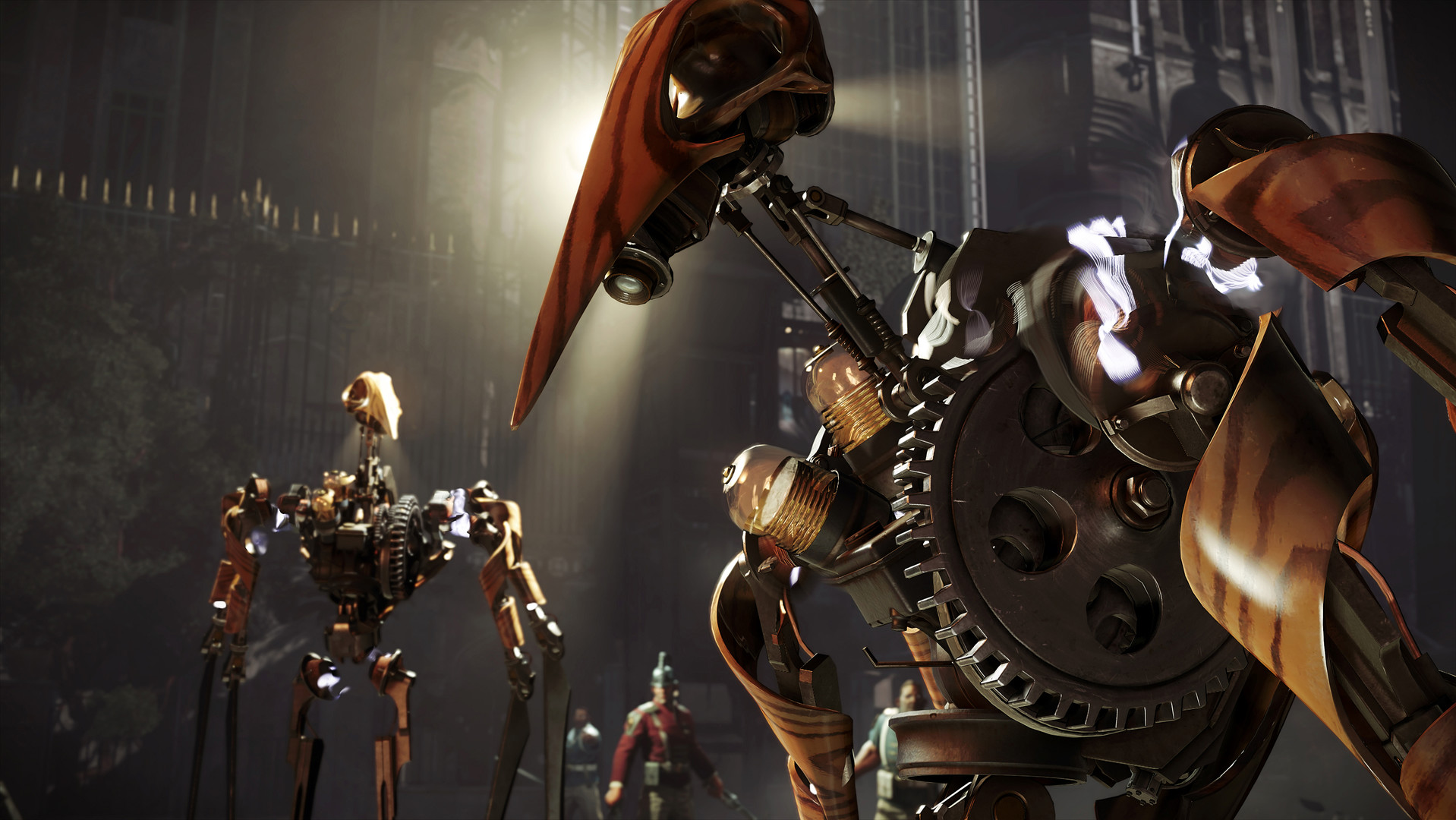
Kirin Jindosh's Clockwork Mansion — mission four, roughly the game's structural midpoint — is the level designers showing off, and they have earned the right. The mansion reconfigures itself at the pull of a lever: walls rotate, floors open, corridors become ceilings. The Clockwork Soldiers that patrol it are fast, heavily armored, and genuinely threatening even on standard difficulty if you are not paying attention to their patrol arcs. Most players will die here more than once. Most players will also find the level magnificent.
What makes the Clockwork Mansion work as design rather than mere spectacle is that the reconfigurable architecture is also the solution to itself. The servants' passages behind the mansion's walls predate Jindosh's mechanical redesign; they were not built to accommodate his levers and rotating panels. If you find them — and the game offers no explicit prompt to look — you can move through the entire level without triggering a single wall shift, rendering the Clockwork Soldiers largely irrelevant because you are never in the rooms they patrol. The mansion is both the problem and its own answer, and the game trusts you to notice.
 Combat encounter in Dishonored 2.
Jindosh himself is a target you can neutralize without ever confronting directly, through a puzzle solution the game buries in an optional note. Solving it costs you the combat climax of the mission entirely and nets you almost nothing in terms of obvious reward. It is the kind of design choice that studios talk about aspiring to and that very few actually commit to, because it requires believing your players want the system more than they want the cutscene.
Where the seams show
The campaign has nine missions, and the distribution of design ambition across them is uneven in ways that become harder to ignore on a second playthrough. The Clockwork Mansion and A Crack in the Slab are genuinely exceptional. The dust district mission that separates them is competent but thin — two rival factions, a straightforward assassination, environments that feel like they were constructed for the required geometry rather than for any narrative logic. It does not break the game; it does lower the temperature at precisely the moment the game's difficulty and complexity should be building.
The story, too, operates at a lower register than the systems supporting it. Delilah Copperspoon is a capable antagonist on paper — a witch who wants to rewrite reality, voiced with cold elegance — but the game spends most of its runtime keeping her at arm's length, deferring the confrontation in ways that make the climax feel compressed. Dishonored 1 had the same structural problem; Harvey Smith and Raphael Colantonio have spoken publicly about the difficulty of writing villains into a game where the player can eliminate them through a hundred different approaches. The constraint is real and the problem is genuine, but knowing why a thing does not quite work does not make it work.
Chaos, lethality, and the game's moral accounting
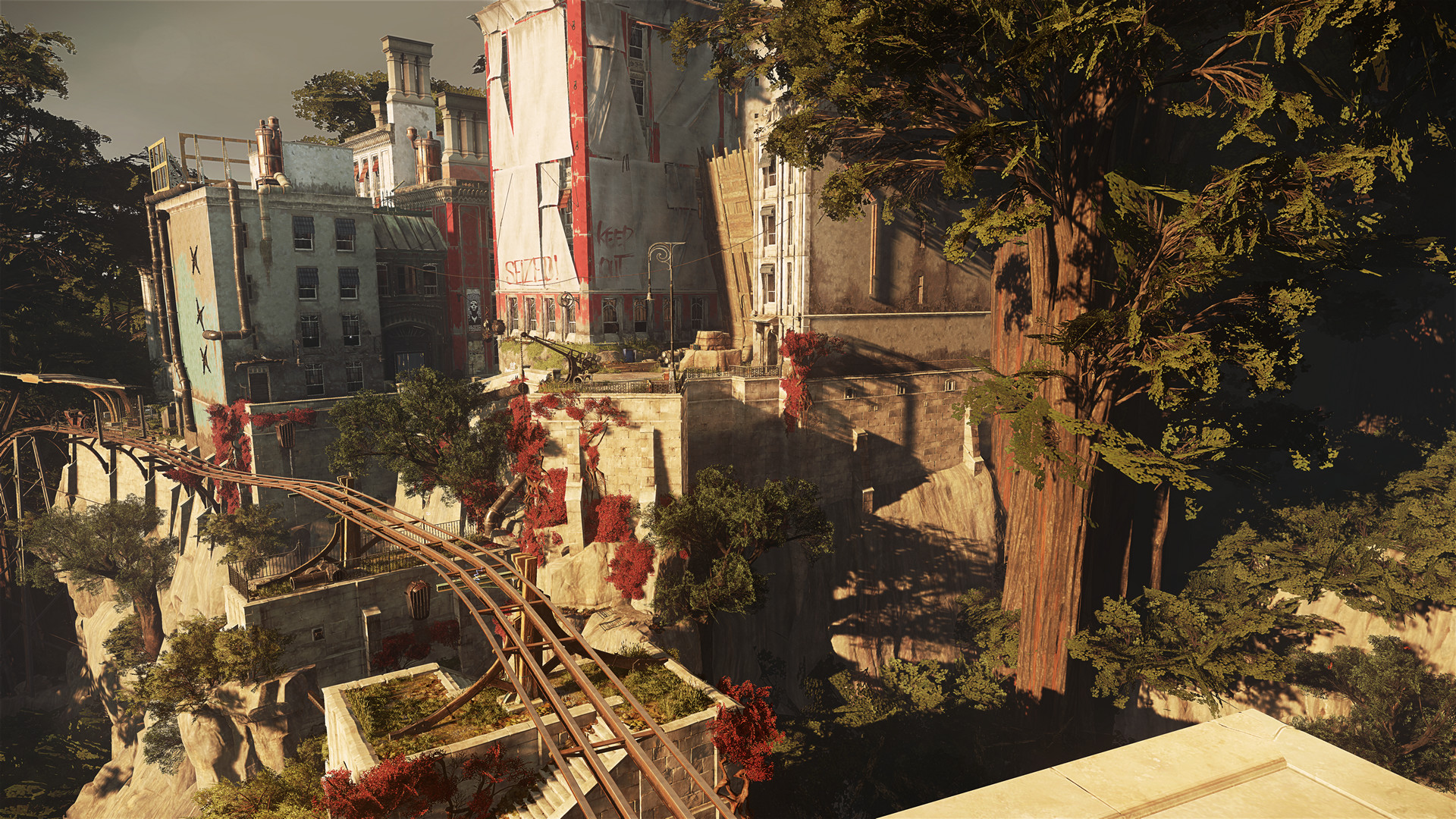
Dishonored 2 inherits the chaos system from its predecessor and refines it without resolving its central tension. High chaos — accumulated through lethal takedowns and discovered bodies — darkens the world, increases enemy aggression, and pushes toward bleaker ending states. The system is trying to say something about the relationship between means and consequences. The problem is that it also makes the game's most expressive mechanical space — open, violent, acrobatic combat — the path to the worst narrative outcome, which creates a quiet friction between what the verbs want you to do and what the story rewards you for doing.
Non-lethal approaches are genuinely creative — sleeping darts, choke holds, Domino chains that let you knock out four guards by knocking out one — but they are also slower and require more information-gathering per encounter. The chaos system does not penalize efficiency; it penalizes lethality specifically, which means a player who wants to engage with combat as a discipline rather than a last resort is being gently punished for a legitimate playstyle. This is a values argument baked into a mechanical framework, and reasonable people can disagree about whether Arkane is right to make it.
The Karnaca setting and what it does for the design
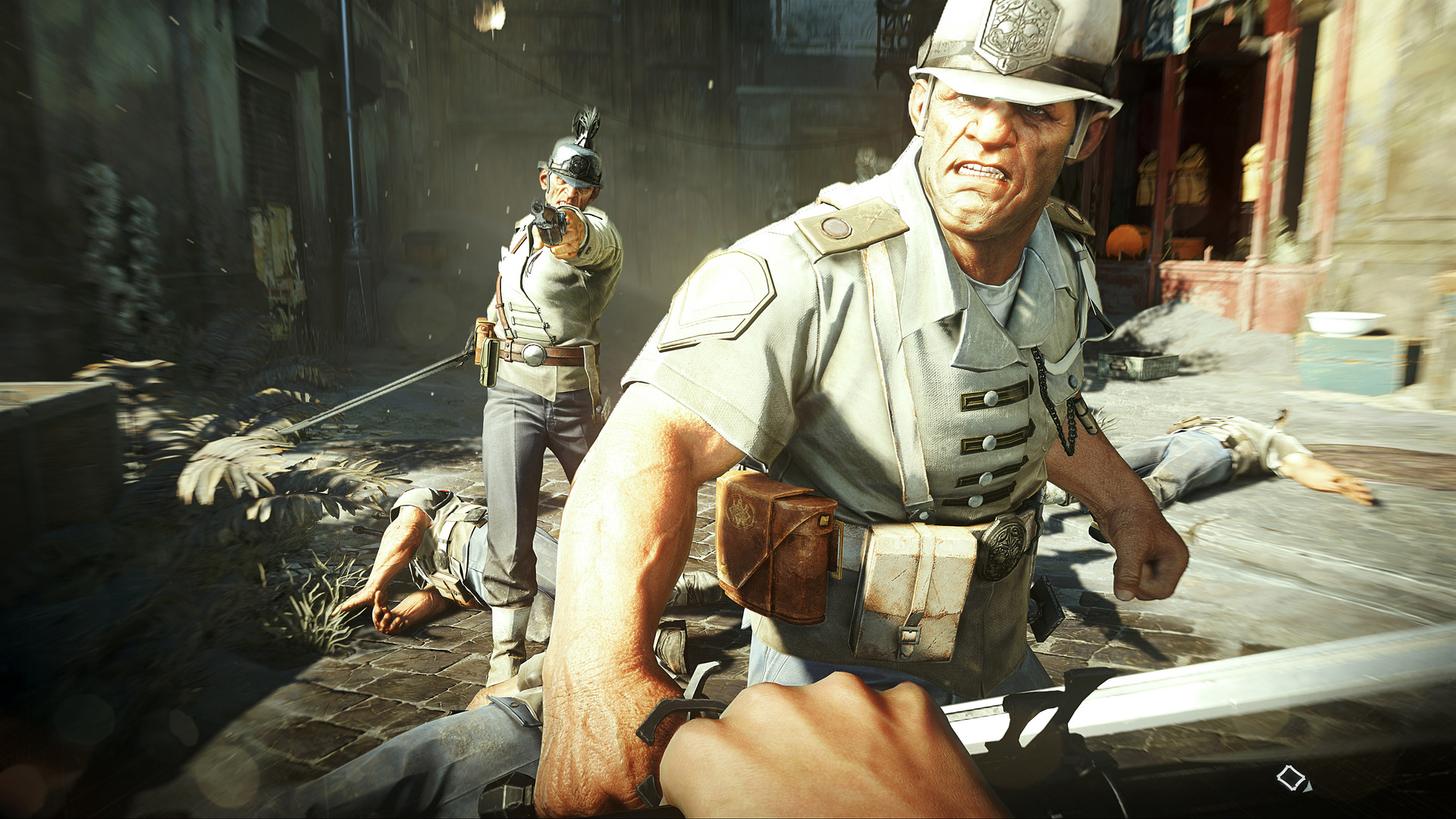
Karnaca, the sun-bleached southern city where most of the game takes place, is doing genuine work that Dunwall in the original could not. The windmill infrastructure — massive whale-oil-free turbines that power the city — feeds into level geometry in ways that make Karnaca feel like a place with a functional economy rather than a backdrop. The bloodfly infestation that has spread through neglected districts gives the environmental storytelling a texture of recent, ongoing crisis: boarded windows, abandoned furniture, the particular way people leave a space in a hurry.
The lighting is worth noting separately. Arkane's art direction here is doing real heavy lifting — the quality of afternoon light in the Dust District, the way the mansion interiors balance warm electric light against cool stone — and it contributes to a game that feels genuinely located in a way that many immersive sims, with their tendency toward industrial grey corridors, do not. Location matters to immersion; a world that looks like somewhere specific is a world you are more willing to take seriously on its own terms.
The ranking question
Where does Dishonored 2 sit on the immersive sim ladder? Above Prey (2017) in level design ambition, below it in systemic depth and NPC behavioral complexity. Ahead of the original Dishonored in almost every mechanical dimension, though the first game's Dunwall carries a more singular atmosphere. Behind Deus Ex (the original, not the reboots) in terms of how completely the choice architecture respects every playstyle without implicit moral hierarchy. These comparisons are worth making precisely because immersive sims are a small enough genre that every entry in it is in conversation with every other, and Arkane knows this better than most studios.
The Clockwork Mansion alone is worth the price of admission, as a piece of spatial design that most studios working in three-dimensional environments would not have the conviction to attempt. A Crack in the Slab is a close second. That two missions in a nine-mission campaign are legitimately among the best level design work of the decade is not nothing. It is not everything either, but it is enough to make the uneven parts around them feel like the cost of extraordinary ambition rather than evidence of a studio coasting. Arkane was reaching for something here; they caught most of it.
Editorial scoring
Quick facts
How long does it take to finish Dishonored 2 gives you a clockwork mansion and dares you to break it?
Main story runs around 47 hours depending on how thoroughly you explore. Completionists can spend 2-3× that.
Is Dishonored 2 gives you a clockwork mansion and dares you to break it good for newcomers to Immersive Sim?
It depends. The systems are deep but the tutorial does a fair job. Veterans of Immersive Sim will feel at home faster.
Which platform should I play Dishonored 2 gives you a clockwork mansion and dares you to break it on?
Console version is the most stable on launch. PC version benefits from the modding scene long-term.
Was Dishonored 2 gives you a clockwork mansion and dares you to break it worth the launch-day price?
Depends on backlog. The replay value justifies the price for genre fans; casual players should wait for a 40%+ discount.
Are there DLCs or expansions worth picking up?
The base game is complete; expansion DLC adds 10-15 hours of additional content if you want more.
What did Arkane Studios get right (and what could be better)?
Strongest: art direction, audio design, set-piece variety. Weakest: late-game balance and a few persistent quest-log bugs.
Reader comments