
Elden Ring dares you to feel lost — and means it
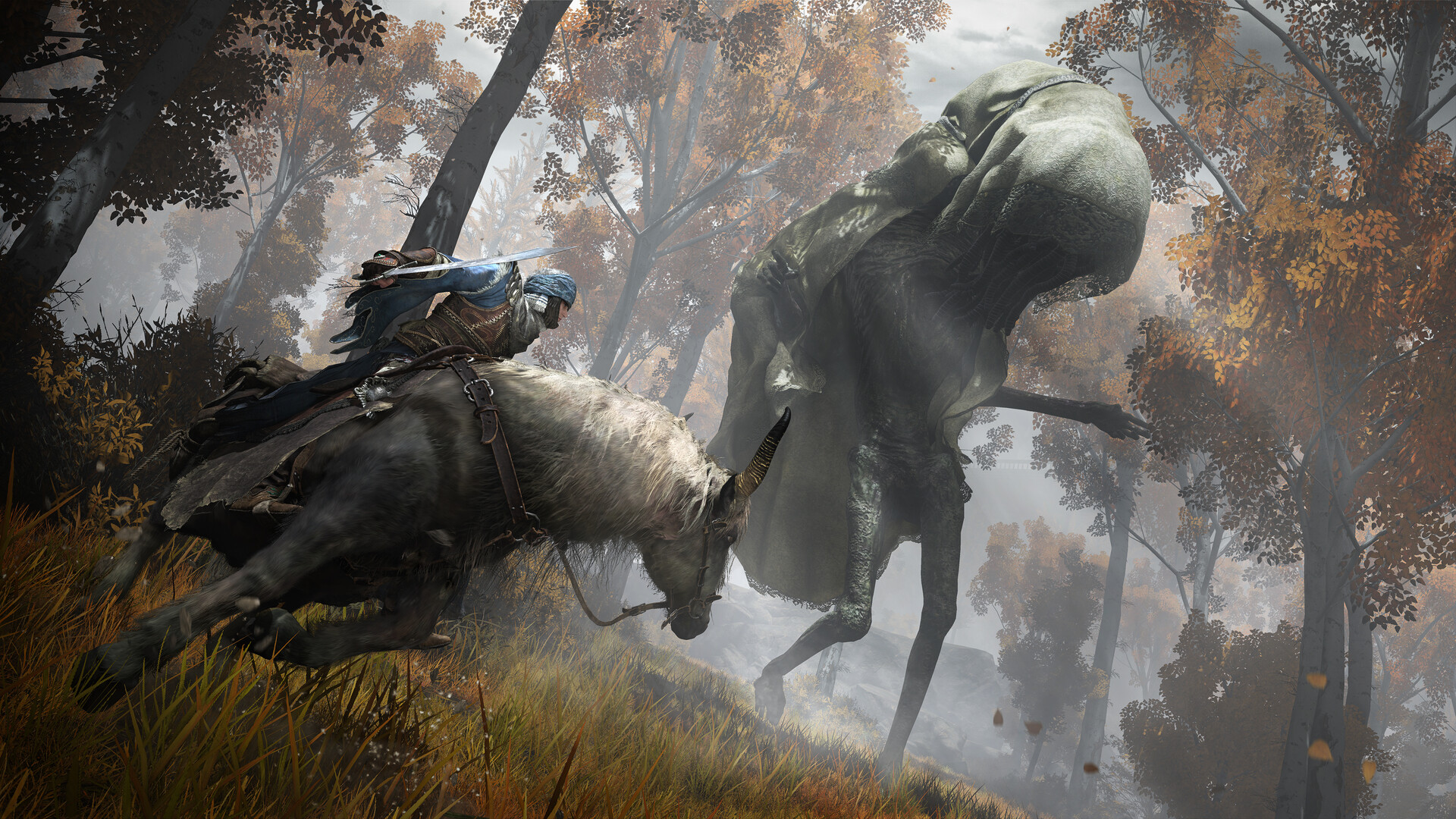
There's a moment about four hours into Elden Ring where you crest a hill in Limgrave and see, across a fog-draped ravine, a castle the size of a small town sitting at the edge of the world. No waypoint. No level recommendation. Just a building and your horse and the uncomfortable feeling that you are, in every measurable sense, very small. That moment is the game's thesis statement, and FromSoftware knew it when they designed the view angle.
After 47 hours — not a sprint, not a hundred-percent crawl, just a reasonably thorough playthrough with time spent poking around optional legacy dungeons and dying repeatedly to a horse-riding boss named Radahn who rains meteors on you — Elden Ring lands as FromSoftware's most ambitious project and, depending on what you want from an open-world action RPG, either their finest work or their most structurally complicated one. Possibly both.
The map is a design argument
Most open-world games are terrified of dead space. Ubisoft, Rockstar, CD Projekt Red — they fill maps with icons the way people fill boxes when moving house: compulsively, without always checking whether the contents are worth keeping. Elden Ring does something different. Its map, when you first receive it, is almost empty. Fog of war with a handful of landmarks. You fill it yourself, physically, by finding map-fragment obelisks scattered across each region. It sounds like busywork until you realize the act of searching is the actual content.
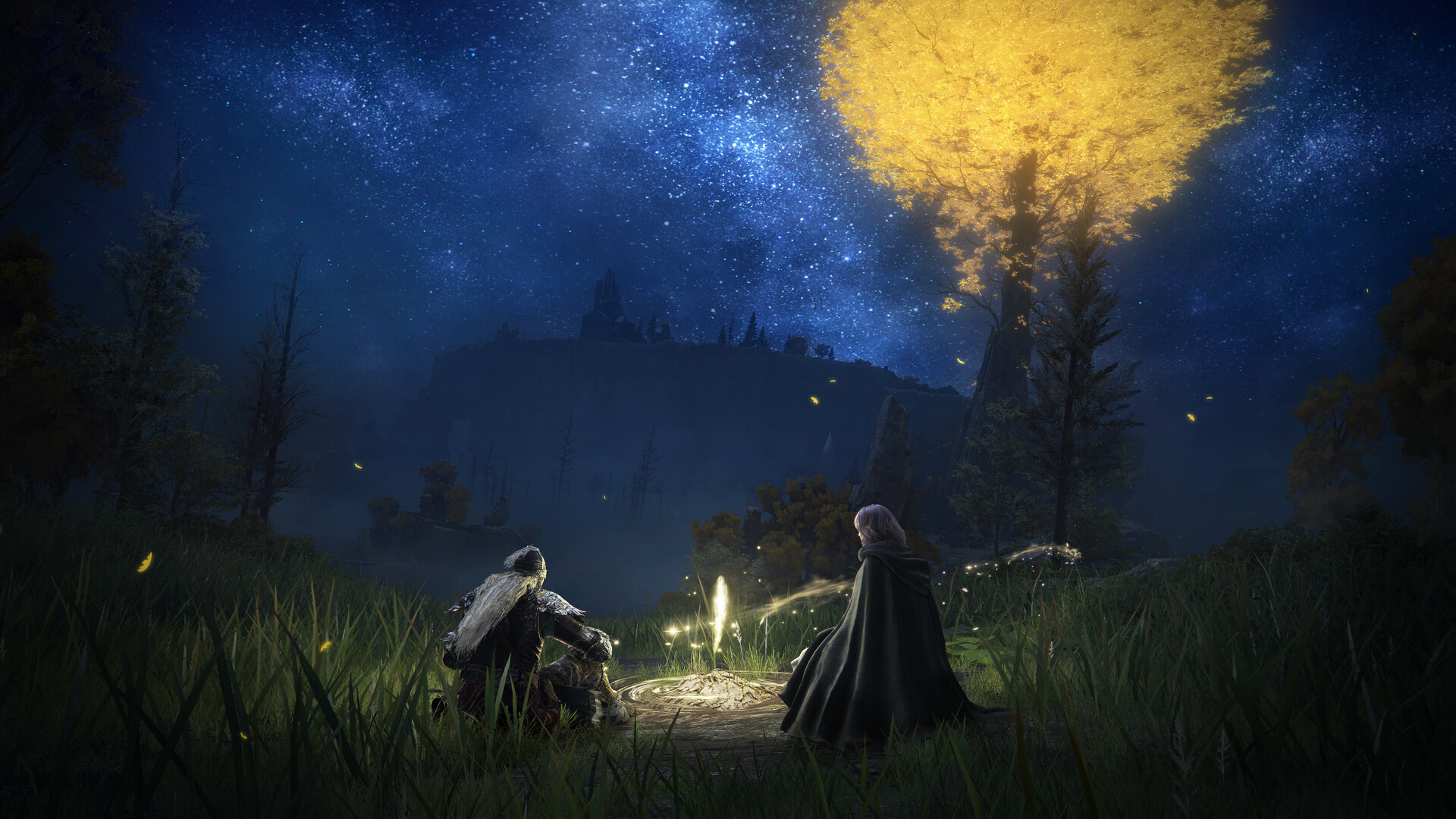 Scene from Elden Ring.
The Lands Between is structured around six major regions, each with a legacy dungeon at its heart — Stormveil Castle, Raya Lucaria Academy, Leyndell — that functions like a condensed Souls game within the open world. These are where FromSoftware's dungeon-design craft is most legible: interlocking shortcuts, enemies placed to teach rather than simply punish, environments that double as lore delivery mechanisms. The open fields and catacombs between them are more variable in quality, but they serve a different purpose. They're for getting your bearings. For realizing you've been heading the wrong direction for 20 minutes and being fine with that.
The one honest criticism of the map is that its latter half — Farum Azula, the Mountaintops of the Giants — compresses what had felt like generous exploration into something more linear. The Haligtree, an optional endgame area requiring two hidden medallion halves to access, partially compensates by rewarding the kind of map-illiteracy that Elden Ring encourages from the start. But the back third does feel like a different design team was working under a deadline.
Combat that earns its reputation, mostly
The core combat is Souls DNA with a few meaningful additions. Jumping attacks finally feel weighted and useful rather than situational. The Ash of War system — equippable weapon skills that replace the fixed moveset of previous games — gives builds a flexibility Dark Souls III never quite managed. A quality build with a Rivers of Blood katana and Corpse Piler skill plays almost nothing like a strength build using Starscourge Greatsword with Lions Claw. These aren't cosmetic differences. They change how you read enemy patterns.
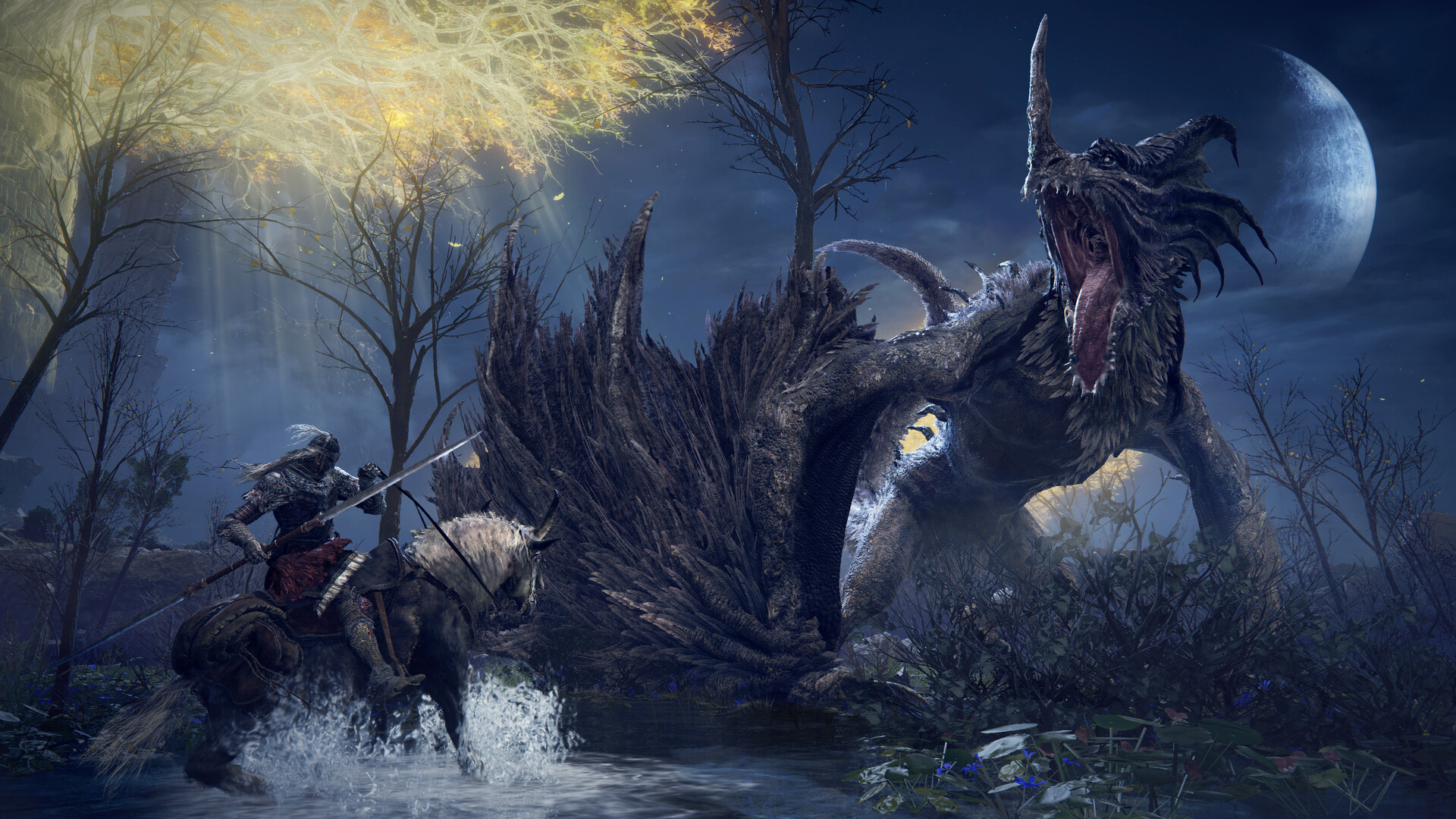 Scene from Elden Ring.
Spirit Ashes — summoned AI companions — are the system most likely to split veteran players. Purists have complained they trivialize fights. That complaint has some validity against certain overtuned bosses: throwing Black Knife Tiche at Malenia and letting her absorb Scarlet Rot while Tiche circles the arena is a legitimate strategy, but it does reduce one of the game's best-designed encounters to something closer to a distraction exercise. What the Ashes actually do is widen the game's accessibility band without gating anything. You can ignore them entirely.
The boss roster is uneven, which isn't unusual for FromSoftware — even Dark Souls II had its Bed of Chaos — but Elden Ring's scale makes the filler more visible. Several dungeon bosses are reskins of overworld enemies with inflated health pools. After the first three or four, the pattern becomes obvious. The main-path bosses and a handful of optional ones (Radahn, Morgott, Maliketh, Godfrey) are excellent precisely because they demand pattern recognition built over time rather than reaction speed alone.
What George R.R. Martin actually contributed
Martin's involvement in Elden Ring's worldbuilding got a lot of marketing attention, and it's worth being precise about what that means in practice. Martin wrote the history of the Lands Between — the pre-game mythology, the Elden Ring itself, the Erdtree, the demigod lineages. He did not write NPC dialogue or item descriptions. That distinction matters because the game's present-day lore, told through item text, environmental storytelling, and brief NPC conversations, is very much Miyazaki's work: cryptic, layered, occasionally contradictory in ways that seem intentional.
The result is a setting with unusually deep structural logic. The reason Starscourge Radahn has deteriorated into a feral giant fighting at a festival in his own honor is traceable through four separate item descriptions and one NPC's questline. Nothing is handed to you. This is either rewarding or aggravating depending on how much you're willing to treat a video game like a research project. For what it's worth, the subreddit is essentially a living archaeology dig, and the quality of fan analysis there suggests the depth is real rather than manufactured obscurity.
How it sits in the genre
Comparing Elden Ring to other open-world ARPGs is instructive because the genre is genuinely crowded now. The Witcher 3 remains the benchmark for authored narrative density — Geralt's questlines have character arcs that Elden Ring's NPC stories can't match by design, since FromSoftware deprioritizes direct exposition. Breath of the Wild beats Elden Ring on traversal freedom and physics-driven emergence; you can do things in that game the developers didn't plan for. Elden Ring is not that kind of systemic sandbox.
What Elden Ring does better than most is create the feeling that the world existed before you arrived and will continue after you leave. The Roundtable Hold NPCs — Fia, D, Diallos, Ranni — are running their own agendas regardless of your choices, and several of their questlines end badly regardless of your intervention. That passivity-as-design is a deliberate choice. It makes the world feel populated rather than staged. Whether that's more valuable than Larian's direct-consequence approach in Baldur's Gate 3, where nearly every NPC decision has a traceable reaction, is a genuine design philosophy question rather than a quality gap.
The technical state, candidly
On PC at launch, Elden Ring had frame-rate problems that were broadly documented and widely mocked. Patches have improved things, but it still isn't a clean PC port by modern standards. Performance on PlayStation 5 and Xbox Series consoles is steadier, and the loading times — once a minor Souls-genre ritual — are now genuinely fast, which makes dying feel less like a punishment and more like a brief interruption.
The cooperative and invasion systems are largely unchanged from Dark Souls III, which means they carry the same friction: summoning requires specific consumables, invasions can feel punishing at the wrong moment, and connection quality varies. Seamless Co-op, a fan mod, addresses most of these issues better than the base game does, which says something unflattering about how little the multiplayer infrastructure has evolved over a decade.
Who this is and isn't for
Elden Ring is not a game that softens its edges to welcome newcomers. It will strand you in front of Margit the Fell Omen at level 20 without suggesting you might want to explore Stormhill before you knock on his door. It will let you wander into Caelid — a region of scarlet rot and enemies 15 levels above Limgrave — through a teleporter chest that looks indistinguishable from any other treasure chest. That's a feature, not a bug, and if you read it as a bug, this game is probably not for you, which is fine.
Players arriving from games like Horizon Forbidden West or Assassin's Creed Valhalla — where handholding is constant and quest markers remove the possibility of genuine surprise — will need to recalibrate. The adjustment period is real. So is the payoff.
Forty-seven hours in, I had still not reached the final boss. I had spent a full session trying to find an NPC named Millicent, following a chain of cryptic quest steps across three separate regions, because someone on a message board said her ending was worth it. It was. Elden Ring is a game that asks you to care about things it refuses to explain, and the strange part is that it works — not because FromSoftware has figured out how to hold your hand, but because they've spent a decade making games that train you not to need one.
Editorial scoring
Reader Q&A
How long does it take to finish Elden Ring dares you to feel lost — and means it?
Main story runs around 47 hours depending on how thoroughly you explore. Completionists can spend 2-3× that.
Is Elden Ring dares you to feel lost — and means it good for newcomers to Open-World ARPG?
For total newcomers, expect a 5-8 hour ramp-up. Once you internalize the loop, it clicks.
Which platform should I play Elden Ring dares you to feel lost — and means it on?
PC version offers the highest fidelity if your rig can handle it. Console versions are polished out of the box.
Was Elden Ring dares you to feel lost — and means it worth the launch-day price?
Released in 2022, and as of writing it holds up. Wait for a sale if you're price-sensitive — major discounts arrive within 6 months.
Are there DLCs or expansions worth picking up?
The base game is complete; expansion DLC adds 10-15 hours of additional content if you want more.
What did FromSoftware get right (and what could be better)?
The systems are confident and the combat is satisfying. The story handoffs and load times are the rough spots.
Reader comments