
Frostpunk doesn't let you be the hero you wanted to be
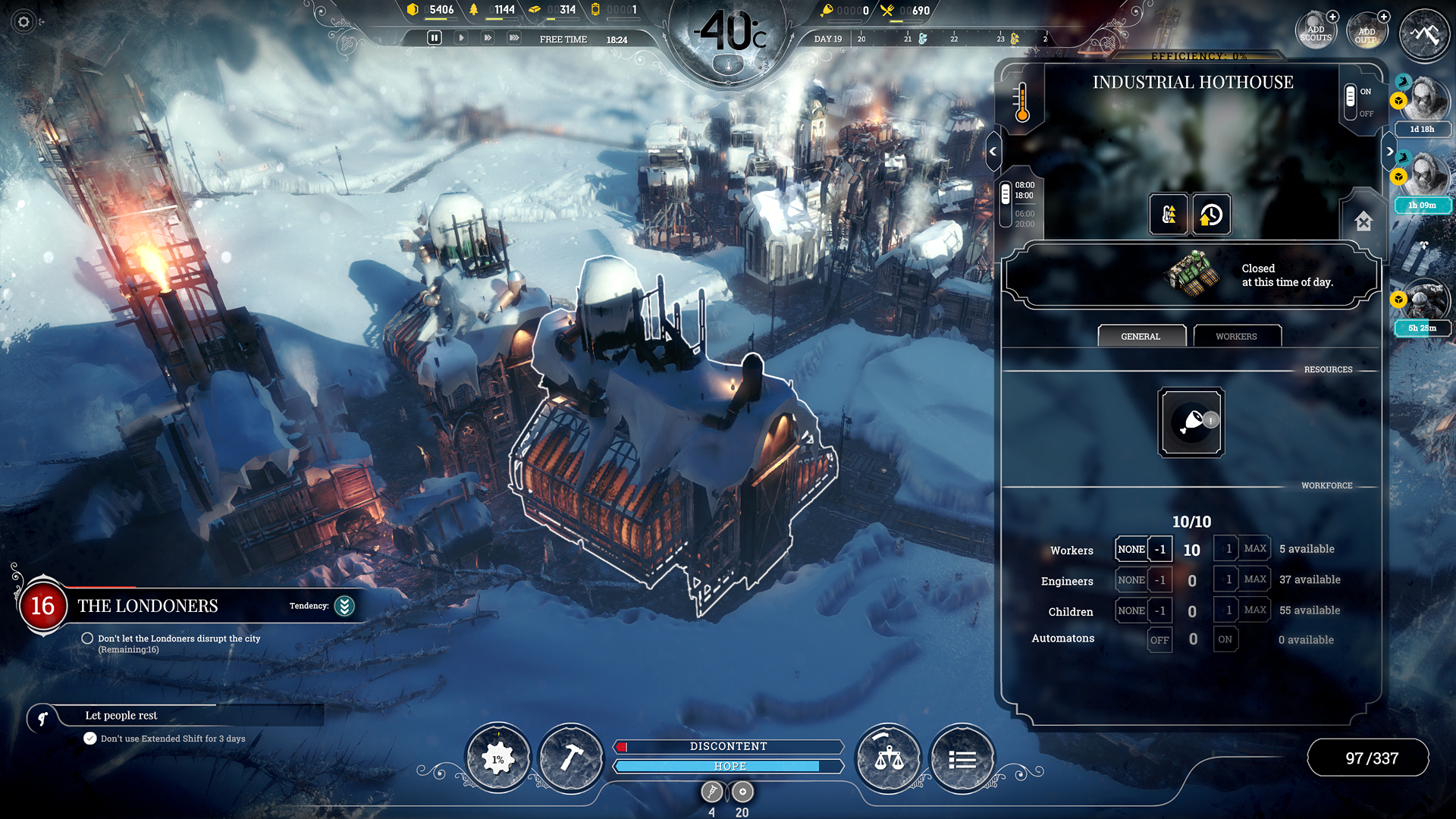
At around hour seven, I passed a law that forced injured workers back onto the job before they had healed. The temperature had dropped to minus forty-seven Celsius, two of my coal trawlers had broken down, and the generator — the single iron heart keeping eight hundred people alive — was six hours from going cold. I told myself it was a temporary measure. By hour twelve, I had a child labour law, a mandatory fourteen-hour workday, and a propaganda centre broadcasting state-sanctioned hope to citizens who had stopped believing in it on their own. I had not lost a single person to the frost. I had become something else.
Frostpunk — 11 bit studios's survival city-builder set in an alt-history 1886 where volcanic winter has ended civilisation as anyone knew it — is not a new game. The original launched in 2018 and was, by any serious measure, the best thing to happen to the city-builder genre that decade. Frostpunk 2, which arrived in September 2024, is what happens when a studio decides to complicate its own thesis rather than just expand it. After thirty-two hours across the Utopia Builder mode and two full runs of the Frostland campaign, the picture is clear enough to be worth reporting properly.
The generator as moral argument
The first game's central conceit was a single generator in a crater, and everything — the labour laws, the faith mechanics, the dread of each approaching Frost Night — radiated outward from it. That design kept the original tight in a way that sequels rarely preserve. 11 bit studios made the reasonable decision to scale up for Frostpunk 2, and the new city is built in districts rather than individual buildings, with political factions replacing the earlier, more personal social-pressure system. It is a sensible evolution on paper. In practice, the intimacy contracts.
 Atmospheric detail in Frostpunk.
The first game made you feel every shovel of coal. The sequel operates at a remove that is, for much of its runtime, clearly intentional — you are now more governor than foreman, and the systemic tension shifts from individual survival to institutional control. Whether that trade-off works depends largely on your tolerance for abstraction. Some players will read the district system and the council voting mechanics as a richer political simulation. Others will spend forty minutes in the first act wondering why the thing that made Frostpunk distinctive seems further away.
The Book of Laws, still the best mechanic in the genre
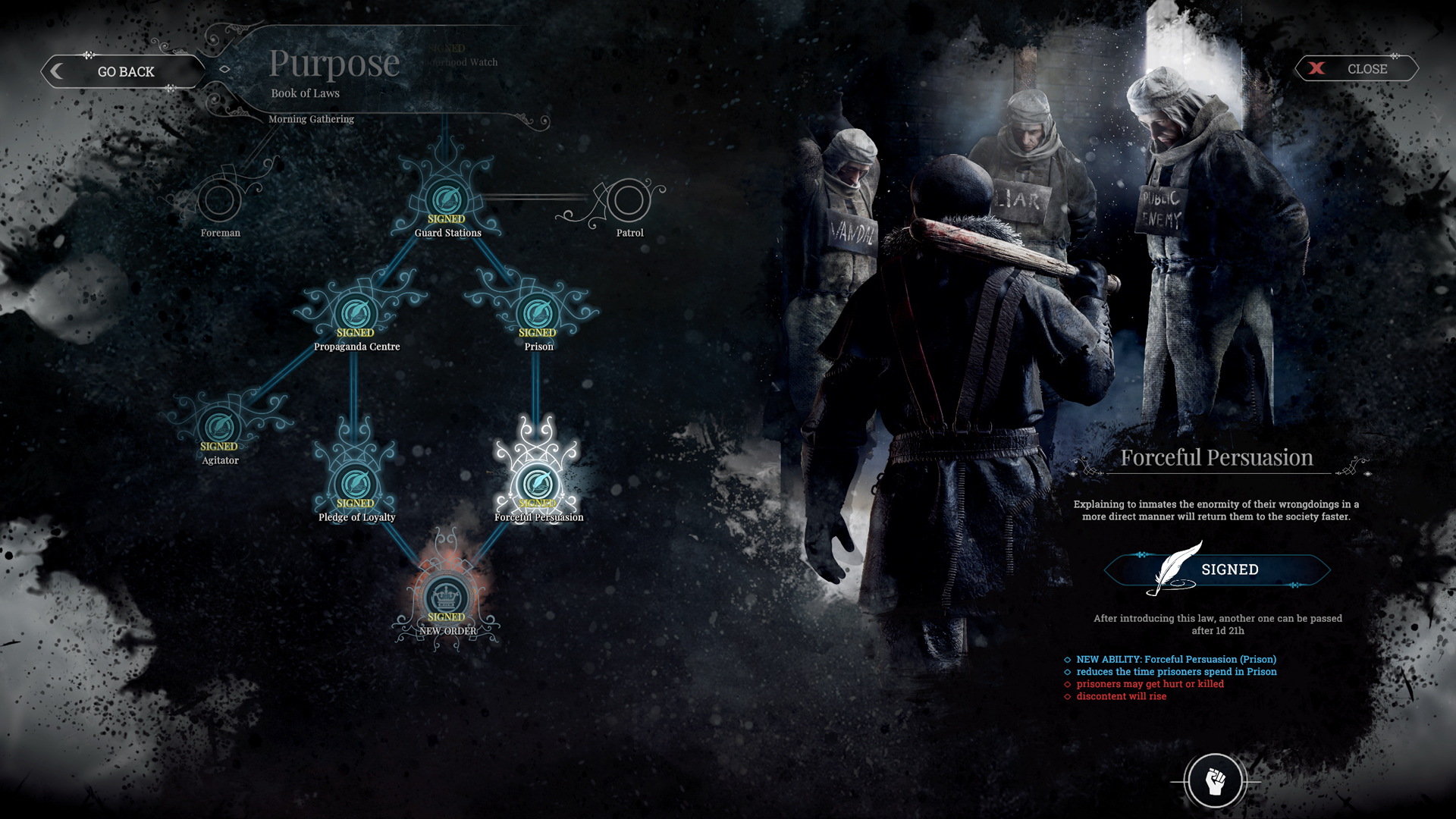
What remains sharp across both games is the law system, and Frostpunk 2 extends it in ways that actually justify the sequel's existence. The original's binary choices — extended shifts or emergency shifts, faith keepers or the order — were already more sophisticated than the genre average; they had downstream consequences that arrived late enough to feel like punishments for decisions you had almost forgotten making. The sequel's council system adds factional buy-in as a prerequisite for passing legislation, which means laws you desperately need can be blocked by factions whose prior demands you ignored or outright antagonised.
This is, mechanically, what good governance simulation looks like. The Pilgrims faction wants open borders and will block heating expansion if you have spent three votes antagonising them. The Stalwarts want order and output and will cheerfully support emergency work laws that your Frostlander population finds dehumanising. You cannot please everyone, and the game is careful enough about this tension that it rarely feels arbitrary — when a law fails to pass, you can usually trace the failure back to a specific sequence of choices three or four hours earlier. That legibility is what separates Frostpunk 2 from city-builders where failure arrives without clear parentage.
 Combat encounter in Frostpunk.
One specific example: in my second campaign run, I had prioritised the Foragers' food network early, which earned me Frostlander support. By the midgame, this meant I had the votes to pass a scavenging rights law that unlocked rare Frostland resources — but the same Frostlander majority blocked my industrial coal extraction bill, forcing a heating crisis I spent six in-game weeks digging out of. The system rewards coherent political strategies and punishes the impulse to optimise each vote in isolation. It is one of the more honest portrayals of coalition governance any game has attempted.
Scale versus texture
The district-building layer is the sequel's most discussed departure, and it earns mixed marks. Building entire districts rather than individual structures accelerates mid-game pacing significantly — you are never stuck placing single buildings for thirty minutes while the temperature ticks down — but it also removes the granular spatial logic that made the original's city feel physically real. In Frostpunk 1, the placement of a medical post relative to your industrial zone had legible consequences for worker sick time. In the sequel, districts snap into zones and the spatial storytelling largely disappears.
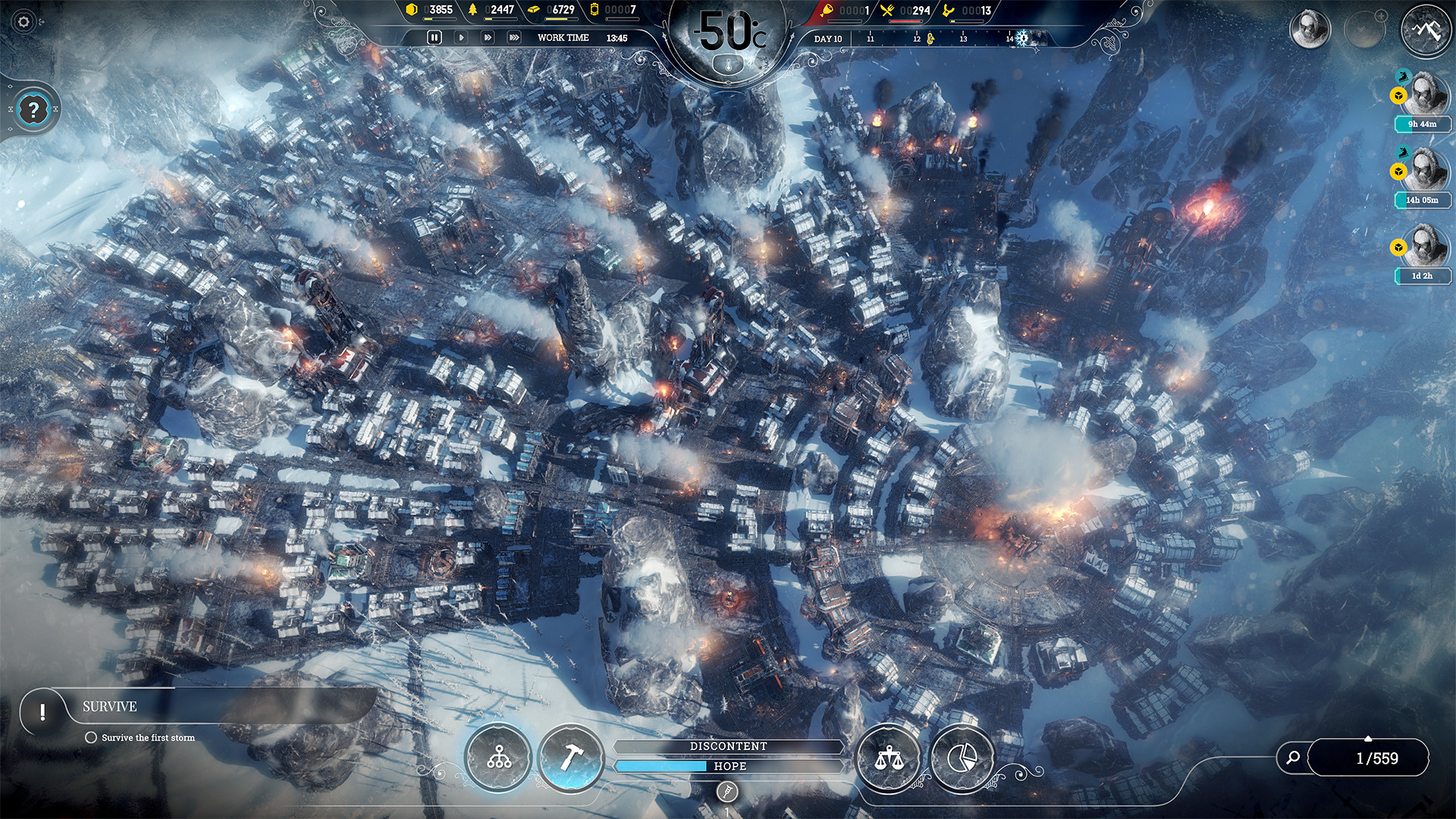
This is a genuine loss, and the game does not fully compensate for it. The visual spectacle of a growing steampunk megacity is considerable — the art direction remains exceptional, particularly the way blizzard conditions change the palette and obscure district edges — but the city reads more as a dashboard than a place. Games like Anno 1800, or even the much smaller Against the Storm from Hooded Horse, maintain a sense of physical consequence in their layouts. Frostpunk 2's map sometimes feels like a very good infographic about a city rather than the city itself.
The Frostland, and why exploration still works
Away from the city, the Frostland expeditions remain one of the best pieces of design 11 bit has produced. Sending teams across a procedurally structured wasteland map, managing their heat and supplies in a separate resource layer, choosing whether to push deeper into a blizzard corridor for a caches of resources or pull back before a team is lost — this is where the sequel's pacing sharpens up considerably. The Frostland feels dangerous in a way that the city, for all its death tallies, sometimes does not.
The narrative fragments discovered during expeditions also carry more weight than the main city's story beats, possibly because they are delivered in smaller doses. Finding the frozen remains of a previous settlement, reading the last administrative records of a captain who made different choices than you did, is the kind of environmental storytelling that Frostpunk has always done well. The sequel does not abandon this; it just buries it under more systems than the first game required.
What thirty-two hours actually costs you
There is a version of Frostpunk 2 that would score higher if the question were purely mechanical ambition. The faction system is genuinely novel. The law tree has real depth. The Utopia Builder mode, which strips away the campaign pressure and lets you run a city across decades, has a long-term resource management complexity that most builders abandon after the first hour. As a design document, this is a serious and considered work.
As an experience, it carries friction that the first game resolved by keeping its scope tighter. The interface, even after two major patches, asks more of you than it gives back in clarity — tooltip chains that require three clicks to resolve a single resource question, council session UX that obscures which faction is blocking what until you have already wasted a vote. These are not trivial complaints. At the difficulty level where the game becomes genuinely interesting, the interface friction becomes a second opponent you did not ask to fight.
Where it actually lands
Frostpunk 2 is better than most of what the survival city-builder genre has offered in the last six years, and it is not as good as Frostpunk 1. Both of those things are true simultaneously, and neither should be treated as a verdict on whether you should play it. If you have not played the original and are coming in cold, the sequel's systems will impress more than they will frustrate. If the first game's specific texture — the manual, almost domestic scale of keeping one cold city alive — is what drew you in, the sequel trades that for something wider and somewhat colder in a different sense.
What stays with you after thirty-two hours is the same thing that stayed with you after ten hours of the first game: the memory of the specific law you passed when you were desperate, and the slow accumulation of evidence that it changed what your city was allowed to become. That is the thing 11 bit studios has not lost. The generator may be bigger now, the population numbers six figures rather than hundreds, the political machinery more elaborate — but you are still the person who signed the paper. That weight is real. Whether the game surrounding it is quite worthy of it is a closer question than it should have been.
Editorial scoring
Reader Q&A
How long does it take to finish Frostpunk doesn't let you be the hero you wanted to be?
Main story runs around 32 hours depending on how thoroughly you explore. Completionists can spend 2-3× that.
Is Frostpunk doesn't let you be the hero you wanted to be good for newcomers to Survival City-builder?
For total newcomers, expect a 5-8 hour ramp-up. Once you internalize the loop, it clicks.
Which platform should I play Frostpunk doesn't let you be the hero you wanted to be on?
Console version is the most stable on launch. PC version benefits from the modding scene long-term.
Was Frostpunk doesn't let you be the hero you wanted to be worth the launch-day price?
Depends on backlog. The replay value justifies the price for genre fans; casual players should wait for a 40%+ discount.
Are there DLCs or expansions worth picking up?
Wait for the Game of the Year edition — it bundles everything at a fair discount.
What did 11 bit studios get right (and what could be better)?
The systems are confident and the combat is satisfying. The story handoffs and load times are the rough spots.
Reader comments