
Helldivers 2 is at its best when everything goes wrong
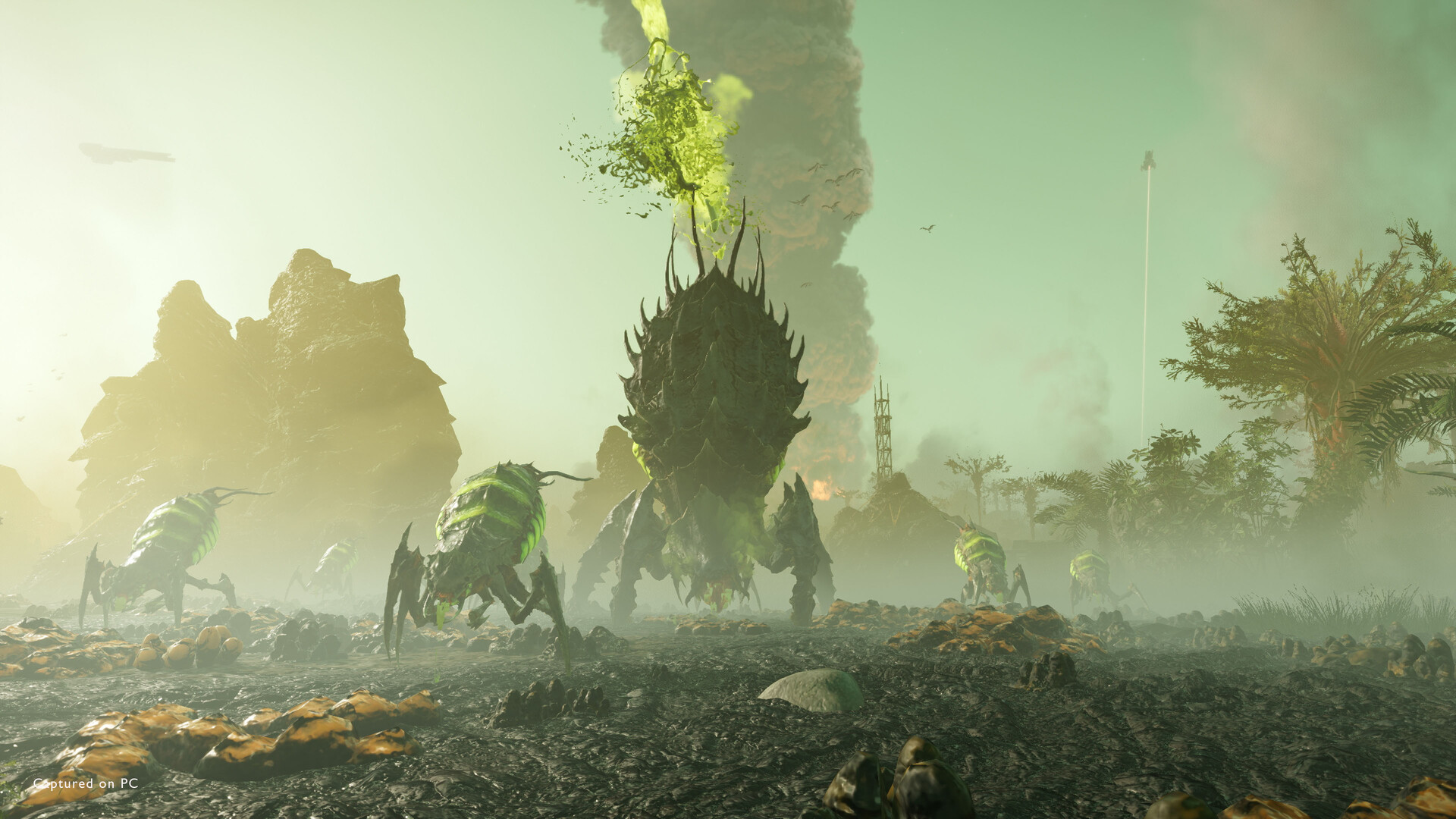
Somewhere around hour six, I called in an Orbital Laser strike on my own position by accident, vaporised two teammates, and then watched the third get crushed by the resupply pod I panic-ordered to compensate. We failed the mission. Nobody quit. We laughed for about forty-five seconds, regrouped on the destroyer, and dropped back into the same Terminid-infested canyon immediately. That sequence — catastrophe, laughter, regroup, retry — is not an edge case in Helldivers 2. It is the product Arrowhead Game Studios is selling, and after eighteen hours with it, I am fairly convinced they knew exactly what they were building.
Helldivers 2 is a third-person co-op shooter about spreading managed democracy across a hostile galaxy, which is satire thin enough to see through but sturdy enough to hold the whole experience together. You and up to three others drop onto procedurally configured planets, complete one or several objectives under a time limit, then extract — or die trying, which happens constantly and usually in ways that are at least partly your own fault. The game launched in February 2024 and, rather unexpectedly, pulled numbers that briefly broke Steam's concurrent-player records for a Sony-published title. The question worth asking is not why it was popular, which is obvious enough, but whether it is actually good — and where the design cracks are.
The Stratagem System Is the Real Game
Most co-op shooters give you weapons and let you sort it out. Helldivers 2 layers a second input language on top of the shooting: Stratagems, which are called in by entering directional code sequences on the left stick, Mid-combat, while enemies are actively trying to remove your limbs. The Orbital Railcannon Strike is Up, Right, Down, Down, Right. The Eagle Airstrike is Up, Right, Down, Up. You will mistype these. You will mistype them at exactly the moment it matters most. And the game is designed to let that happen, because the tension between knowing the sequence in your muscle memory and executing it correctly under pressure is where a substantial amount of the drama lives.
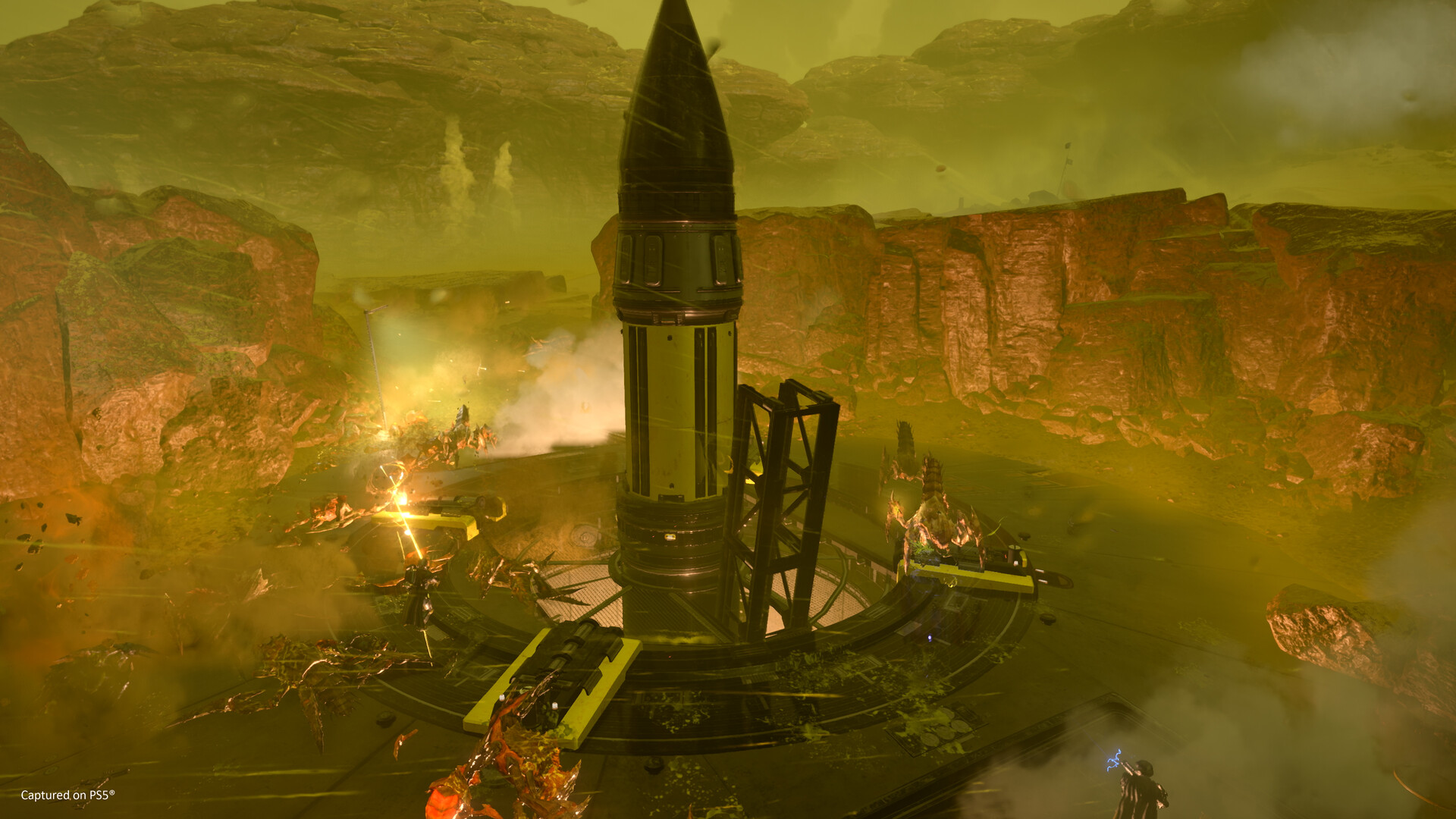 Scene from Helldivers 2.
What makes the system clever rather than merely punishing is that Stratagems are not equally weighted. Some — like the Resupply or the basic Orbital Precision Strike — are low cooldown workhorses you lean on constantly. Others, like the Orbital Laser or the Eagle 500kg Bomb, have long cooldowns and the destructive radius of a small catastrophe, which means deciding when to spend them is a genuine tactical decision rather than a reflexive button press. The game trusts you to construct your loadout before a mission and then live with those choices planetside, which is a design philosophy closer to Deep Rock Galactic's class-based preparation than to the more freewheeling kit-swapping of something like Remnant 2.
The four-person squad limit also means Stratagem overlap becomes a conversation. Bringing two Orbital Laser users is redundant; coordinating so that one player covers anti-armour and another handles crowd control produces noticeably better results. Arrowhead never explicitly teaches you this — there is no tooltip explaining squad composition theory — but the game's difficulty curve makes it legible through failure, which is the right way to teach it.
Friendly Fire Is Not a Bug
Helldivers 2 has full, permanent, non-optional friendly fire. This is load-bearing. Every decision you make about where to stand, where to throw, where to call a strike — all of it carries consequence not just for the enemies in front of you but for the people beside you. The Expendable Anti-Tank launcher has a backblast. The cluster bombs scatter unpredictably. The Autocannon's shells do not care whether the thing they hit is wearing a democracy-approved helmet. Teammates die to teammates constantly, and the game tracks kills-against-allies with the same cheerful bureaucratic detachment it applies to everything else.
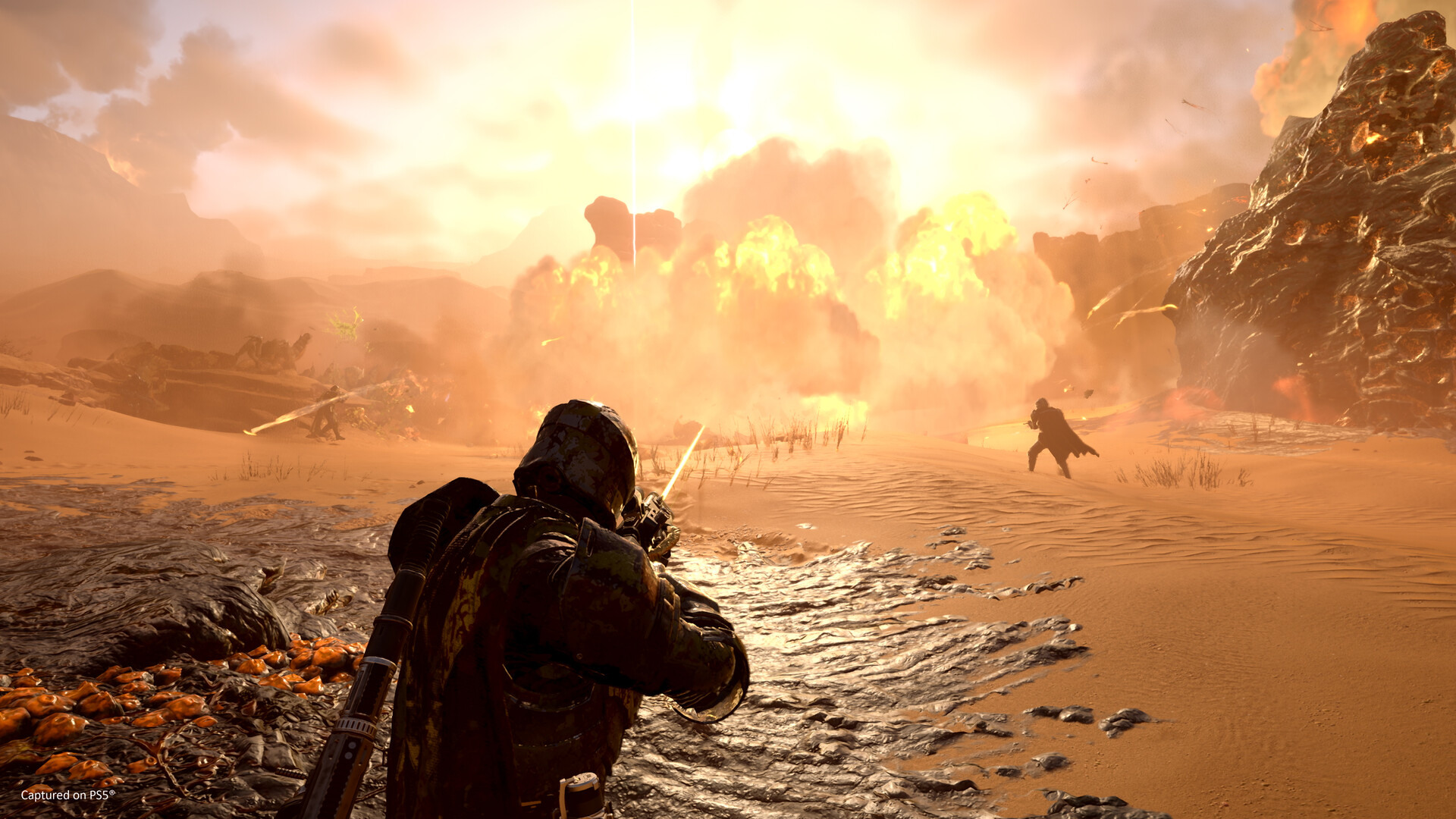 Scene from Helldivers 2.
Other co-op shooters have flirted with this — Vermintide 2 has friendly fire on higher difficulties, and Deep Rock Galactic makes it optional — but few commit to it as a default, non-negotiable condition of play. The effect is that spatial awareness becomes a skill. You develop habits: calling out before you drop a pod, marking where you are before a teammate fires support, learning which Stratagems have unpredictable scatter and giving them wider berth. None of this is in the tutorial. All of it is necessary.
The Enemy Factions Are Doing Different Jobs
The two main enemy factions — Terminids (insectoid, fast, numerous) and Automatons (robotic, ranged, armoured) — are not reskins of each other, which matters more than it might sound. Fighting Terminids at high difficulty is about managing swarm density and keeping your footing while something large and armoured charges you from one direction and a hundred smaller things skitter in from four others. The threat geometry is close-range and chaotic. Fighting Automatons is slower, more deliberate; they shoot back accurately from distance, their hulking Devastator units soak incoming fire, and the correct response is cover and positioning rather than the frantic kiting that gets you through a Terminid breach.
This means the effective loadout against one faction is frequently suboptimal against the other, which gives the mission-selection screen actual strategic weight. A squad geared for Terminid incursions — lots of area-denial, incendiary options, light anti-armour — will have a hard time against an Automaton base assault without adapting. Arrowhead could have smoothed this over and made the factions feel interchangeable for the sake of accessibility. They did not, and the game is better for it.
Where It Starts to Fray
The progression system is less interesting than the combat it surrounds. Requisition Slips, Medals, Super Credits — the currency stack is longer than it needs to be, and unlocking Stratagems through the Ship Modules tree requires enough passive grinding that the early hours can feel artificially constrained. By hour four I had a clear sense of which tools I wanted and a clear sense that I was not going to have them for another three sessions of missions I had already mentally solved. Deep Rock Galactic handles this better: its unlocks feel like genuine expansion of possibility rather than a gate on catching up to the game's own design ambitions.
Server stability at launch was, charitably, poor. Connection failures during extraction — the moment of highest tension, when you have survived the mission and are simply trying to leave — produced a specific kind of frustration that no amount of good mission design could fully absorb. Arrowhead has patched aggressively since launch, and the situation is meaningfully improved, but it is worth noting that a game whose entire design proposition rests on shared chaotic experience is unusually fragile when the servers are the chaos-generator rather than the planets.
The Galactic War Is a Clever Frame, and Also a Little Hollow
The live-service layer — the Galactic War, in which all active players collectively push front lines across a persistent star map — is the part of Helldivers 2 that generates most of its community conversation and also the part I find hardest to evaluate. On one level it is a genuinely interesting extension of the co-op conceit: your individual missions contribute to a larger campaign, major orders from Super Earth High Command push players toward specific planets, and the fiction that your squad is one unit among millions actually holds because millions of people are playing. The Malevelon Creek moment — where the community organised an extended, eventually failed defence of a single Automaton planet — became a genuine piece of shared cultural memory in the span of a week.
On another level, the individual player's influence on that macro campaign is nearly imperceptible, and the Galactic War's outcomes are clearly authored by Arrowhead rather than genuinely determined by player action. That is probably the correct design choice — a truly player-determined campaign would be impossible to balance — but it creates a slight dissonance between the narrative claim (your contribution matters) and the mechanical reality (it matters approximately as much as one vote in a very large election). The frame is fun. It just does not bear too much scrutiny.
Where It Lands
Eighteen hours in, Helldivers 2 sits comfortably above Payday 3 and well below the structural elegance of Deep Rock Galactic in my personal co-op shooter ranking — which is not a dismissal, because Deep Rock Galactic is one of the better-designed games of the last decade. What Arrowhead has built is a game that is mechanically honest about what it is: a controlled catastrophe generator, a machine for producing stories about things going wrong in funny and occasionally heroic ways. The Stratagem input system is the clearest expression of this — it introduces fallibility at the level of individual player action and then makes that fallibility social, visible, and recoverable.
The progression could be leaner, the server infrastructure needed to be better at launch, and the Galactic War is better as atmosphere than as system. But none of that is why you play Helldivers 2. You play it because you called in a resupply pod on your own teammate and you are still laughing about it two sessions later. Arrowhead built a game around that specific feeling, and it is harder to engineer than it looks.
Editorial scoring
Quick facts
How long does it take to finish Helldivers 2 is at its best when everything goes wrong?
Main story runs around 32 hours depending on how thoroughly you explore. Completionists can spend 2-3× that.
Is Helldivers 2 is at its best when everything goes wrong good for newcomers to Co-op Shooter?
For total newcomers, expect a 5-8 hour ramp-up. Once you internalize the loop, it clicks.
Which platform should I play Helldivers 2 is at its best when everything goes wrong on?
PC version offers the highest fidelity if your rig can handle it. Console versions are polished out of the box.
Was Helldivers 2 is at its best when everything goes wrong worth the launch-day price?
Depends on backlog. The replay value justifies the price for genre fans; casual players should wait for a 40%+ discount.
Are there DLCs or expansions worth picking up?
Skip the cosmetic DLC. The story expansion is the only one we'd recommend at full price.
What did Arrowhead Game Studios get right (and what could be better)?
Strongest: art direction, audio design, set-piece variety. Weakest: late-game balance and a few persistent quest-log bugs.
Reader comments