
Hitman 3 — Mendoza's high-stakes finale, examined
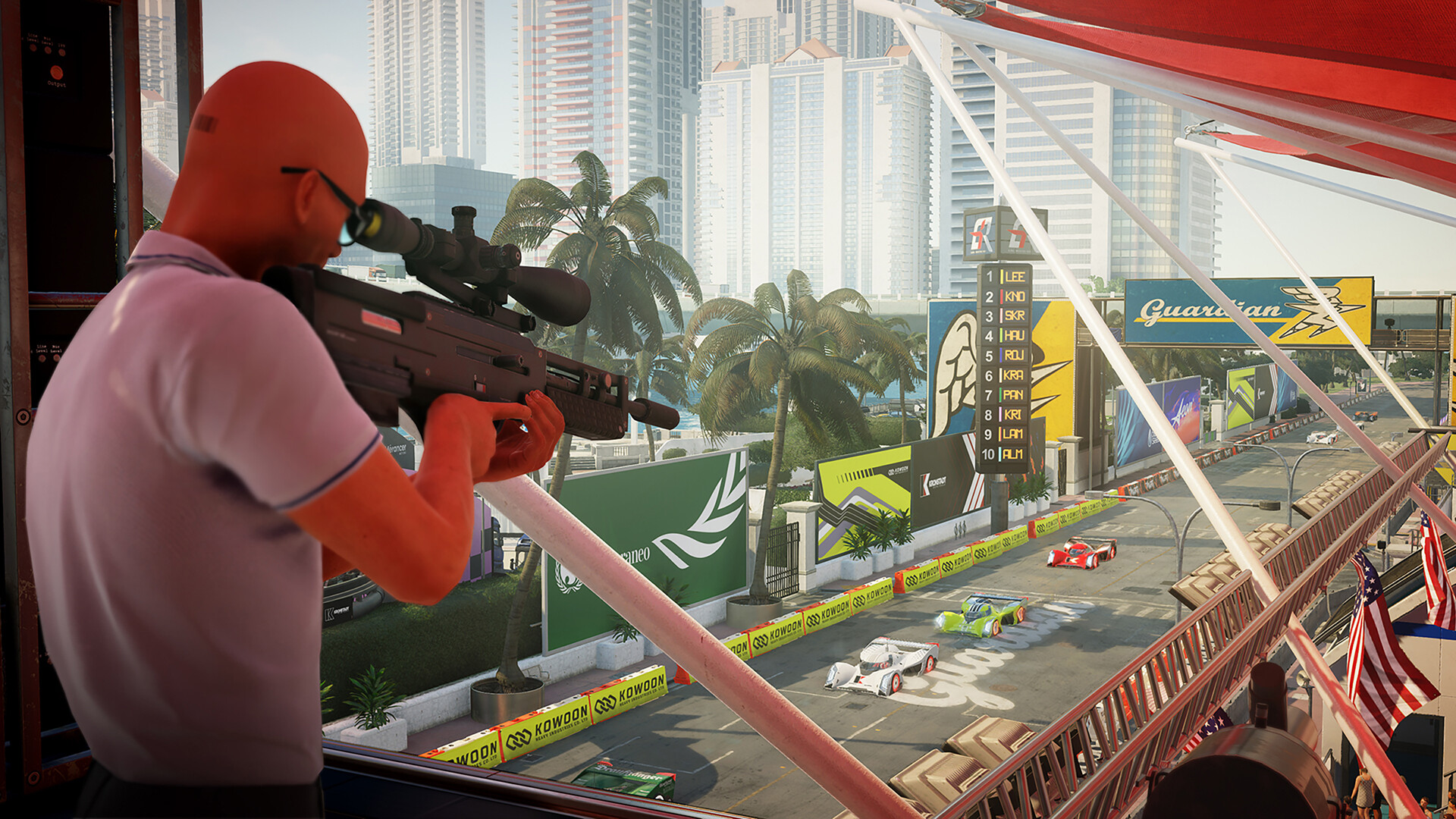
A man in a pressed suit stands at the edge of a vineyard at golden hour, swirling a glass of Malbec while a private security convoy circles the estate below. That's the opening image of Mendoza, the penultimate level in Hitman 3, and IO Interactive is not being subtle about its influences. This is a heist-movie set-piece dressed up as a wine-tasting — the social engineering, the layered disguise system, the timed window for a clean exit. The fact that there are no vault doors or laser grids doesn't matter. Every design choice in this level is fluent in the grammar that Ocean's Eleven and Heat (1995) codified for the genre.
The heist subgenre in games has a long tradition of borrowing that cinematic vocabulary. The Diamond Casino Heist mission in Grand Theft Auto V structures its infiltration around approach vectors, crew roles, and a getaway logic that comes directly from Michael Mann's blueprint. Payday 3's casino vault scenario takes inspiration from cinematic heist films so openly that it barely bothers disguising the source material. Mendoza sits in this company, and what makes it worth examining is how IO achieves the same narrative tension without a single line of dialogue about cracking a safe.
The Social Layer Is the Heist
Most heist set-pieces in games treat social engineering as a wrapper — a cutscene justification before the action starts. Mendoza makes it the whole structure. Agent 47 arrives as a wine buyer, and the level's opening third is entirely about acquiring access: finding the right conversation, wearing the right face, being in the right place when a target decides to confide. There's no ticking clock on screen. The pressure is architectural.
 Scene from HITMAN World of Assassination.
IO's World of Assassination trilogy refined this over three games, but Mendoza represents the system at its most confident. The estate is divided into social zones — public terraces, a private cellar, a restricted security wing — and each requires a different identity to traverse. The game tracks suspicion through a contextual awareness model rather than a simple visibility cone, meaning a guard who doesn't recognize your face will clock the way you're walking before he checks your name tag. That specificity is what separates Hitman's infiltration logic from Watch Dogs 2's more permissive hacking fantasy, where social disguise is largely decorative.
The mission's two primary targets, Tamara Vidal and Don Yates, are never in the same room at the same time during their scripted cycles. That's not an accident. IO is forcing the player to run two parallel confidence operations simultaneously, keeping one mark engaged while maneuvering on the other. It's a direct translation of the ensemble-juggling structure from heist cinema — the distraction and the execution happening in separate rooms while a third party holds the perimeter.
Level Architecture as Risk-vs-Reward Design
The Mendoza estate is roughly 40% larger than Berlin's Berghain level from the same game, but it feels more constrained because IO has carefully segmented it. Open terraces bleed into choke-pointed corridors that lead to high-security interiors, and each transition is a decision point. You can clear access legitimately, which takes time and exposes you to multiple NPC routines, or you can find shortcuts that are faster but noisier. The risk-vs-reward curve running through those choices is the same one that makes the Mafia trilogy's narrative-mission design compelling — momentum versus caution, always in tension.
There's a wine cellar sequence midway through the level that crystallizes this. To reach Don Yates in his private tasting room, the player can either acquire the sommelier disguise through a legitimate three-step social chain, or move a single unconscious body into a blind spot and take his jacket directly. The first route is cleaner on exit but costs around eight minutes of real time. The second route is a 90-second shortcut with a 40-second window before the body is found. IO never tells you this. You have to read the patrol timings yourself, which is exactly the kind of operational literacy that heist films present as expertise — the protagonist who sees the rotation before the mark even finishes their drink.
The Heist Subgenre's Debt to Setting
Part of what the heist genre sells, in games and in film, is the location itself. Ocean's Eleven is inseparable from the Bellagio. Heat is inseparable from Los Angeles's industrial nightscape. Mendoza leans hard into this logic — the Argentine vineyard isn't just a backdrop, it's an active element of the mission design. Sightlines are broken by rows of vines. Sound carries differently across open ground than through the stone corridors of the main house. A target's outdoor schedule depends on the time of day, which the player can manipulate through story beats.
Compare this to how the New Vegas Strip operates as a hub-zone with branching faction quests in Fallout: New Vegas — the setting does ideological work there, staging the conflict between the NCR's exhausted democracy and House's technocratic control against the neon backdrop of a resource everyone wants. Mendoza is operating on a smaller canvas, but it's doing similar work: the vineyard represents old-money power, inherited influence, the kind of control that doesn't need visible security because it's built into the landscape. That's the actual target, not just the two people standing in it.
Yakuza's arcade and cabaret club subgames demonstrate Sega's commitment to side-content depth, but they work because they're embedded in districts that feel like real places — Kamurocho has density and specificity. Mendoza has the same quality at mission scale. IO's environment team built a functioning estate logic: staff rotation, maintenance schedules, vendor arrivals. The level reads as a place that would exist without 47 in it, which is the hardest thing to achieve in this kind of design.
Narrative Stakes and the Question of Earned Resolution
Hitman 3's story has been a persistent weak point across the trilogy — the Constant, the Providence conspiracy, 47's engineered past — all of it gestures at psychological depth without fully committing. Mendoza is where the script gets closest to mattering. The revelation about Diana Burnwood's role in the mission comes through a cutscene that recontextualizes the player's entire run through the level, and IO has the confidence to deliver it after the targets are already dead. The heist is over. The betrayal lands in the silence.
This is structurally similar to how the Mafia trilogy's narrative includes mob-owned venues that drive the story arcs — the setting carries thematic weight that the dialogue alone can't support. In Mafia II, the mob offices and warehouses aren't just locations; they're arguments about what that world costs. Mendoza makes a similar argument. The vineyard is beautiful and the people who own it are monstrous, and IO keeps both of those facts in frame simultaneously.
What the Level Gets Wrong
For all its craft, Mendoza has a pacing problem on repeat runs. The mission's density — which reads as richness on a first playthrough — becomes friction on subsequent attempts. The three-step disguise chains that felt like elegant design on discovery feel like mandatory queuing on run four. Berlin's Berghain level solves this through target ambiguity: you don't know which of the 11 ICA agents you're hunting until you find them, so each run has genuine variance. Mendoza's targets are fixed, their schedules are fixed, and once you know the layout, the social-engineering layer deflates.
This is a structural tension in Hitman's design generally — the game rewards mastery by making mastery feel like going through motions. Payday 3's approach to replayability leans on procedural element shuffling to avoid this, even if the execution is uneven. IO has tried to address it through Elusive Targets and escalations, but those exist outside the main campaign. Within Mendoza itself, there's no equivalent of the freedom Berlin gives you.
The Genre at Its Best
The heist-game subgenre works best when it makes you feel like the smartest person in a room full of people who don't know you're there. Mendoza achieves that on a first run in a way that few levels in the trilogy match. The social-engineering mechanics are doing real work, the setting is specific and atmospheric, and the narrative payoff lands harder because IO trusted the player to have already solved the puzzle before telling them what it meant.
It's not a perfect level. The replayability curve drops off sharper than it should, and the story it's embedded in never quite earns the weight IO places on this particular mission. But as a piece of heist-subgenre design — as an argument about what games can do with the grammar that cinema built — Mendoza is one of the stronger examples the medium has produced. The suit fits. The Malbec is a prop. The real work is reading the room before the room reads you.
Editorial scoring
Reader Q&A
What's the standout set-piece in HITMAN World of Assassination like?
Mission-driven and well-paced. Multiple approach angles — stealth or loud — and consequences depend on enemy AI and scripted triggers. Most players settle into a rhythm by the second attempt.
How long is the major mission arc in HITMAN World of Assassination?
Around 4-8 hours depending on how thoroughly you scout. The full campaign is significantly longer; this arc is one set-piece among many.
Do I need prior series knowledge before playing HITMAN World of Assassination?
Most entries in this lineage stand alone. Helpful context if you've played the predecessors, but not required. Each title resets the player's frame of reference.
What makes a heist-style sequence land?
Sightline clarity, NPC density, audio cues, set-piece pacing. When all four align, the sequence is memorable. When even one's off — say, flat NPC behaviour — it falls flat.
Is HITMAN World of Assassination accessible to newcomers to the genre?
Generally yes. Systems are introduced gradually and difficulty is forgiving on default. Veterans will get more from the deeper systems, but the surface layer welcomes new players.
Which films influenced this design lineage?
Soderbergh's Ocean's Eleven, Mann's Heat, and Scorsese-era crime films are the obvious roots. Designers from this subgenre have cited those films in interviews going back twenty years.
Reader comments