
Like a Dragon: Infinite Wealth is the JRPG that actually earns its runtime

Ichiban Kasuga is broke, sunburned, and trying to sell fish by the roadside on the outskirts of Honolulu when Like a Dragon: Infinite Wealth properly introduces its stakes. Not through a cutscene about the fate of the world — that comes later — but through the quiet humiliation of a man whose life has collapsed twice over and who still insists, with the particular stubbornness of a Dragon Quest obsessive, that things will work out. It is a strange way to open a hundred-hour JRPG. It is also exactly the right one.
Ryu Ga Gotoku Studio has made long games before. Yakuza: Like a Dragon ran around sixty hours if you engaged with it honestly, and that was considered sprawling for the series. Infinite Wealth is considerably bigger: a dual-protagonist structure, a new Hawaiian setting running alongside the familiar streets of Yokohama, and a combat system rebuilt with enough new moving parts that returning players will need a session or two to stop fumbling. The question with any game at this scale is not whether it is long, but whether the length is doing something. Here, for most of the runtime, it genuinely is.
Combat that has actually moved forward
The turn-based foundation introduced in Yakuza: Like a Dragon is still here, but Infinite Wealth adds positioning in a way that changes how you read each encounter. Characters can now move freely within a radius before acting, which means chaining knockbacks into walls or off ledges stops being incidental and starts being a habit you build deliberately. Landing an enemy in a group for splash damage, then following up with a job-specific skill that hits in a line — that loop becomes muscle memory by the midgame, and it is satisfying in the way that Octopath Traveler's break system is satisfying: a small mental puzzle attached to each fight.
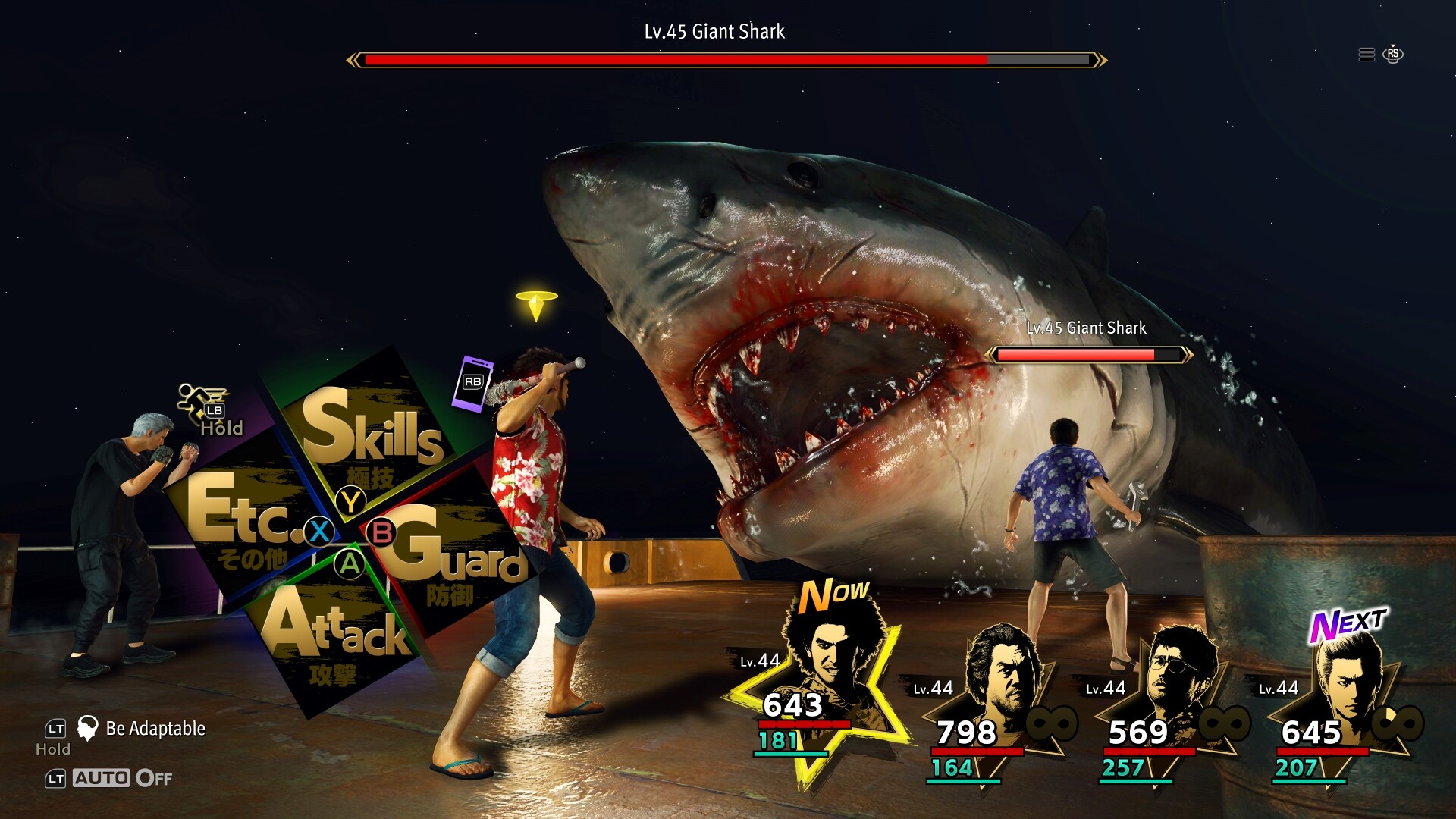 Scene from Like a Dragon: Infinite Wealth.
Job classes return and expand significantly. Ichiban's roster eventually stretches to around twenty-plus jobs, several of which have to be unlocked through side content rather than the critical path. The Pyrodancer and Geodancer classes, exclusive to female party members, lean into positional combos in ways that reward building around them rather than just slotting in whoever has the highest stats. There are some jobs that never stop feeling like filler — the Bodyguard class exists mostly to tick a thematic box — but the majority of the system has enough internal logic that you will spend more time in the menu than you expect and not resent it.
Hawaii as a setting, not just a backdrop
Honolulu, or rather the game's Honolulu-adjacent fiction, Honolulu, does something the Yakuza series rarely needs to do: it has to justify existing. Kamurocho works because it is a compressed, hyperreal version of Kabukicho that the studio has been refining since 2005. A new map does not have that accumulated texture. What saves Kalani Valley and the surrounding districts is that the design team resists the temptation to make Hawaii a postcard. The shopping streets are mid-range and slightly worn. The beach areas have homeless encampments as part of the story geography, not just as grim decoration.
The Sujimon system — essentially a parody of Pokémon that has you cataloguing and battling Hawaiian street characters — is also doing location work. It is ridiculous, clearly, but it forces you to walk every block of the map with attention rather than sprinting between quest markers. By the time you have hunted down a variant Sujimon hiding behind a food truck in a back alley, you know that alley. The city becomes legible in a way that open-world maps in games like Forspoken or Hogwarts Legacy rarely manage, because you have reasons to look at it closely that are not just checklist completion.
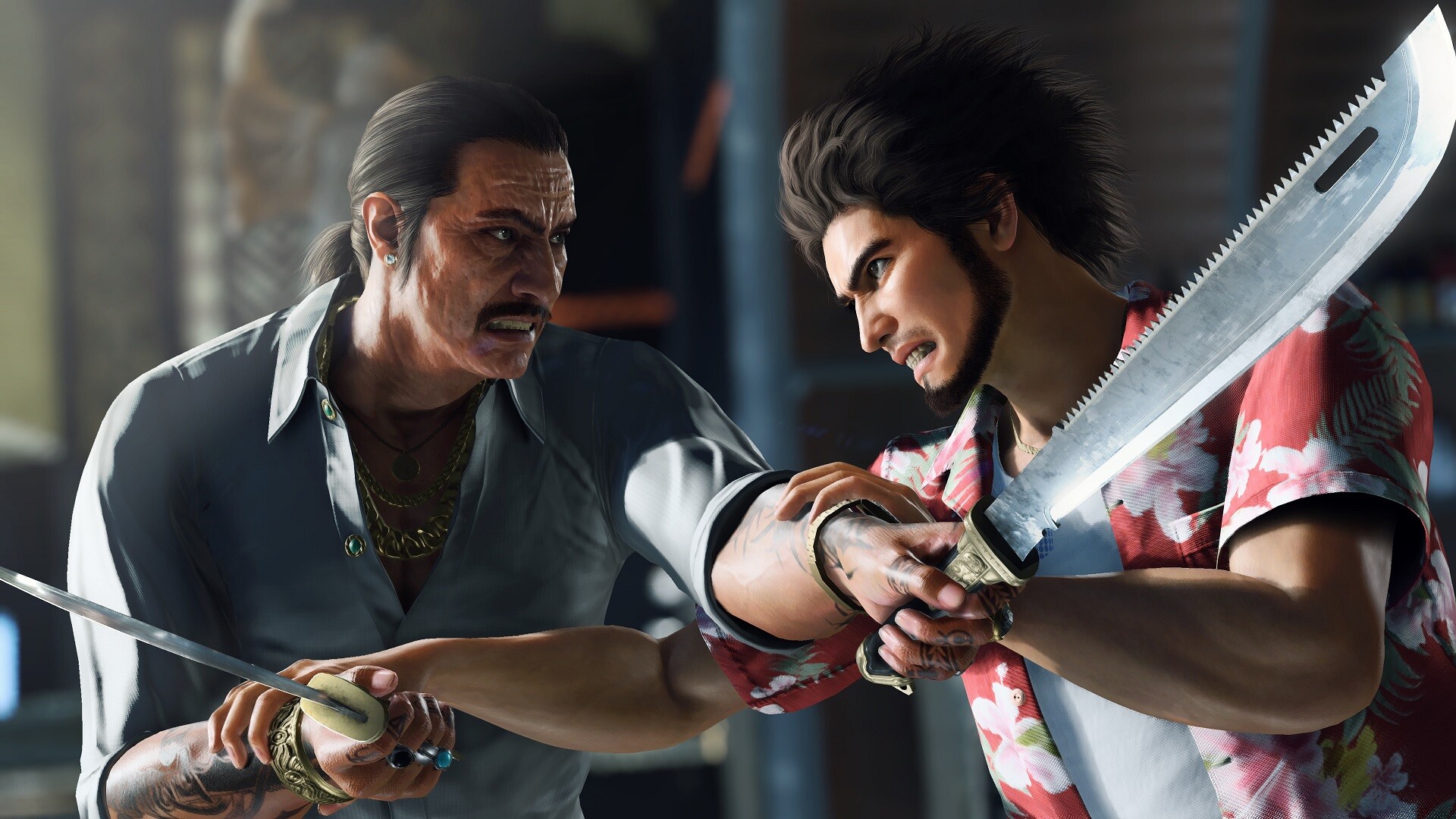 Scene from Like a Dragon: Infinite Wealth.
The dual-protagonist structure and what it costs
Kiryu returns, and his sections carry a specific weight this time: he is dying. Lung cancer, worked through slowly across substories and a set of dedicated bond scenes that are among the most carefully written things RGG Studio has produced. There is a quiet scene in a Honolulu convenience store, Kiryu buying cigarettes out of habit and then putting them back, that earns its moment without editorial comment. The game trusts you to sit with it.
The structural cost of splitting between two protagonists is that momentum sometimes fragments. The early chapters shuffle awkwardly between Ichiban's story thread and Kiryu's, and there are two or three transitions in the first act that feel like the game switching tabs rather than cutting with purpose. It smooths out after Chapter 5 or so, when the two narratives have enough forward motion that interleaving them creates tension rather than interruption. But the opening hours are the place where an impatient player might check out, and that is a real editorial flaw in something asking this much of your time.
Side content, and the question of what earns the word 'optional'
Infinite Wealth has roughly forty-five substories in Honolulu alone, plus a separate set in Yokohama, plus Sujimon, plus the Palekana resort management sim, plus hostess club, plus... the list continues. Some of this is genuinely good. The substories in particular have improved in craft since Yakuza: Like a Dragon — several resolve with tonal pivots that only work because the writing earns them, and a handful will land harder than most of the main plot. One late-game substory involving a terminally ill fan of Ichiban's favorite hero show is the kind of thing that makes you want to recommend the game to people who do not play JRPGs.
The Palekana resort sim is more complicated. Mechanically it resembles a stripped-down city-builder, and it rewards time invested with gear and stat boosts relevant to the main game. The problem is that the loop is not interesting enough to carry its own weight, and the rewards feel calibrated to encourage engagement rather than to match the activity's actual fun level. It is the clearest example of content that exists to extend runtime rather than to be played. You can largely ignore it and be fine, but its presence signals something about the game's ambitions versus its execution.
What actually lingers
The party is the game's best argument for its own length. Tomizawa, Chitose, Chitose's reversal mid-story, Kiryu's refusal to let anyone carry his illness for him — these are not complex characters by literary fiction standards, but they are written with enough consistency and enough room to breathe that spending a hundred hours with them does not feel like an endurance test. The bond events, unlocked through spending time with party members between main chapters, range from goofy karaoke scenes to something genuinely affecting. RGG Studio has always been better at this than it gets credit for, and Infinite Wealth is the strongest version of that skill.
There is also something worth naming about how the game handles Ichiban's earnestness without making it a joke. He is a man who believes in people past the point of sense, and the story does not punish him for it. That is an unusual choice. Most games would sand that quality down by the third act, introduce the disillusionment arc, teach the lesson. Infinite Wealth lets him stay himself, which is either sentimental or just honest, depending on what you bring to it.
Like a Dragon: Infinite Wealth is not a lean game, and it does not pretend to be. A few systems feel like obligations dressed up as features, and the early chapters ask for more patience than they strictly deserve. But the core of it — the combat, the city, the characters, the specific way Kiryu's story is handled — makes the investment pay out in ways that most games three times shorter do not manage. If you finish it and feel like nothing happened, you were not paying attention.
Editorial scoring
Reader Q&A
How long does it take to finish Like a Dragon: Infinite Wealth is the JRPG that actually earns its runtime?
Main story runs around 47 hours depending on how thoroughly you explore. Completionists can spend 2-3× that.
Is Like a Dragon: Infinite Wealth is the JRPG that actually earns its runtime good for newcomers to Turn-based RPG?
Yes — Like a Dragon: Infinite Wealth is the JRPG that actually earns its runtime is a great entry point. The early hours teach the systems gradually and the difficulty curve is reasonable.
Which platform should I play Like a Dragon: Infinite Wealth is the JRPG that actually earns its runtime on?
PC version offers the highest fidelity if your rig can handle it. Console versions are polished out of the box.
Was Like a Dragon: Infinite Wealth is the JRPG that actually earns its runtime worth the launch-day price?
Released in 2024, and as of writing it holds up. Wait for a sale if you're price-sensitive — major discounts arrive within 6 months.
Are there DLCs or expansions worth picking up?
Wait for the Game of the Year edition — it bundles everything at a fair discount.
What did Ryu Ga Gotoku Studio get right (and what could be better)?
Strongest: art direction, audio design, set-piece variety. Weakest: late-game balance and a few persistent quest-log bugs.
Reader comments