
Lincoln Clay deserved better than this game
Lincoln Clay stands in the rain outside a New Bordeaux funeral home, wearing a borrowed suit and holding a bouquet of damp flowers. It is 1968. He has just watched his adoptive family get massacred by the Italian mob. The camera holds on his face for a long moment — grief, then something colder. It is one of the most effective opening hours in the entire Mafia series. Then you spend the next fifteen hours driving across the same six districts to collect protection money from the same categories of criminal, over and over, until you've stripped every racket in every neighbourhood on the map.
That tension — between a story worth telling and a game that doesn't quite deserve it — is the defining experience of Mafia III: Definitive Edition. The 2020 repackage from Hangar 13 tidies up some technical issues from the 2016 original and bundles in all three DLC chapters, but it doesn't patch the structural rot at the game's core. What you're left with is a genuinely compelling revenge thriller wrapped around one of the most repetitive open-world loops a mid-budget studio has produced in recent memory.
The story still earns its place
Lincoln's arc is carried almost entirely by Alex Hernandez's performance and by a script that actually engages with the racism of 1960s Louisiana rather than treating it as window dressing. Getting turned away from a white-only motel, being stopped by police for driving in the wrong neighbourhood — these aren't cutscene moments. They happen to you in gameplay, which makes them land differently than a narrative cutscene ever could. That choice alone showed more courage than most open-world games manage.
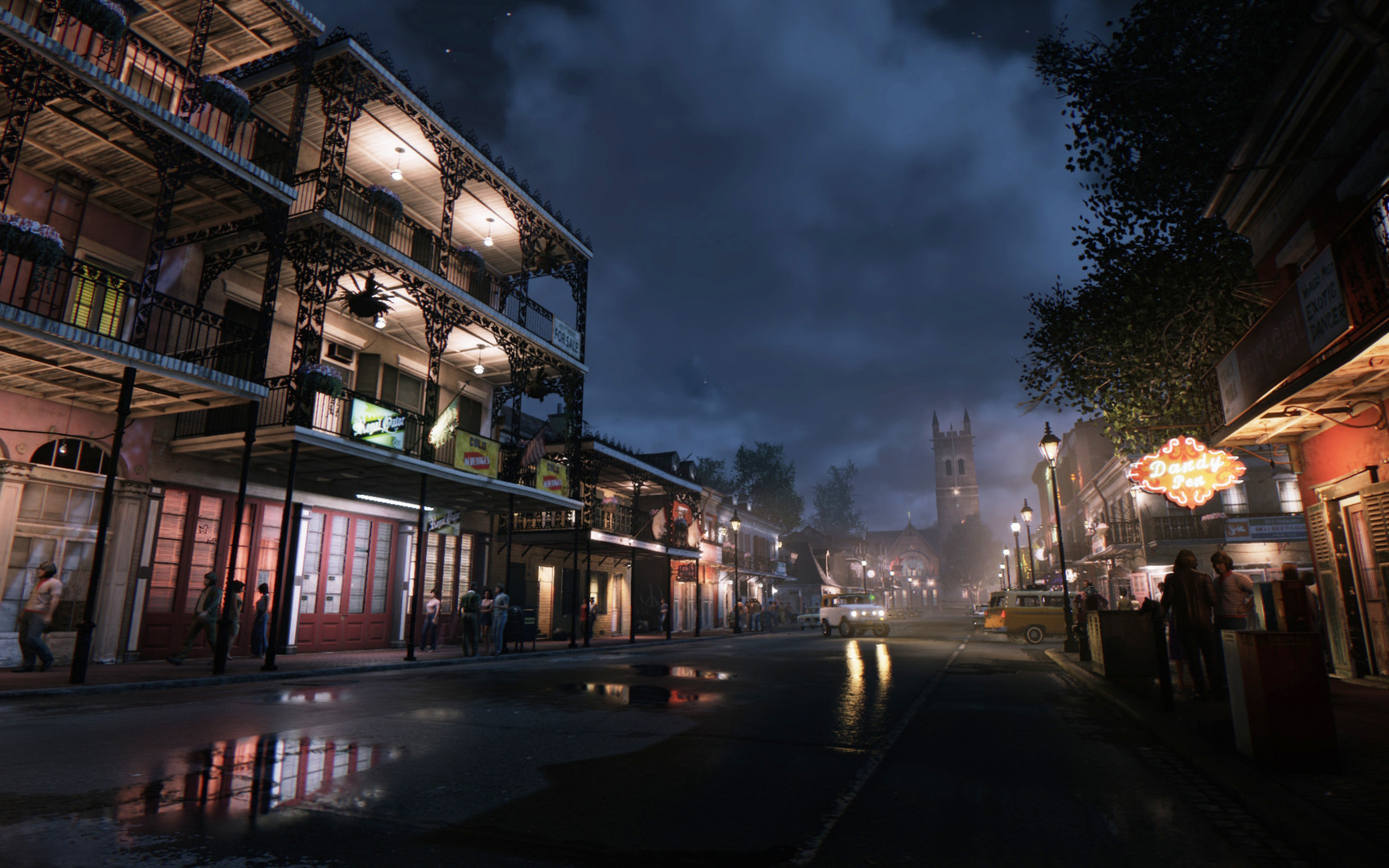
 Atmospheric detail in Mafia III: Definitive Edition.
The supporting cast holds up surprisingly well too. Cassandra, Vito Scaletta, and Thomas Burke — the three underbosses you build your empire around — each feel like people with conflicting agendas rather than quest-givers. The game uses a faux-documentary framing device, with historians and survivors recounting events decades later, that keeps the tone grounded and slightly elegiac. It also lets the writers telegraph early on that Lincoln's story ends in a specific kind of tragedy, which gives the whole run a weight that most games in the genre avoid.
Sal Marcano, the primary antagonist, is perhaps the weakest link here. He's a competent mob boss, but he lacks the screen time to become truly menacing. Compare him to the slow-burn menace of something like Arthur Morgan's gang dynamics in Red Dead Redemption 2 — Marcano appears, delivers exposition, and disappears. The final confrontation, when it comes, feels undersized for everything Lincoln has been through to get there.
The racket loop will test your patience
Here is the structure, stripped bare: each of New Bordeaux's districts contains two rackets. Each racket is run by a lieutenant. To reach the lieutenant, you sabotage the racket's income by completing a set of identical sub-tasks — burning drug supplies, killing enforcers, smashing cash counters. You do this across roughly nine districts. The game rarely changes the verbs.
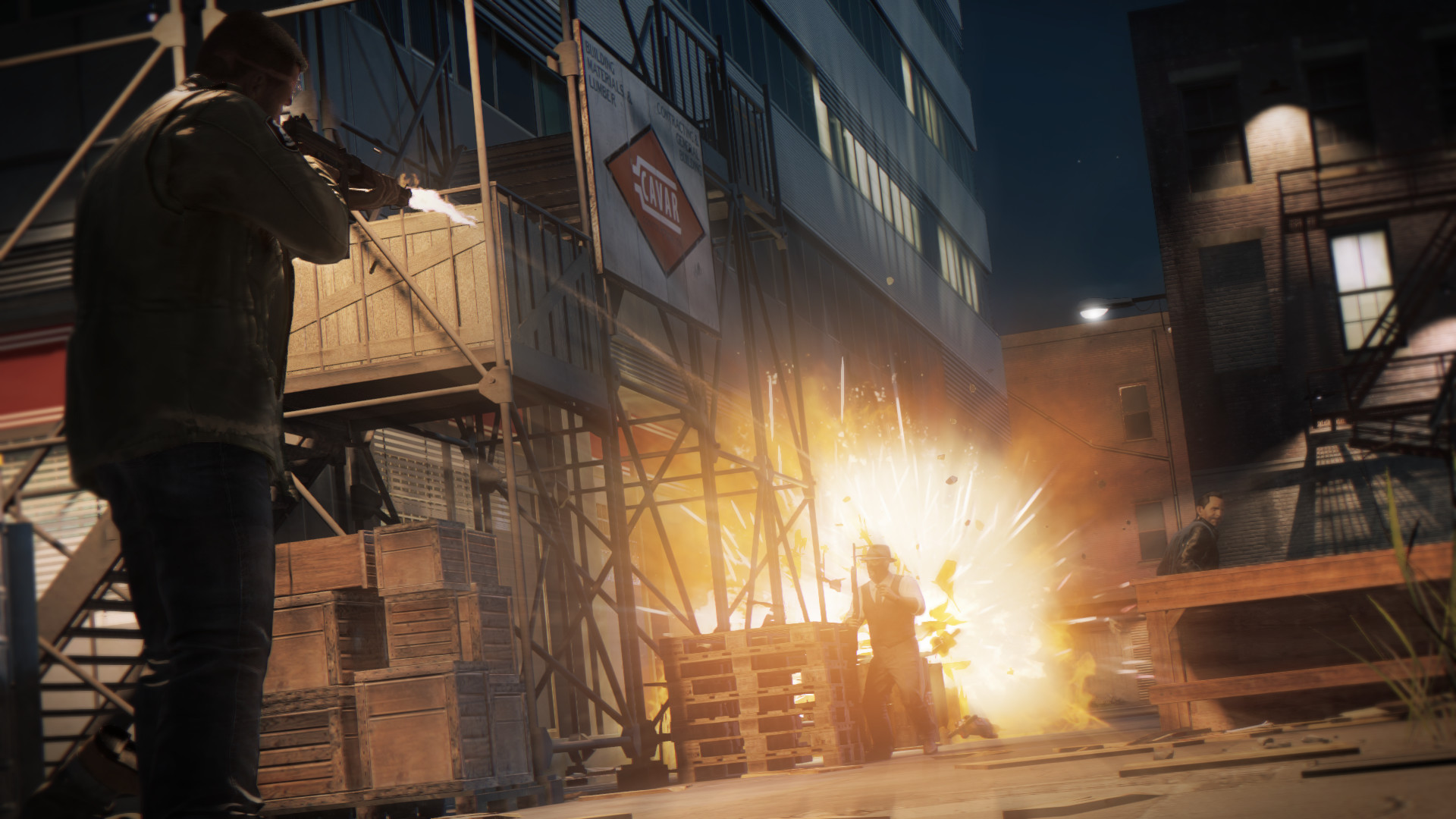
 Combat encounter in Mafia III: Definitive Edition.
By the fifth district, you will start noticing how the missions blur together. By the seventh, you may be asking yourself what you're doing. The stealth mechanics are functional — Lincoln can whistle enemies around corners, use tall grass as cover, perform silent takedowns — but they're never inventive enough to make the repetition feel like skill expression. It's the opposite problem from something like Dishonored, where the same level design rewards lateral thinking differently each time through. Mafia III gives you the same room and asks you to clear it the same way.
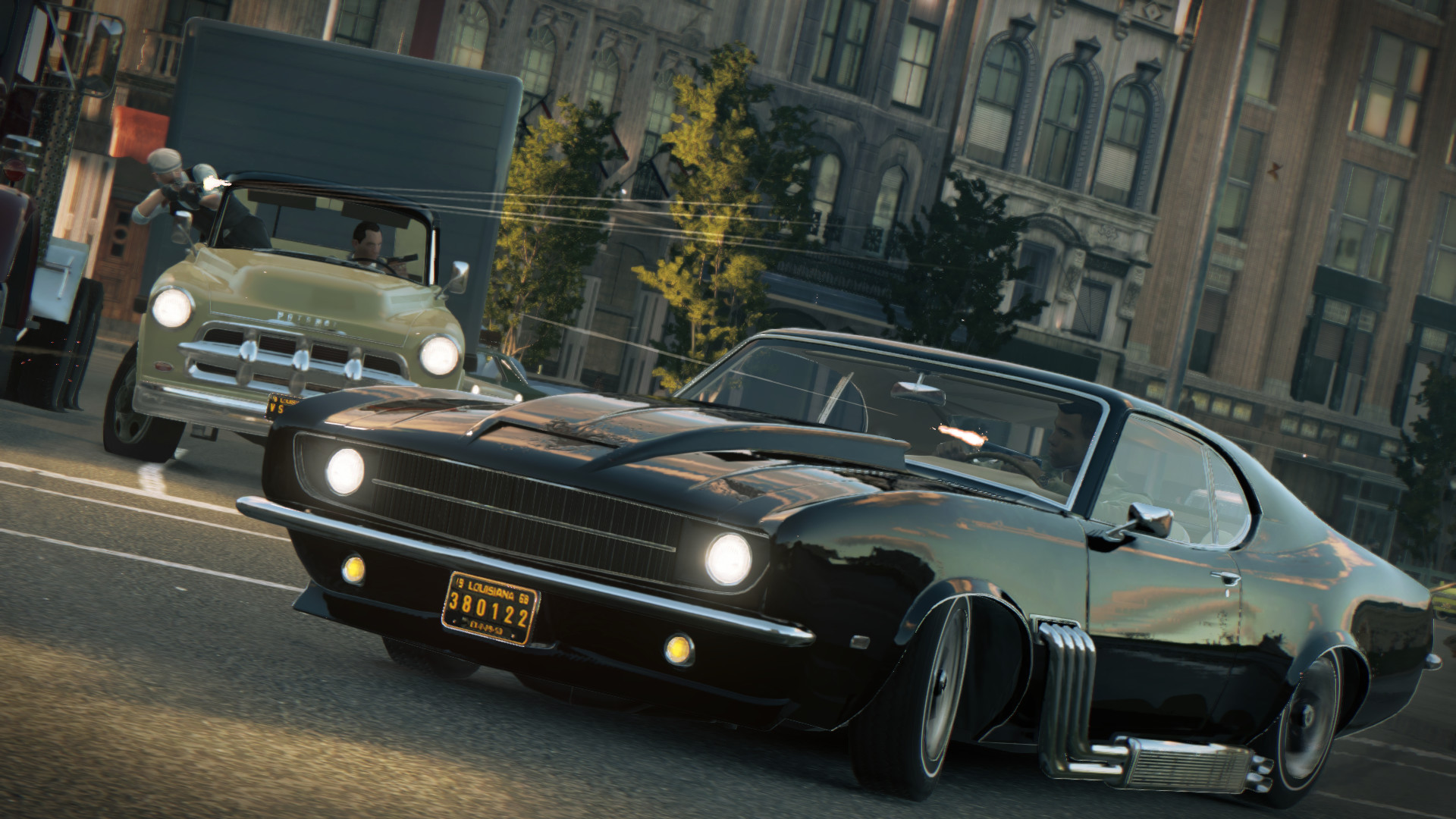
The driving holds up better. New Bordeaux has a satisfying physicality to it — cars feel heavy, roads have texture, and the period-accurate 1960s soundtrack (Creedence, Hendrix, the Stones) does real work in making the world feel inhabited. There's a stretch in the early game where you're just cruising between objectives, the radio cycling through tracks, and it genuinely evokes something. Then another identical warehouse shows up on the map.
What the Definitive Edition actually fixes
The 2016 release on PC had a frame rate locked to 30fps at launch — a decision so baffling it became a minor industry story at the time. The Definitive Edition removes that cap, and the game runs considerably better as a result. Draw distances are improved, there's less pop-in, and most of the major crash bugs from the original run have been addressed. None of this is transformative, but it's competent work.
The three DLC chapters — Faster, Baby!, Stones Unturned, and Sign of the Times — are bundled in from the start. They range from decent to surprisingly good. Sign of the Times, which involves Lincoln investigating a cult operating on the edges of New Bordeaux, is the strongest of the three; it has a focused story and a more varied mission structure than the base game. Faster, Baby! is a tight, three-hour civil rights story set in a small rural town that almost feels like a different, better game. If you're bouncing off the main campaign, these chapters are worth playing first.
One thing the Definitive Edition doesn't fix is the mission variety problem, because that would require rebuilding a significant portion of the game. Some things can't be patched. The collection is honest value in terms of content volume — probably thirty-plus hours if you engage with everything — but volume was never Mafia III's issue. Quality control over the mid-section was.
Compared to its own series
Mafia and Mafia II, both also repackaged in the same Definitive Edition treatment, are tighter, more linear games. Mafia II in particular is built around setpieces and scripted sequences that hold up well precisely because they don't try to simulate a systemic open world. Mafia III's ambition — to do a full GTA-style territory-control sandbox with a prestige-TV storyline — was always going to be a harder ask for a studio making only their second game.
Hangar 13 clearly had a vision. The problem isn't a lack of craft in the writing or characterisation — it's a systems design that never found an answer to the central question every open-world game has to answer: how do you make the hundredth encounter feel as meaningful as the first? Rockstar spends years iterating on that problem. Ubisoft, for all the criticism it absorbs, has at least built institutional knowledge around it. Hangar 13 didn't have that, and it shows.
Who it's actually for
If you came to Mafia III specifically for the story — for Lincoln, for the setting, for a big-budget game that was willing to put the Black American experience at the centre of a revenge narrative set in the Jim Crow South — then it's worth your time. Skip no cutscenes. Let the soundtrack run. Engage with the factions. There's something real there.
If you need the gameplay to carry equal weight, this will frustrate you. The combat is serviceable but never exciting; the stealth is workable but never clever. There are better open-world games for systems satisfaction — even within the crime genre, something like the original Sleeping Dogs punches harder mechanically, despite a fraction of the budget.
Lincoln Clay deserved a game that matched his story. What he got was a game that works in spite of itself — carried by performance, period, and a script that refused to look away from uncomfortable history. That's not nothing. It might even be enough, depending on what you're looking for. Just don't expect the gameplay to meet the writing halfway.
Editorial scoring
Reader Q&A
How long does it take to finish Lincoln Clay deserved better than this game?
Main story runs around 120 hours depending on how thoroughly you explore. Completionists can spend 2-3× that.
Is Lincoln Clay deserved better than this game good for newcomers to Open-World Crime?
It depends. The systems are deep but the tutorial does a fair job. Veterans of Open-World Crime will feel at home faster.
Which platform should I play Lincoln Clay deserved better than this game on?
PC version offers the highest fidelity if your rig can handle it. Console versions are polished out of the box.
Was Lincoln Clay deserved better than this game worth the launch-day price?
If you're a fan of Hangar 13, yes. If you're new to the studio, a sale price is more comfortable.
Are there DLCs or expansions worth picking up?
Wait for the Game of the Year edition — it bundles everything at a fair discount.
What did Hangar 13 get right (and what could be better)?
The systems are confident and the combat is satisfying. The story handoffs and load times are the rough spots.
Reader comments