
Monster Train makes Slay the Spire look like it was holding back
Picture a train steaming toward Hell while you stand on three stacked floors of it, placing monsters like chess pieces, watching a Seraph stomp down from the top carriage into a corridor already packed with Hellhorned imps who explode on death. The Seraph takes splash damage. The imps die and detonate. The damage ripples back through your own units. You had planned this. It worked better than it should have. That is Monster Train at its best — a precise machine that keeps producing moments you did not see coming even when you engineered every part of them.
Shiny Shoe released Monster Train in May 2020, a few years after Slay the Spire had more or less defined the roguelike deck-builder genre and convinced roughly forty other studios that the formula was a safe template. Most of those studios were wrong, or at least cautious. Monster Train did something different: it took the template apart, added a spatial layer, doubled the mechanical density, and shipped a game that makes MegaCrit's classic feel — in hindsight — like a proof of concept. That is not a slight against Slay the Spire. It is a statement about how much further the genre had left to travel.
The third floor changes everything
Slay the Spire is fundamentally a card-math puzzle. You build a deck, you play it against enemies standing in a line, you track numbers. Monster Train keeps the cards but forces you to also manage real estate. Enemies board your train at the bottom floor and fight upward, room by room. Your Pyre — the engine you are defending — sits at the top. You place monster units on floors to intercept the onslaught, and you only have three floors to work with. Where you put things, and in what order, shapes every fight.
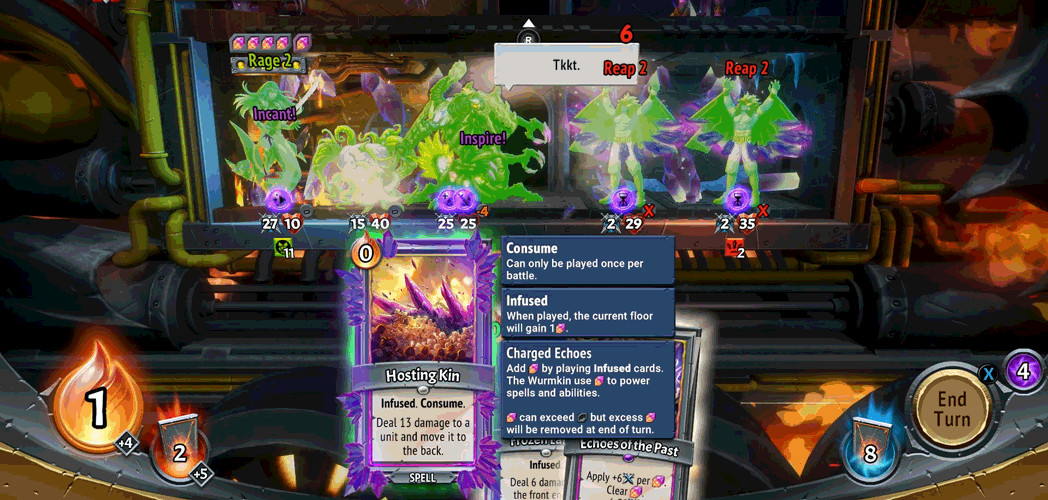 Atmospheric detail in Monster Train.
This changes the texture of decision-making in ways that take a few runs to fully register. A unit with a powerful death trigger needs to die on the right floor, which means you need enemies there to kill it, which means you might deliberately under-defend a lower floor so the spillover hits correctly. A boss unit with Armor might be placed on floor two to absorb the first wave, then the overflow climbs to floor three where your actual killing setup lives. None of this is explained in tutorial text that feels like homework. The game demonstrates it and lets you work the logic out, which is the right call.
Two clans, infinite combinations
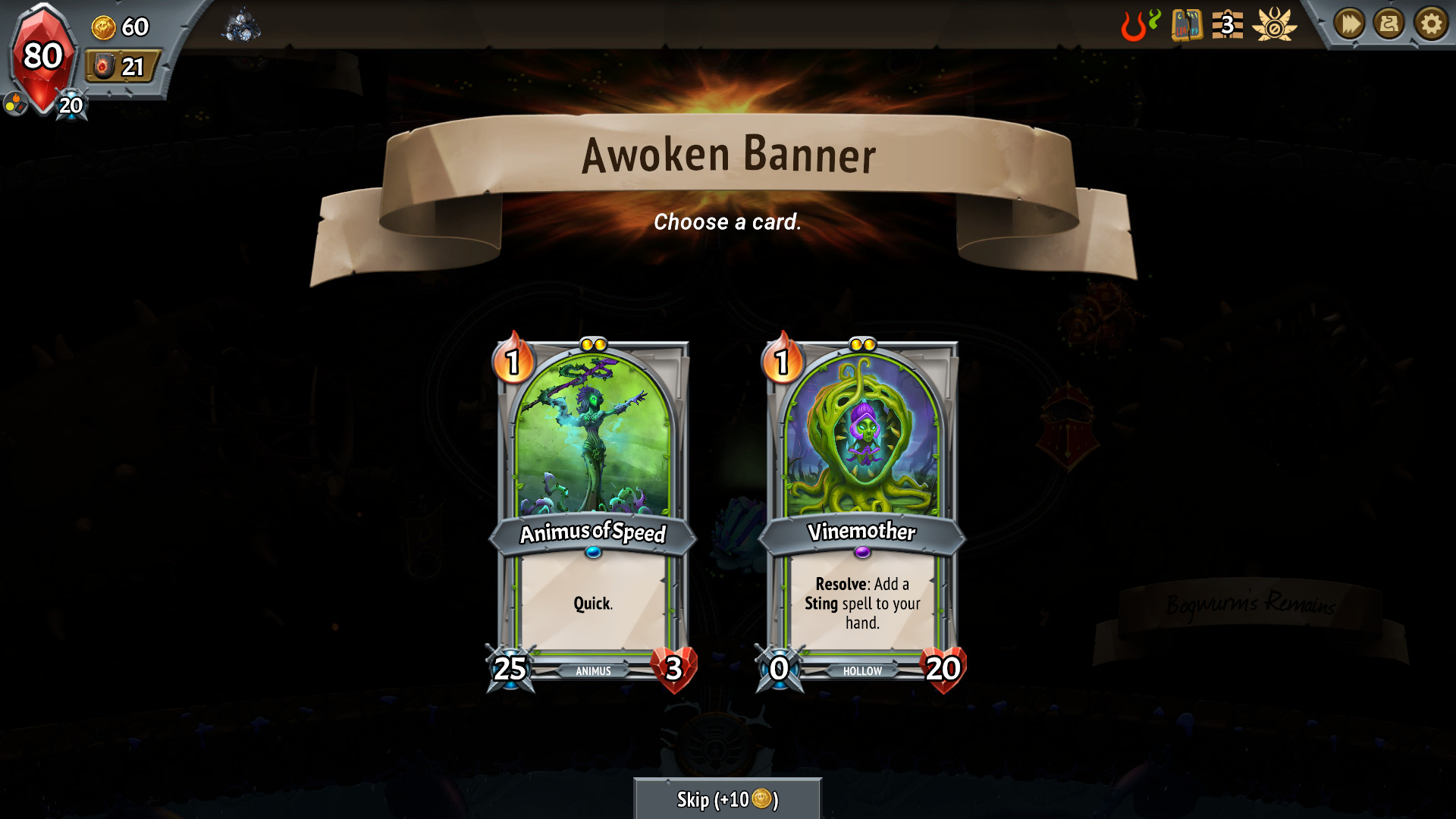
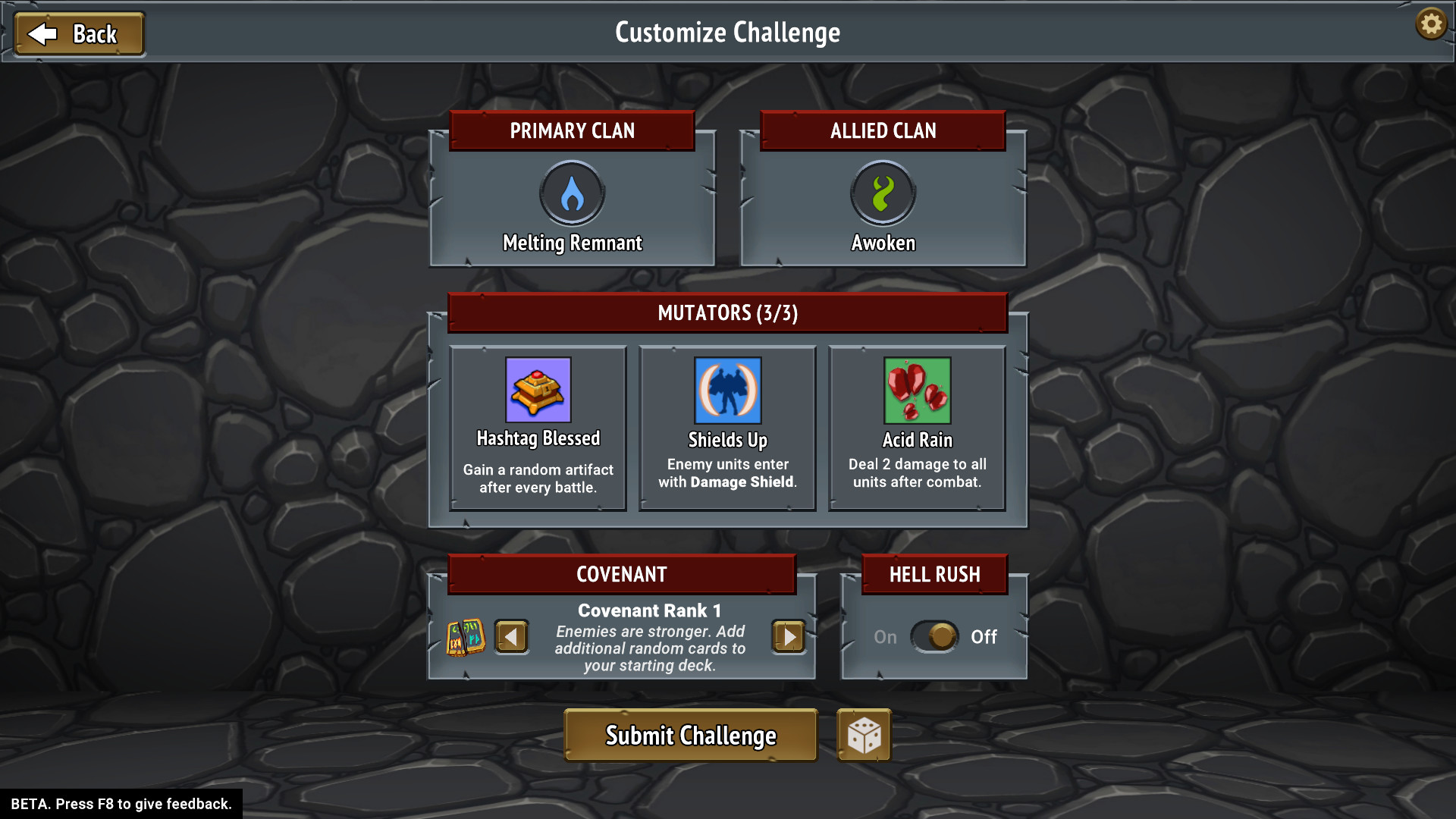
Each run picks a primary clan and a secondary clan from a roster of five. The Hellhorned lean into direct damage and rage stacks. The Awoken build around plant units that regenerate. The Stygian Guard manipulate spell capacity and spell damage. The Umbra consume their own units to generate powerful echoing effects. The Melting Remnant are made of wax and deliberately die and reform into stronger versions of themselves, which is a mechanic so weird that it takes two runs with them before it stops feeling like a liability. These five clans generate twenty-five possible pairings, and the interactions between them are not cosmetic — they produce genuinely different strategic priorities.
Hellhorned primary plus Stygian secondary, for instance, creates a build that loads up on cheap damage spells to feed rage stacks while using Stygian's capacity upgrades to cast three or four cards a turn instead of the default two. Awoken primary plus Umbra secondary creates a cycle of plant units that get consumed, trigger Umbra bonuses, then regenerate through Awoken passives. The combinations that sound broken on paper often fall apart in the mid-game when the unit costs stop scaling properly. The combinations that sound awkward sometimes crystallize around a single artifact that you did not know existed until it appeared in a reward screen. After 85 hours there are still interactions I have not seen.
 Combat encounter in Monster Train.
Cards, artifacts, and the upgrade screen you will spend too long on
Monster Train's card upgrade system is more granular than Slay the Spire's. Most cards offer two separate upgrade paths rather than a single enhanced version. A basic Hellhorned unit might upgrade either to gain more attack or to gain an area-of-effect sweep. The right choice depends on your current deck architecture, not on which upgrade sounds stronger in isolation. This is a small thing that adds up. By the mid-game you are reading your own deck like a diagnosis, looking for the specific hole an upgrade needs to fill.
Artifacts work similarly. They are passive bonuses you acquire through runs, and many of them modify core systems rather than just adding flat stat bumps. Demonhorn Idol makes your Pyre's ember count regenerate differently. Ancestral Shell caps incoming damage on a unit per turn, which sounds defensive but actually enables you to leave units in front of lines they could never survive unaided. The artifact pool is large enough that you will not see every piece in twenty runs, and several of them are only useful in specific clan synergies, which means finding one can suggest a direction for an entire run.
Covenant levels and the Shiny Shoe difficulty ladder
Once you beat the base game, a Covenant system unlocks, stacking difficulty modifiers in increments the way Hades uses its Heat system or Slay the Spire uses Ascension. Monster Train goes to Covenant 25. Higher Covenant levels add conditions like reduced shop options, stronger champion enemies, and — at the sharp end — modifications that fundamentally change how enemy waves behave. Most players will find a comfortable ceiling somewhere around Covenant 8 to 12. Getting past Covenant 20 is a project that requires build literacy that the game never explicitly teaches, which is either a strength or a flaw depending on how you feel about learning through failure.
The Champion — a personal hero unit you modify through a card-based upgrade sequence over the course of each run — scales with difficulty in a way that keeps it relevant without making it feel mandatory. At lower Covenants the Champion is a useful anchor. At higher Covenants the Champion build is often the thesis statement of the entire run, and every other card decision is written to support it. Some players find this too constrictive. The counterargument is that the thesis keeps changing because the Champion evolves differently each time based on which upgrade cards appear.
Where it actually falls short
The narrative framing is thin. Monster Train has a story — Hell has frozen, a rogue Seraph is responsible, you are reclaiming the Pyre Heart — and it is told through voiced conversations between characters on the train. The writing is functional and occasionally clever, but it never earns investment the way Supergiant's Hades does, where the dialogue is doing mechanical and narrative work simultaneously. Monster Train's story exists in the gaps between runs, and it does not change how you play or what you care about while playing. This is fine. It is just a missed opportunity given how much personality the visual design suggests.
There is also a run-pacing issue that appears around the second ring of the map on longer sessions. The game structures each run across three interconnected rings of nodes — battles, shops, challenges — and the middle ring can produce stretches where the battles stop introducing new pressure and feel like maintenance rather than escalation. The boss fights at the end of each ring compensate for this, and most of them are well-designed, but the mid-ring flatness is noticeable enough that a handful of my longer sessions lost momentum before recovering it.
The verdict after 85 hours
Most deck-builders that launched in Slay the Spire's wake added a gimmick and called it depth. Monster Train added actual structural complexity — the floor system, the dual-clan pairings, the two-path upgrades — and then balanced it well enough that the complexity pays off in clarity rather than chaos. The game is generous with variety, disciplined with its mechanical language, and genuinely difficult to exhaust. That mid-game lull and the lightweight story are real criticisms, not dealbreakers.
Slay the Spire is a great game. Monster Train is what happens when a studio studies a great game and then refuses to be satisfied with replication. Eighty-five hours in, there are still clan combinations I have not seriously explored and Covenant levels I have not cracked. That is not padding. That is a system with enough moving parts that mastery keeps retreating just far enough to stay interesting — and the pursuit of it never stops feeling like your own idea.
Editorial scoring
Quick facts
How long does it take to finish Monster Train makes Slay the Spire look like it was holding back?
Main story runs around 85 hours depending on how thoroughly you explore. Completionists can spend 2-3× that.
Is Monster Train makes Slay the Spire look like it was holding back good for newcomers to Roguelike Deck-builder?
For total newcomers, expect a 5-8 hour ramp-up. Once you internalize the loop, it clicks.
Which platform should I play Monster Train makes Slay the Spire look like it was holding back on?
PC version offers the highest fidelity if your rig can handle it. Console versions are polished out of the box.
Was Monster Train makes Slay the Spire look like it was holding back worth the launch-day price?
Depends on backlog. The replay value justifies the price for genre fans; casual players should wait for a 40%+ discount.
Are there DLCs or expansions worth picking up?
Wait for the Game of the Year edition — it bundles everything at a fair discount.
What did Shiny Shoe get right (and what could be better)?
Strongest: art direction, audio design, set-piece variety. Weakest: late-game balance and a few persistent quest-log bugs.
Reader comments