
Outer Wilds knows the answer — you just have to die enough times to hear it
There is a moment in Outer Wilds where you float, weightless, inside a collapsing star. Ash spirals past the cockpit glass. The Nomai text you came to read is dissolving in the heat. You have maybe forty seconds before the supernova takes you, and you know — because you've died here six times already — that you're still not going to make it out. But you read faster anyway. That image, that specific feeling of racing a dying sun while your notepad fills with half-answers, is what Mobius Digital built their entire game around. After 120 hours with Outer Wilds across two playthroughs and one very ill-advised attempt to skip the Ash Twin Towers puzzle entirely, the question isn't whether the game holds up. It does. The question is what kind of game it actually is, and whether the label 'Exploration Mystery' covers the distance.
Outer Wilds is not a survival game, not a puzzle game in the conventional sense, and not quite an adventure game either — even though it borrows liberally from all three. What it actually is, at its skeleton, is a knowledge-gated game in a time-loop wrapper. You cannot progress through force or through grinding. There are no upgrades, no skill trees, no stat checks. You progress by learning things. Knowing where to go opens the door; knowing why gives you the key. That's a design commitment most studios would flinch at, and Mobius held the line on it completely.
What the Loop Actually Does
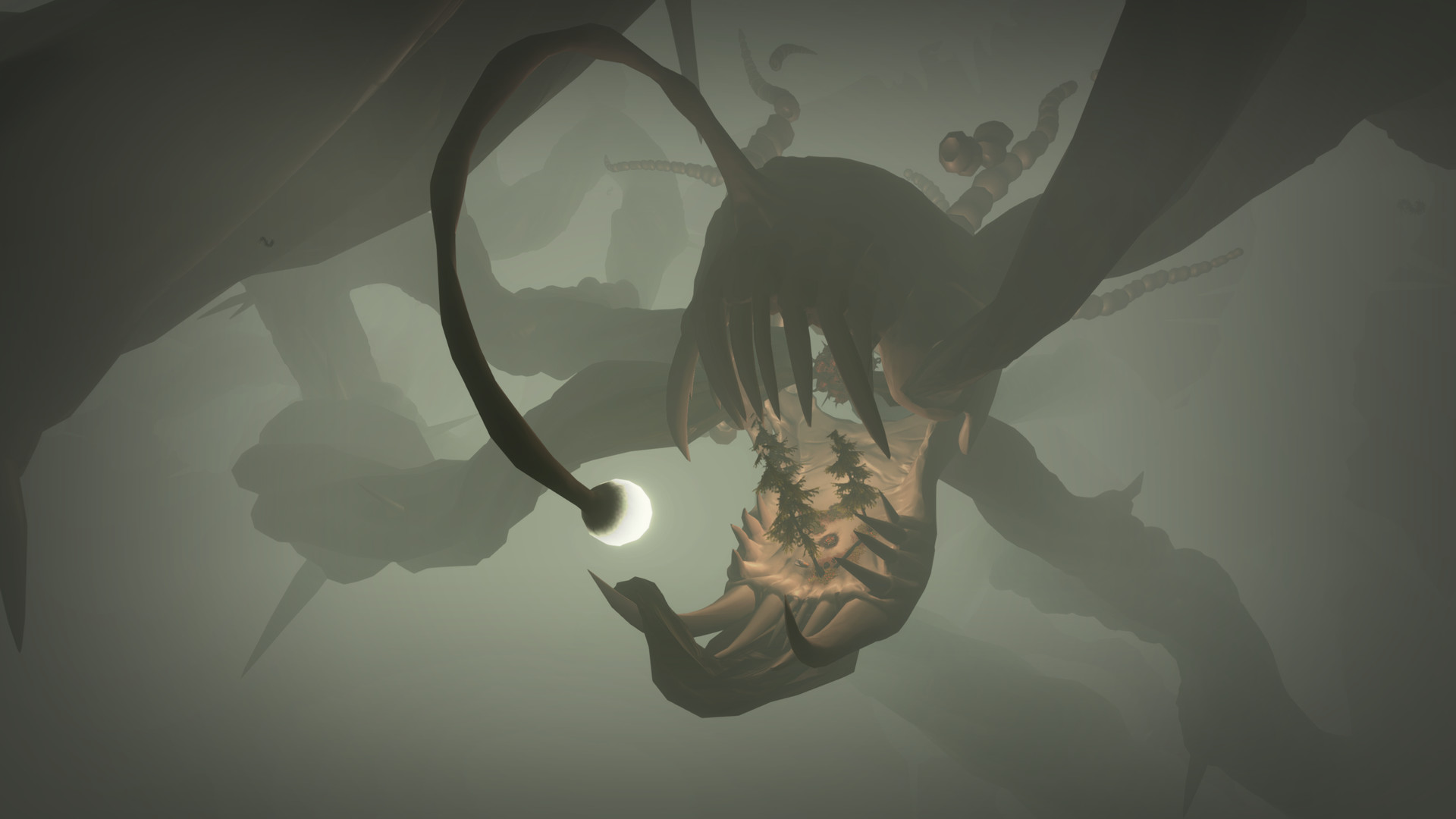
The 22-minute time loop in Outer Wilds is frequently described as a mechanic. It's more accurate to call it a philosophy. Every loop resets the solar system — Brittle Hollow's crust collapses fresh, Ash Twin's sand columns refill, the Anglerfish drift blind through Dark Bramble in the same three corridors. But nothing resets in your head. That asymmetry is the point. Death is not failure; it's punctuation. You die, the loop ends, and you carry forward every scrap of text, every recorded conversation, every piece of orbital geometry you've worked out on a napkin.
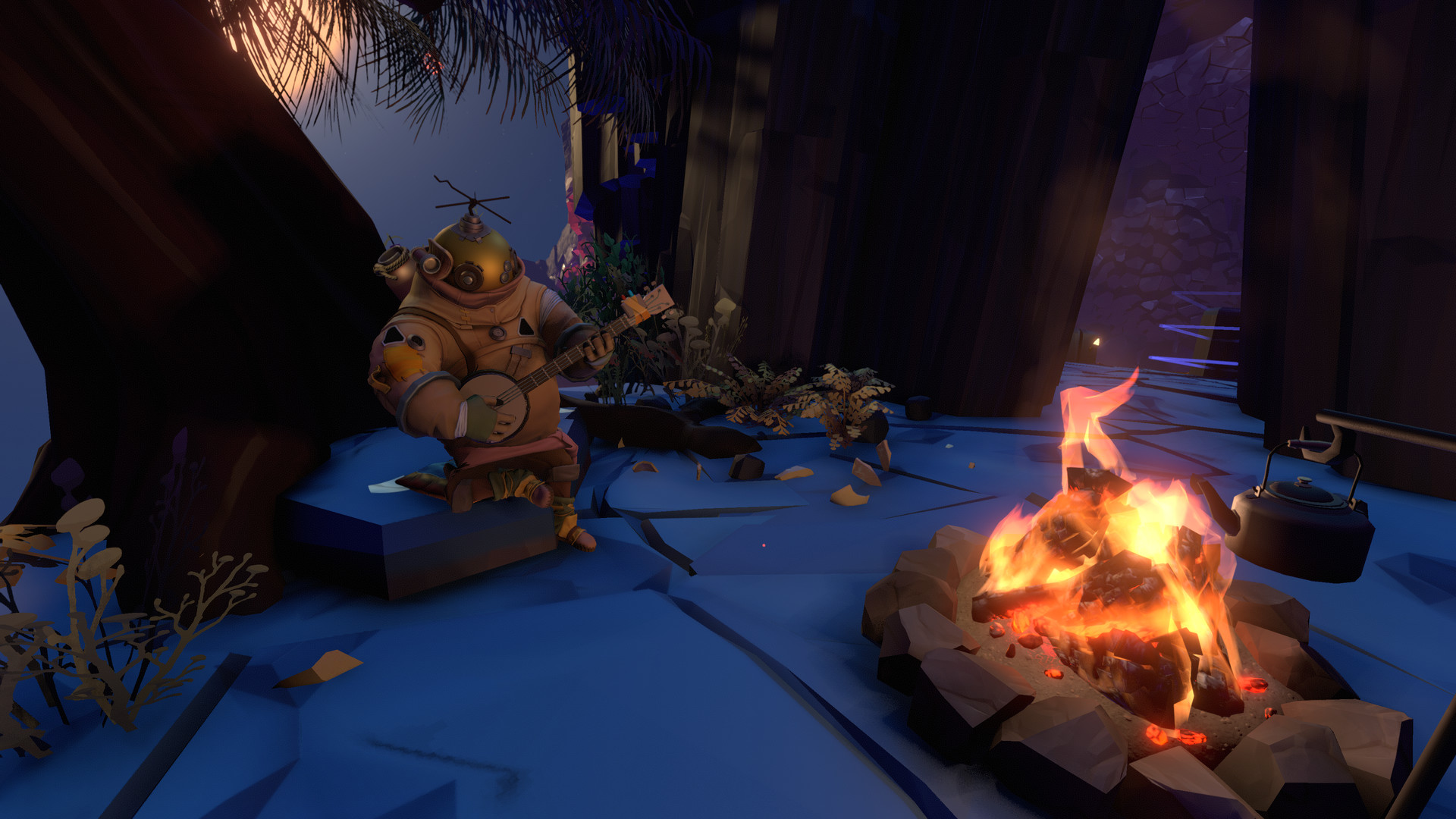 Scene from Outer Wilds.
What this produces is a game with almost no friction and almost no hand-holding simultaneously, which should be a contradiction. Other time-loop games — Returnal, Deathloop, even the much smaller 12 Minutes — use the loop as a pressure mechanism. Outer Wilds uses it as a library card. You can spend an entire loop flying slowly around Giant's Deep doing nothing but watching the storm cycle, and that's fine, because eventually you'll notice the current pattern and file it away. The game trusts that you will connect the dots. Occasionally that trust is misplaced; a handful of the late-stage logical leaps require knowledge the environment gestures toward rather than states, and two or three players I know gave up at exactly those moments. The margin for confusion is real. But the game's answer to that is consistent: go read more walls.
The Solar System as a Level Designer
Each of the six major locations in Outer Wilds functions as its own distinct puzzle box with its own physical rules. Ash Twin runs on sand physics and a timer. Brittle Hollow runs on gravity and controlled demolition. The Interloper is a geology lesson with a brutal punchline. What's clever is that none of these locations exist in isolation — they're in constant conversation. A piece of text on Ember Twin points you toward a structure on Ash Twin, which contains instructions that only make sense once you've fallen through Brittle Hollow's core. The solar system is the level, and Mobius designed it so that nothing is in the wrong place.
The flight model deserves a specific mention because it does real work. Landing on Brittle Hollow requires you to actually understand approach angles. Navigating Dark Bramble requires patience and directional sound cues that the game teaches you without ever stating them as rules. The physics are Newtonian enough to bite you if you're sloppy — I have killed my Hearthian explorer by forgetting that my own ship's gravity doesn't exist in zero-G more times than I'd like to admit — but forgiving enough that you feel like a pilot rather than a physics exam student. It's the right balance, and it's doing narrative work: you're supposed to feel like a curious kid who just learned to fly, because that's exactly what you are.
 Scene from Outer Wilds.
Where It Sits on the Exploration Mystery Ladder
The 'Exploration Mystery' genre is small and a little underexamined. Return of the Obra Dinn, Heaven's Vault, Pentiment, the original Myst — these are games where the act of uncovering information is the primary satisfaction, and narrative revelation does the job that combat upgrades do in other genres. Outer Wilds belongs in that company, and probably sits near the top of it. Its mystery is coherent, which Myst's often wasn't. Its world is physicalized and traversable in ways Heaven's Vault can't match. And unlike Obra Dinn, which is essentially a deduction engine, Outer Wilds is asking an emotional question as much as an intellectual one.
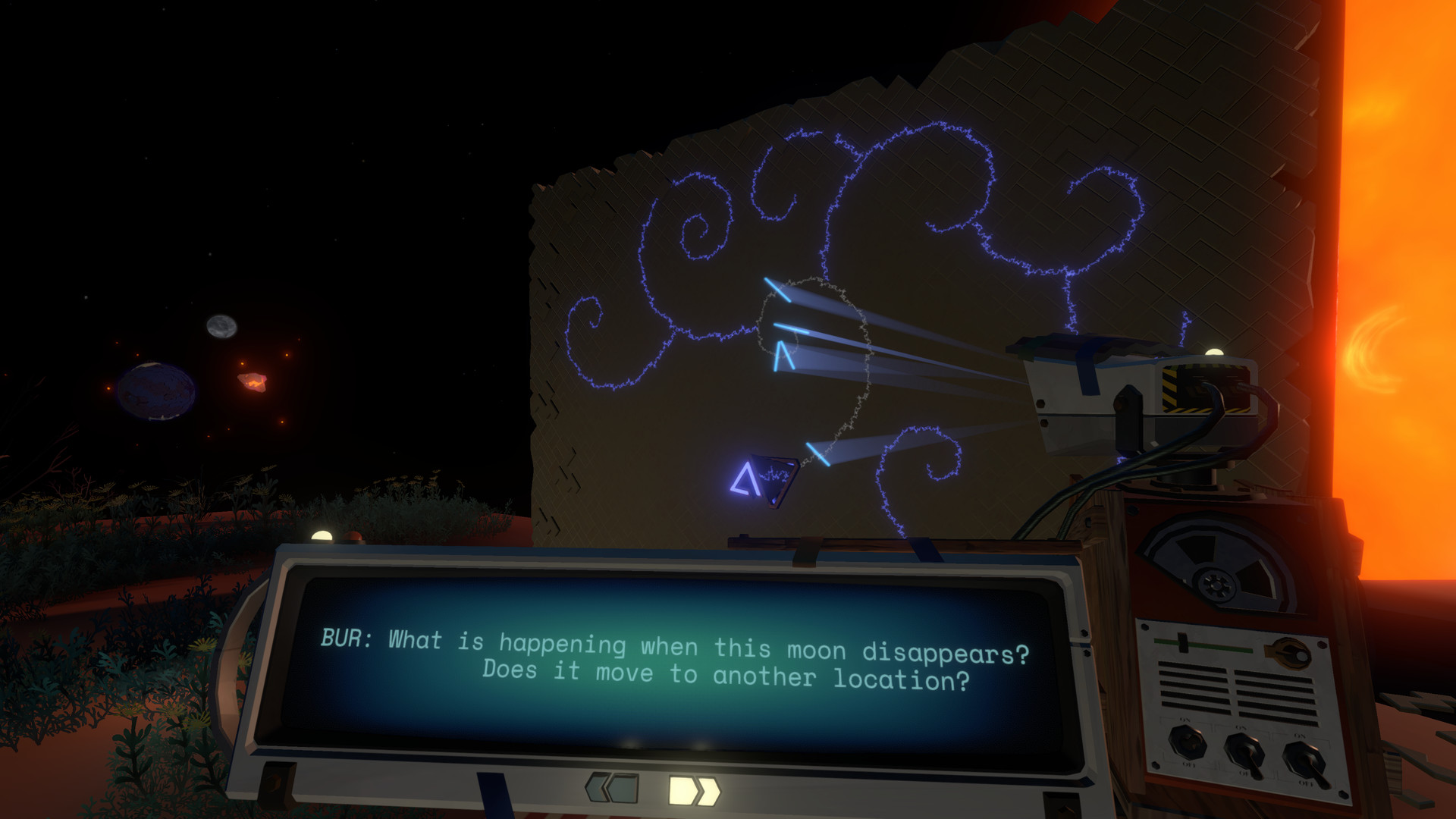
The Nomai are the key to why. The extinct alien civilization you're piecing together is not presented as a tragedy to be solved. It's presented as a community to be known. Their arguments are preserved in branching wall-text conversations. Their jokes are still carved in stone. Solanum, on Quantum Moon, is a genuine moment of cross-species contact that the game earns through forty hours of context. By the time you understand what happened to them — and what's about to happen to you — the revelation lands with weight that most games reach for in cutscenes. Outer Wilds lands it through environmental archaeology. That's not easy to do, and it doesn't always work on the first pass; the story's emotional peak requires you to have read enough that the pieces assemble naturally, and players who skip Nomai text will find the ending hollow.
Echoes of the Eye: The Asterisk
The 2021 DLC cannot be discussed in the same breath as the base game without a significant asterisk. Echoes of the Eye is slower, darker, and structurally different in ways that divide players sharply. Its core mechanic asks you to extinguish light sources and interpret dream-logic imagery to unlock a second, deeply buried mystery. The horror-adjacent stealth sequences that arrive in the DLC's back half have a legitimate scare-factor — I genuinely tensed up each time — but they also break the game's foundational contract. In the base game, dying is low-consequence and instructive. In the DLC's dark zones, dying while being chased by a Stranger sends you back far enough to genuinely frustrate, which transforms the emotional register from curious to anxious.
The payoff is worth it for players who commit. The final sequence in Echoes ties back to the base game in a way that recontextualizes the Eye of the Universe ending without diminishing it. But the path there is uneven in a way the base game never is. If Outer Wilds is a ten, Echoes of the Eye is a seven with a scene near the end that briefly touches eleven. That's still worth the cost of admission, but go in with adjusted expectations.
What 120 Hours Teaches You
Two full playthroughs, separated by about two years, produce very different experiences. The first is the mystery: raw, occasionally bewildering, occasionally sublime. The second is the architecture. On a second run you notice how efficiently the game feeds you information — how the Attlerock observatory is precisely the right first conversation, how the Ash Twin project is visible from multiple angles before you can possibly enter it, how the game's pacing is built into the orbital mechanics themselves. Some locations are only accessible at specific points in the 22-minute cycle, which means the solar system itself is a clock, and Mobius tuned it carefully.
At 120 hours — across both runs, plus deliberate experiments like trying to reach the Ash Twin core without the warp pad — there are still corners I haven't fully mapped. Not because the game is large, but because it's dense. Every surface has been considered. That kind of authorial intentionality is rare enough to name: Outer Wilds is, without much argument, one of the best-designed games released in the last decade, and the exploration-mystery genre won't have a stronger example until someone builds something that learns from it directly. It's not for everyone. It demands patience, tolerance for dying mid-sentence, and a willingness to take notes. In exchange it gives you a universe that makes sense, a civilization worth mourning, and an ending you'll think about in the shower for three weeks.
There are games you finish and file away, and games that change the shape of what you expect from the medium afterward. Outer Wilds is the second kind. Go find out why the loop ends. Just don't expect anyone to tell you.
Editorial scoring
Quick facts
How long does it take to finish Outer Wilds knows the answer — you just have to die enough times to hear it?
Main story runs around 120 hours depending on how thoroughly you explore. Completionists can spend 2-3× that.
Is Outer Wilds knows the answer — you just have to die enough times to hear it good for newcomers to Exploration Mystery?
Yes — Outer Wilds knows the answer — you just have to die enough times to hear it is a great entry point. The early hours teach the systems gradually and the difficulty curve is reasonable.
Which platform should I play Outer Wilds knows the answer — you just have to die enough times to hear it on?
PC version offers the highest fidelity if your rig can handle it. Console versions are polished out of the box.
Was Outer Wilds knows the answer — you just have to die enough times to hear it worth the launch-day price?
Released in 2019, and as of writing it holds up. Wait for a sale if you're price-sensitive — major discounts arrive within 6 months.
Are there DLCs or expansions worth picking up?
The base game is complete; expansion DLC adds 10-15 hours of additional content if you want more.
What did Mobius Digital get right (and what could be better)?
Strongest: art direction, audio design, set-piece variety. Weakest: late-game balance and a few persistent quest-log bugs.
Reader comments