
PAYDAY 2 still rewards the crew that doesn't panic
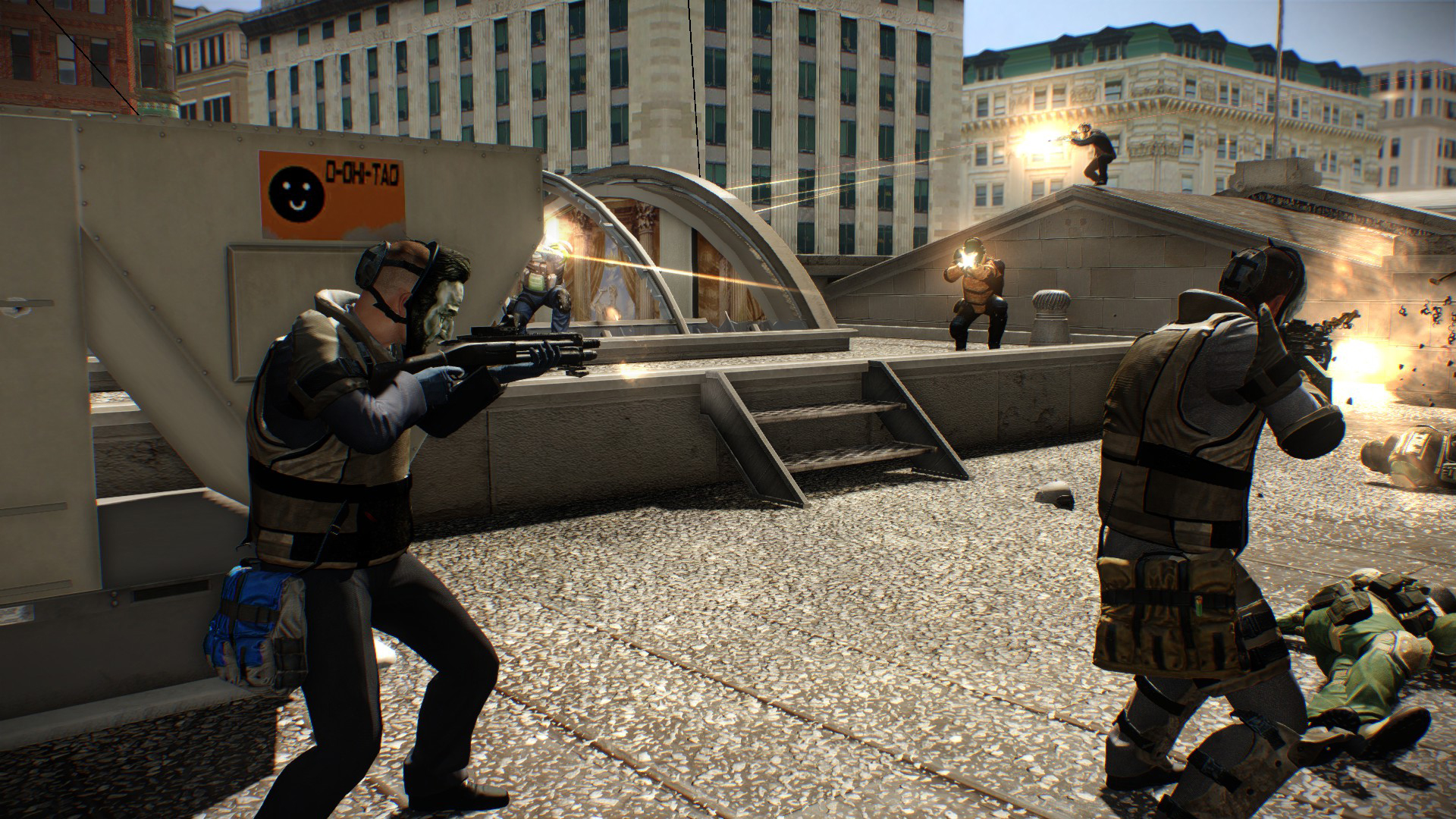
Four players are crouched behind a bank counter in Washington D.C., cable ties on every hostage, one guard silently folded into a closet. Nobody has fired a shot. Then someone clips a laser tripwire on the way to the vault and the whole building erupts — police radios crackling, the drill whining uselessly against the noise of flashbangs, the team's carefully rehearsed plan collapsing in about eight seconds. PAYDAY 2, released by Overkill Software in August 2013, was built entirely for that moment and the decisions that follow it.
After roughly 85 hours across stealth runs, loud chaos, and a fair number of mid-heist arguments over voice chat, the game still holds up as one of the more honest co-op shooters on the market. That's a specific claim, so it's worth being specific about what it means. PAYDAY 2 doesn't pretend every run will go cleanly. Its systems are designed around failure, recovery, and the way a group of people communicates when things are visibly deteriorating. That's rarer than it sounds.
What Overkill Actually Built
The mechanical foundation is a class-based skill tree divided into five specialisations: Mastermind, Enforcer, Technician, Ghost, and Fugitive. Each has three tiers branching further into sub-builds. A Mastermind specialising in medic skills can revive downed teammates faster and shout down enemy attacks on civilians; an Enforcer built around the Shotgunner path hits so hard in close quarters that the AI briefly hesitates before rushing. These aren't cosmetic differences. Group composition genuinely alters how a heist plays, which means the planning starts before the loading screen.
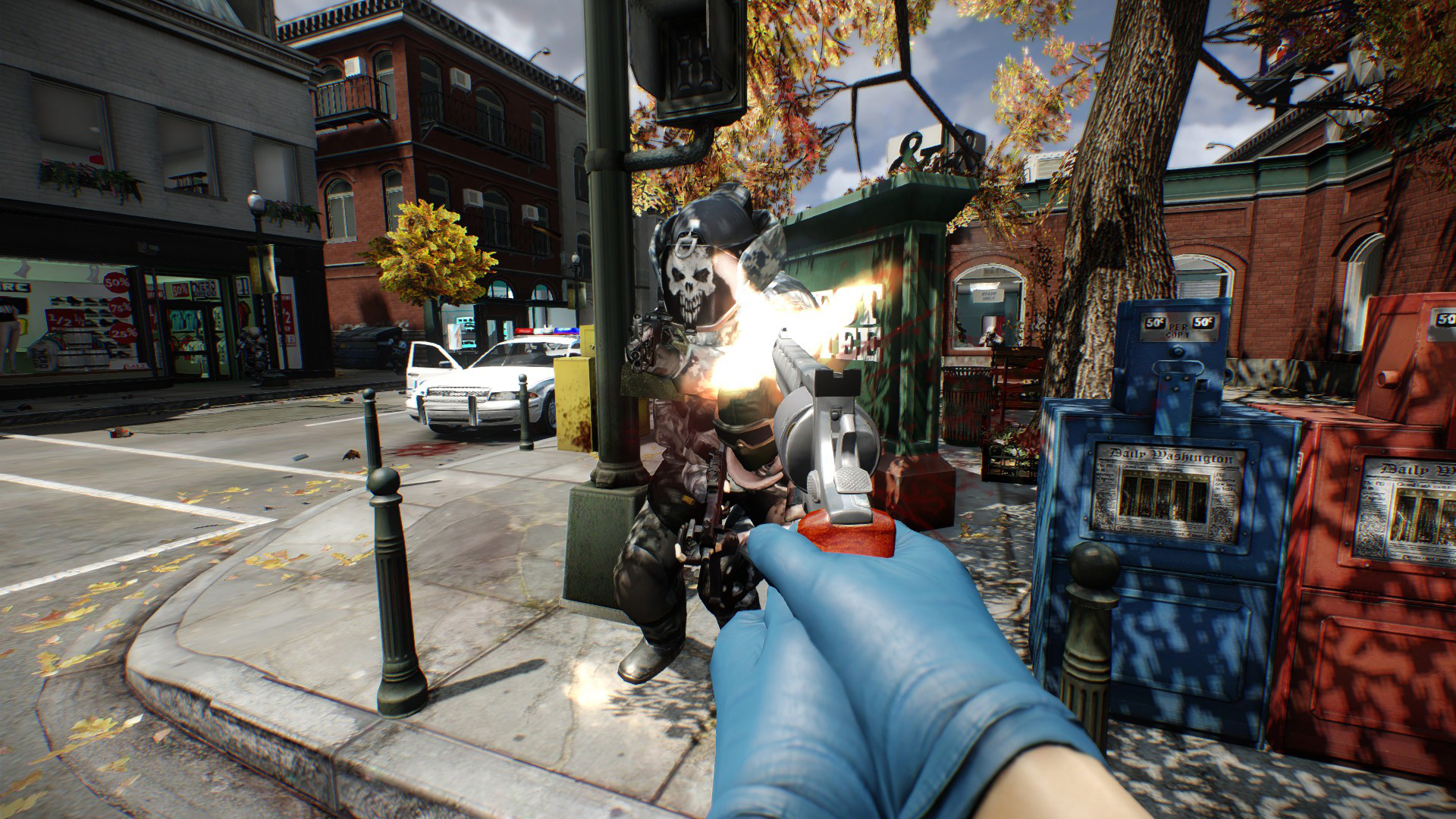 Atmospheric detail in PAYDAY 2.
The heist roster at the game's core — before the years of DLC expansion — covers a recognisable range: bank jobs, armoured car intercepts, diamond store smash-and-grabs, a nightclub drug cook that became something of a community meme. Each has a stealth path and a loud path, and the distance between them is significant. Going loud on the Jewelry Store map is a two-minute sprint. Going loud on Firestarter, a multi-day heist across three connected maps, is a sustained attrition fight that will test whether your team has a coherent reload rotation. The level design does real work here.
The AI police waves scale with the heist's difficulty tier — Normal, Hard, Very Hard, Overkill, and beyond into the game's harder optional settings. What's notable is that the game doesn't simply increase enemy health at higher difficulties. It changes enemy types, introduces shield units and bulldozer specials at more aggressive spawn intervals, and starts punishing teams that default to one spot and hold it. A strategy that cruises through Hard can completely fall apart on Death Wish because the underlying logic of the encounter has changed.
The Stealth Layer, Honestly Assessed
Stealth in PAYDAY 2 is functional and occasionally brilliant, but it has a ceiling. The detection system runs on a visible awareness cone attached to each guard, a numerical suspicion meter, and a series of timer-based pagers you answer when you kill a guard quietly. Four pagers per run — a fifth answered call triggers the alarm. That constraint creates genuine tension. In a four-player run, the decision of who takes which guard and when is a small negotiation, and it gets interesting when two guards are on converging paths and the timers are running.
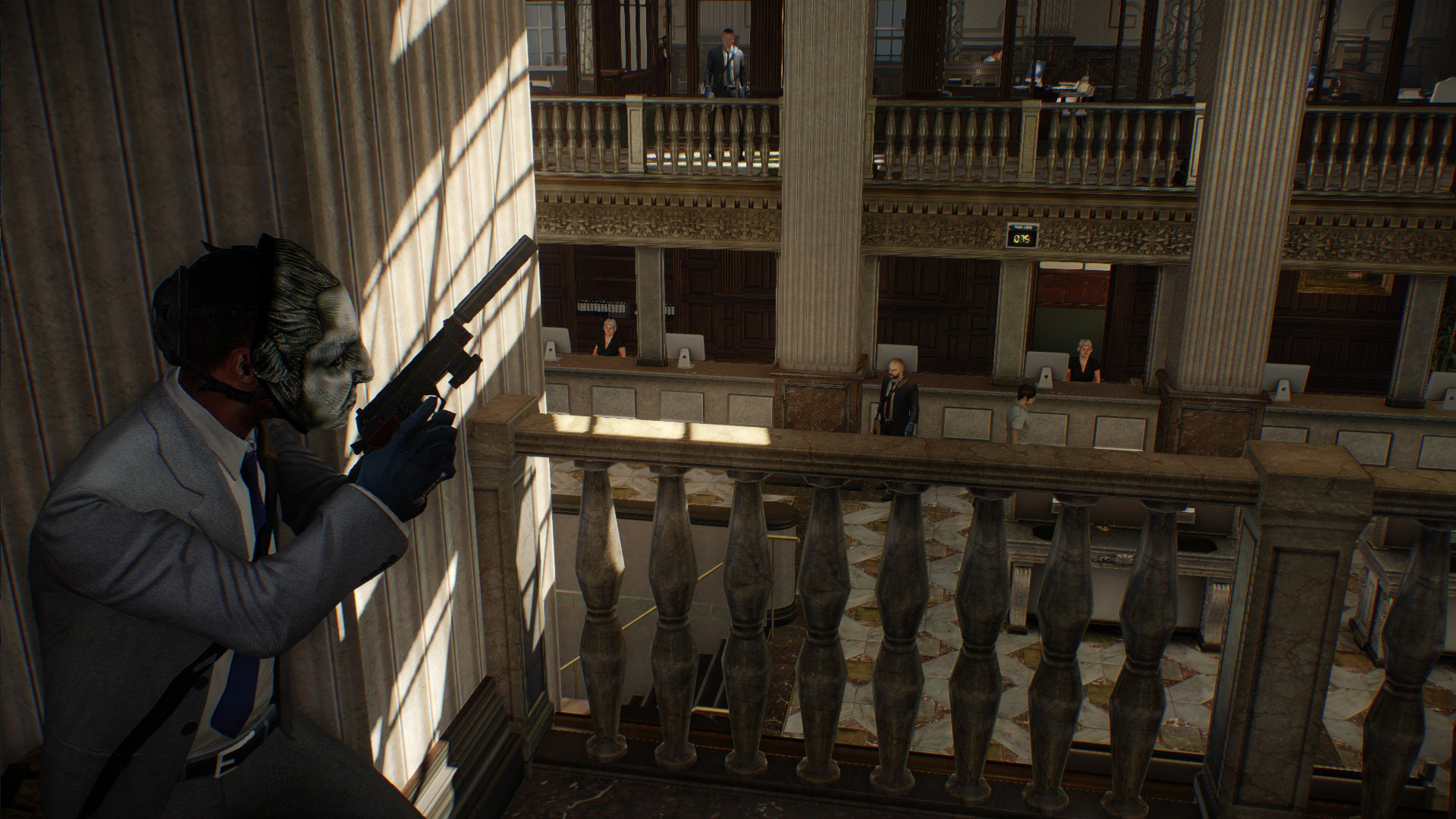 Combat encounter in PAYDAY 2.
Where it gets awkward is in the civilian AI, which can feel inconsistent. A bystander who witnesses a body will sometimes freeze and stare for a full three seconds before reacting, giving you enough time to cable-tie them. Other times the same scenario triggers an instant alarm. Veterans learn the edge cases and route around them, but new players often can't tell whether they made a mistake or encountered a rough engine tick. It's not game-breaking, but Overkill never fully ironed it out across the game's update cycle, and it still shows.
Eight Years of DLC and What That Means
PAYDAY 2's post-launch history is almost impossible to summarise without a spreadsheet. The game received paid DLC for years — heist packs, weapon packs, character packs, skill point boosts — until the total content library became one of the more unwieldy storefronts in Steam history. At its peak the DLC list ran to over 60 items. Some of it is genuinely substantial: the Goat Simulator heist is an absurdist set piece that functions as a real map, the Alesso Heist added a nightclub concert stage you have to manage during the job, and several weapon packs included firearms that became staples of high-difficulty builds.
Some of it is not worth the asking price. A handful of character skin packs add almost nothing to the gameplay loop, and a few weapon DLCs sit well below the power curve of the base game's better options. The trouble for a new player in 2024 is figuring out which DLC actually changes what they experience and which is padding. Overkill did make a significant chunk of previously paid content free via a large 2018 update, which helped. But the storefront still requires homework, and that's a genuine friction point for anyone coming in late.
Worth noting: the game's economy for unlocking weapons and modifications uses a card-drop system tied to post-heist rewards. It's largely cosmetic in its current state and doesn't gate the most effective skill builds, but the randomised nature of what drops was more contentious in earlier years when certain items were harder to access. The structure has been revised over time and isn't predatory in the way some contemporaries were, but it's not nothing either.
How It Plays With Strangers vs. a Regular Crew
The gap between a coordinated four-person team and a public lobby is wider in PAYDAY 2 than in most co-op games. That's not quite a criticism — it's partly the design working as intended — but it does shape what kind of game you're actually getting. In a public lobby on a stealth heist, somebody will always sprint through a laser. In a coordinated team with voice chat, the same heist becomes a different genre almost, something closer to a puzzle with a time limit. Both versions are in there, and which one you default to will determine how much you enjoy the game.
The matchmaking itself is barebones. You can filter by heist name and difficulty, which is enough to find a run, but there's no in-lobby communication system, no role selection, no way to signal your build before the heist starts. Teams fall into chaos not because the players are bad but because nothing in the interface nudged them toward coordination. Compared to how something like Deep Rock Galactic handles lobby readiness signals, PAYDAY 2's pre-heist lobby feels like a 2013 artefact. Which, to be fair, it is.
Where It Still Earns Its Place
The reason to return to PAYDAY 2 in 2024 — or to come to it fresh — is that the core loop has a mechanical density that a lot of later co-op shooters haven't matched. The skill system is broad enough to support genuine experimentation across dozens of hours. Build theory for high-difficulty runs is still actively discussed in the community, with players testing interaction between the Crew Chief perk and specific shotgun breakpoints, or arguing about the optimal crew configuration for the Death Sentence difficulty on Bank Heist: Deposit. That level of ongoing engagement with the mechanical layer is a reliable signal that the foundation is solid.
PAYDAY 3 launched in 2023 and had a difficult start — server problems, a thinner heist roster, mixed reception to its revised skill system. Some of those issues were addressed over subsequent patches, but it didn't displace its predecessor in active player count for most of its first year. That says something. A game from 2013 holding that position against its own sequel is either an indictment of PAYDAY 3 or a testament to PAYDAY 2, and the honest answer is probably both.
The Verdict
PAYDAY 2 rewards the group that treats failure as information. The heist that goes loud when it shouldn't teaches your team something. The successful stealth run that required three restarts teaches more. The skill ceiling is real, the build depth holds up, and the best heist designs still generate the kind of specific, story-shaped memories that only co-op play produces. New players should expect an interface that hasn't been modernised and a DLC catalogue that needs a guide to navigate. Veterans already know what they have. If you don't own it and you play co-op shooters, the case for skipping it keeps getting harder to make.
Editorial scoring
Reader Q&A
How long does it take to finish PAYDAY 2 still rewards the crew that doesn't panic?
Main story runs around 85 hours depending on how thoroughly you explore. Completionists can spend 2-3× that.
Is PAYDAY 2 still rewards the crew that doesn't panic good for newcomers to Co-op Heist FPS?
Yes — PAYDAY 2 still rewards the crew that doesn't panic is a great entry point. The early hours teach the systems gradually and the difficulty curve is reasonable.
Which platform should I play PAYDAY 2 still rewards the crew that doesn't panic on?
Console version is the most stable on launch. PC version benefits from the modding scene long-term.
Was PAYDAY 2 still rewards the crew that doesn't panic worth the launch-day price?
Released in 2013, and as of writing it holds up. Wait for a sale if you're price-sensitive — major discounts arrive within 6 months.
Are there DLCs or expansions worth picking up?
Wait for the Game of the Year edition — it bundles everything at a fair discount.
What did Overkill Software get right (and what could be better)?
The systems are confident and the combat is satisfying. The story handoffs and load times are the rough spots.
Reader comments