
Persona 5 Royal makes rebellion look this good for a reason
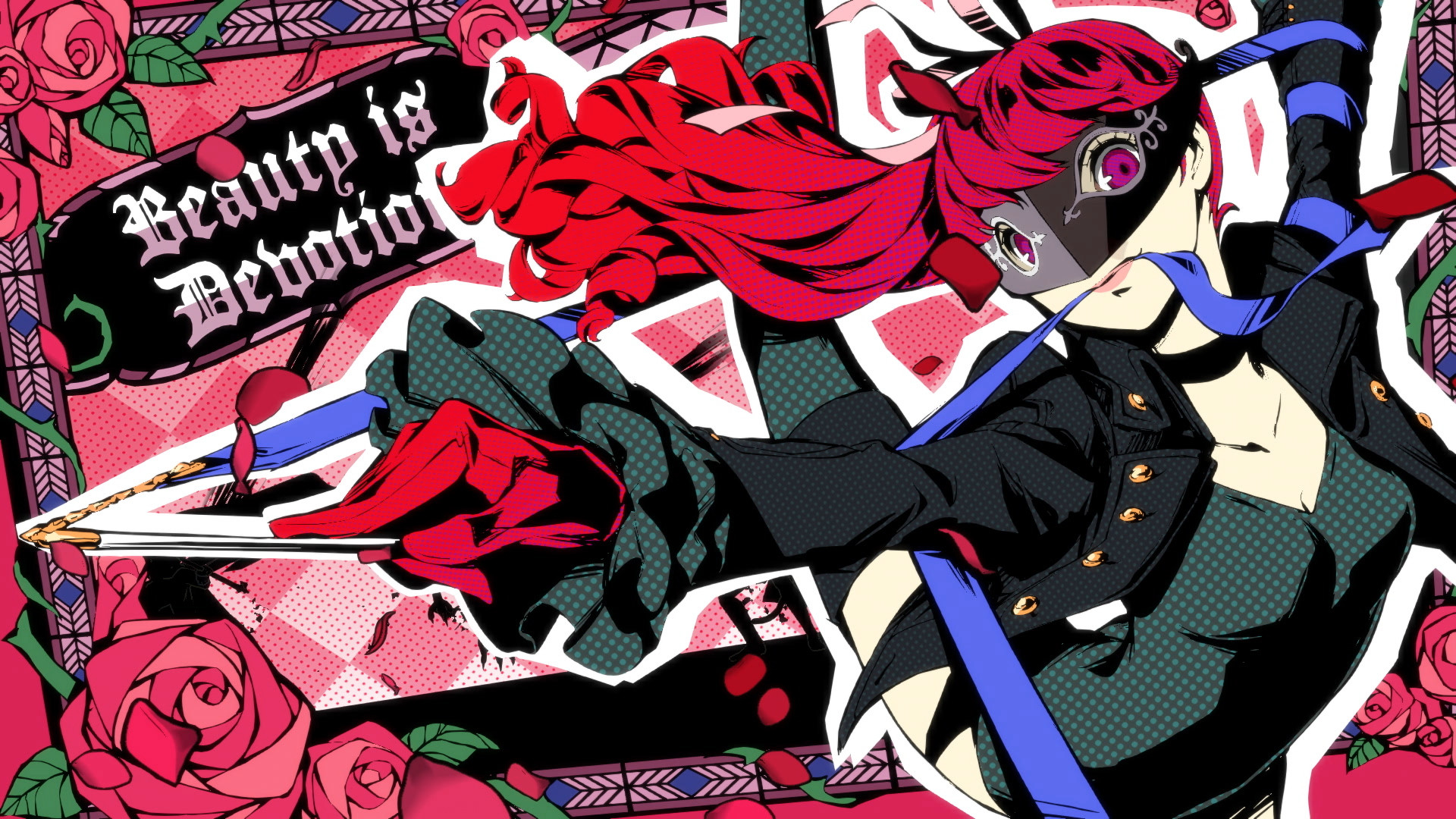
Eighty-five hours in, with every Palace cleared, every Confidant maxed, and Ryuji's absolutely exhausting battle cry burned into my memory, Persona 5 Royal still found ways to surprise me. That alone should tell you something. Most JRPGs of this length start revealing their seams around hour forty. Atlus's 2019 original — expanded into Royal in 2020 for PS4, then ported across everything with a processor in 2022 — holds its construction together through something more deliberate than spectacle. It knows exactly what kind of game it wants to be and executes that vision with a rigour that most studios in this genre wouldn't bother attempting.
That vision is, at its core, about friction styled as freedom. The Phantom Thieves are teenagers who can't control their school schedules, social calendars, or parole conditions — and somehow that constraint becomes the engine the whole game runs on. Persona 5 Royal is a time-management RPG that disguises itself as a heist anime, and the disguise is so persuasive that you're already committed before the mechanical implications fully land. This is not a criticism. It's a design compliment of the highest order.
The calendar is the real dungeon
Every in-game day is parcelled into chunks: daytime, after school, and evening, sometimes with additional slivers carved out by story beats. You pick what to do with each chunk, and the choices compound. Spend three evenings reading a library book to raise your Knowledge stat, and you've given up three evenings with Makoto's Confidant, which means fewer battle perks when her Personas need to perform. Nothing is wasted, but nothing is free either — and the game communicates this not through tutorial pop-ups but through gentle, mounting regret.
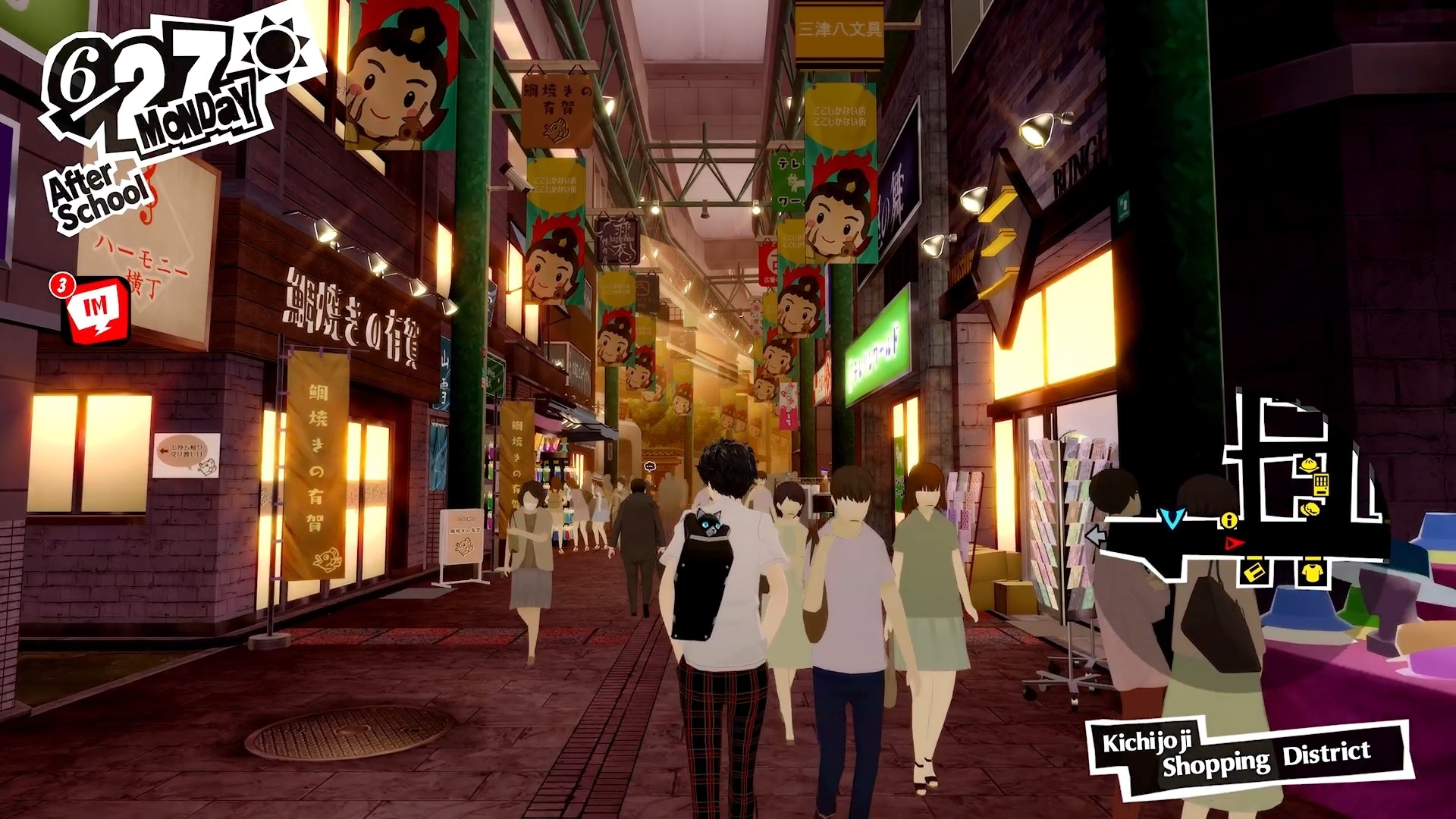 Atmospheric detail in Persona 5 Royal.
Older entries in the Persona series handled this similarly, but 4 Golden's Inaba felt small enough that you rarely felt the weight of what you weren't doing. Tokyo — split across Yongen-Jaya, Shibuya, Shinjuku, and a dozen other districts — carries actual urban density. Choosing Leblanc's coffee bar over Akihabara's video game shop feels like a real trade-off rather than a menu selection. That texture matters. It's why the calendar system, which could read as punishing, mostly reads as satisfying.
Palaces versus Mementos, and why the gap matters
The hand-crafted Palaces are where Royal's design reaches its peak. Each one is architecturally themed around the cognitive distortions of its villain — Madarame's museum, Kaneshiro's flying bank, Futaba's pyramid — and the puzzles inside reflect that theming with unusual consistency. Kaneshiro's vault sequences, where you're essentially tracing the logic of money laundering through spatial design, are clever in ways that most puzzle designers would be proud to put on a CV. The pacing within each Palace also gives players momentum: find the map, locate the treasure, create the calling card, return for the boss.
Mementos, the procedurally generated subway dungeon, is the inverse. It exists to serve Confidant requests and to give players somewhere to grind Personas, and it never pretends otherwise. The problem is that it goes on for roughly twice as long as it has any business doing. By the fourth or fifth trip, the visual monotony — grey tiled corridors with colour-coded segments that feel like a loading screen stretched into gameplay — starts to erode goodwill. Royal adds some quality-of-life improvements through Mona's scooter speed boost and Jose's collectible-exchange system, but neither fixes the fundamental dullness of repeating the same corridor structure for 20-plus hours.
 Combat encounter in Persona 5 Royal.
Turn-based combat that actually respects your time
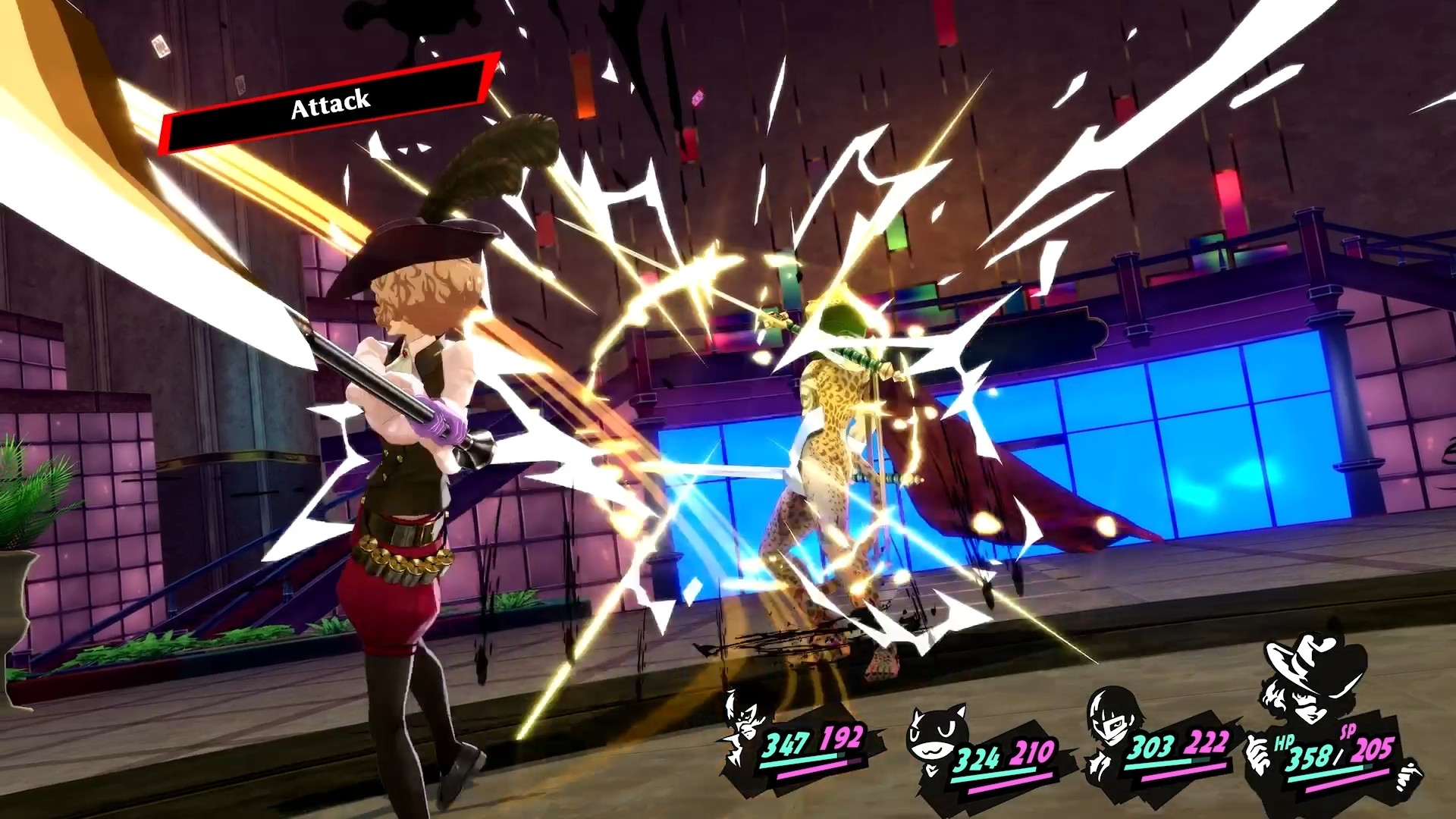
The Press Turn system — inherited from Shin Megami Tensei and refined across multiple Persona entries — still functions as one of the most elegant combat designs in the genre. Hit an enemy's elemental weakness, and you earn a Baton Pass: transfer your action to another party member who gains a stat buff and gets to move immediately. Chain four of them correctly, and you've converted a single encounter into an efficiency demonstration. The mechanical expression of teamwork here is more meaningful than anything in the recent Final Fantasy XVI, where party members are mostly passengers.
Royal adds Showtime attacks — cinematic dual-character specials that trigger under certain conditions — and while they look extraordinary, their activation logic is opaque enough that you mostly receive them as pleasant interruptions rather than planned tools. They're flashy and fun; they're not strategic. The more impactful addition is the third-semester content, which introduces new party configurations and slightly rebalances Persona fusion toward lategame viability. If you're coming to Royal from the original, that rebalancing alone justifies the upgrade.
Where the story earns its length
Persona 5 Royal's central narrative — teens discover adults are corrupt, teens form vigilante group, teens get crushed by the scale of what they started — takes around 60 hours to reach its first conclusion. That sounds exhausting, and there are stretches, particularly in the midgame lull between the fourth and fifth Palaces, where the pacing genuinely suffers. But the character work is specific enough that the length earns its keep. Futaba's arc around social anxiety and survivor's guilt is handled with more care than most games give to their main protagonist. Yusuke is consistently the funniest written character in the cast, which the English localisation preserves well.
Royal's third semester — the new material added after the original's ending — is worth the extra 15 to 20 hours. It recontextualises the game's themes around collective comfort versus personal truth in ways that the original's finale only gestured at. New character Kasumi Yoshizawa's Confidant arc, which restructures across the whole playthrough rather than sitting in a tidy chapter, initially feels scattered but pays off sharply in the final stretch. Akechi's expanded role is also stronger here, and the game wisely resists tidying up every ambiguity around him.
Style as substance, not decoration
There's a version of this conversation that treats Persona 5's aesthetic as separate from its design — as if the red-and-black UI, Shoji Meguro's jazz-inflected soundtrack, and the animated menu transitions are cosmetic layers you could peel off without losing anything structural. That's wrong. The visual language reinforces the game's argument. Every UI element behaves like a stolen document: stamped, filed, dramatically revealed. The music shifts register depending on whether you're in a Palace, a café, or a boss fight, using genre contrast — acid jazz against operatic synths — to underline tonal changes the story is already making.
Meguro's "Life Will Change" and "Rivers in the Desert" are the tracks most people quote, and for good reason — both land at moments where the gameplay and narrative have spent hours earning the emotional spike. But the quieter work carries weight too. "Beneath the Mask" as the night-time ambient theme runs for so many cumulative hours that it becomes almost architectural, a sonic wallpaper you stop noticing until the game deliberately pulls it away. That's a compositional strategy, not an accident.
Where Royal sits in the genre
Comparing Persona 5 Royal to its immediate contemporaries isn't straightforward, because very few games are actually doing the same thing. Baldur's Gate 3 is a longer RPG with more systemic freedom but no equivalent to the calendar constraint that gives Persona its shape. Metaphor: ReFantazio, Atlus's own 2024 follow-up, borrows the social link structure and iterates on the combat, but its world lacks the specificity of Tokyo's geography. The closest comparison is probably Persona 4 Golden, not because they're equivalent in quality — Royal is more sophisticated — but because both understand that an RPG's emotional core lives in the mundane hours between boss fights.
Royal isn't a perfect game. Mementos is a drag. A couple of Confidant arcs — Mishima's in particular — feel like placeholder writing that survived too many revision passes. The English voice direction swings between excellent and flattened in ways that the Japanese track mostly avoids. But none of that changes the fact that Atlus built something here with genuine structural intelligence: a system in which style and mechanics reinforce each other so consistently that the 85 hours feel chosen rather than endured. That's harder to do than it looks, and most studios making JRPGs right now aren't managing it.
If you've been waiting for the right moment to start Persona 5 Royal, you've now run out of excuses. Clear a month. Accept that Mementos is going to test your patience around hour fifty. Get through it. What's on the other side justifies every hour you put in to reach it.
Editorial scoring
Reader Q&A
How long does it take to finish Persona 5 Royal makes rebellion look this good for a reason?
Main story runs around 85 hours depending on how thoroughly you explore. Completionists can spend 2-3× that.
Is Persona 5 Royal makes rebellion look this good for a reason good for newcomers to Stylish JRPG?
It depends. The systems are deep but the tutorial does a fair job. Veterans of Stylish JRPG will feel at home faster.
Which platform should I play Persona 5 Royal makes rebellion look this good for a reason on?
PC version offers the highest fidelity if your rig can handle it. Console versions are polished out of the box.
Was Persona 5 Royal makes rebellion look this good for a reason worth the launch-day price?
Depends on backlog. The replay value justifies the price for genre fans; casual players should wait for a 40%+ discount.
Are there DLCs or expansions worth picking up?
Skip the cosmetic DLC. The story expansion is the only one we'd recommend at full price.
What did Atlus get right (and what could be better)?
Strongest: art direction, audio design, set-piece variety. Weakest: late-game balance and a few persistent quest-log bugs.
Reader comments