
Saints Row IV is ridiculous on purpose — and that's the whole point
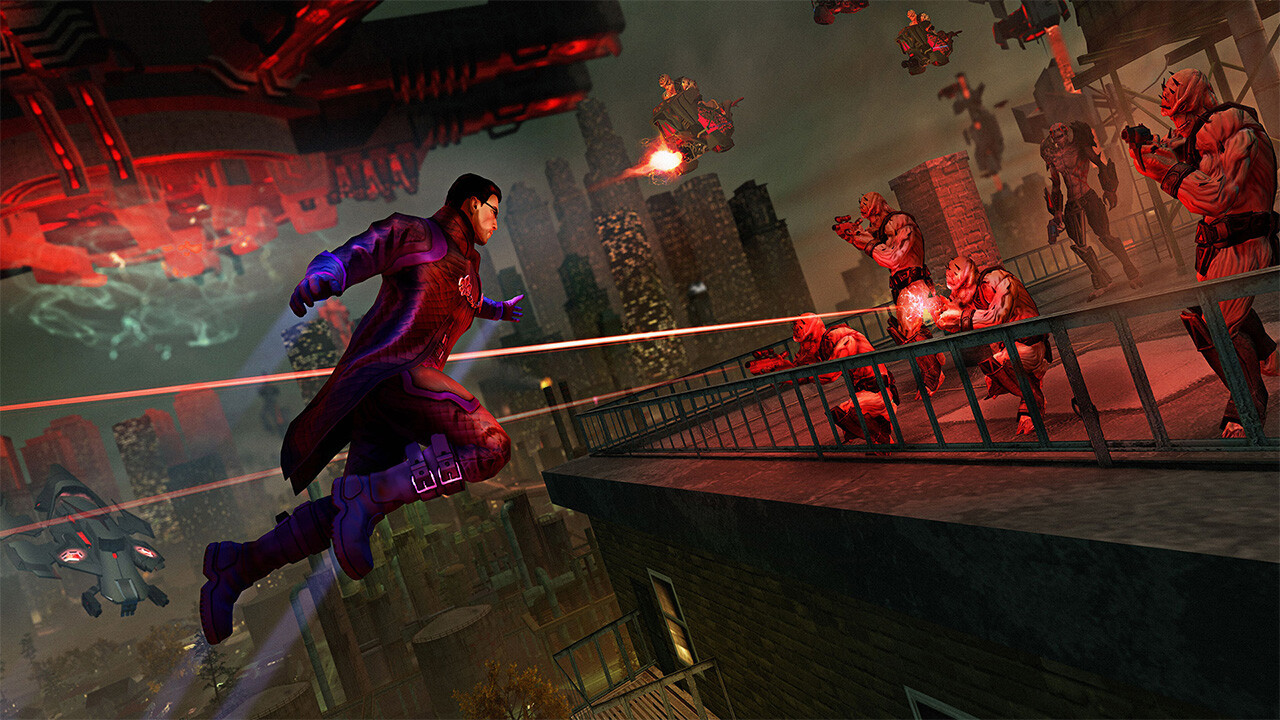
Saints Row IV is a game built on the premise that restraint is for other franchises. Released by Volition in August 2013, it takes the open-world crime sandbox that Deep Silver had been pushing toward absurdity since the second entry and finally, without apology, runs it off a cliff — and then gives the player superpowers so they can fly back up. The Boss of the Third Street Saints becomes the President of the United States, gets abducted by an alien warlord named Zinyak, and ends up fighting through a simulated version of Steelport while hurling fireballs and sprinting at speeds that make cars irrelevant. The game knows exactly what it is. The question worth asking is whether knowing what you are is the same as executing it well.
The honest answer is: mostly, yes — with caveats that stack up across a fifteen-hour playthrough. Saints Row IV is genuinely funny at times, genuinely well-designed in places, and genuinely unfinished in others. It succeeds less because it's trying harder than its predecessors and more because it's finally honest about the direction the series had been heading since Saints Row: The Third turned Stilwater's gang politics into a circus. What it offers is a specific kind of sandbox comedy — one that works when the writing is sharp and the movement systems are doing something interesting, and drags when neither of those things is true.
Superpowers are the real design engine here
The superpower system is the game's single most significant structural decision, and it's a better one than it might sound on paper. Early access to Sprint lets you cross Steelport faster than any vehicle, which sounds like it removes the point of the city — and to some extent it does — but the trade-off is that traversal becomes tactile and skill-expressive in ways that driving never quite was. Once you unlock Glide and then the jump upgrades, the movement set starts to feel genuinely satisfying to chain. It's closer to Crackdown's agility orb progression than to anything in the prior Saints Row entries, and that's not an accident; the freedom of vertical and horizontal movement reshapes how you read the environment.
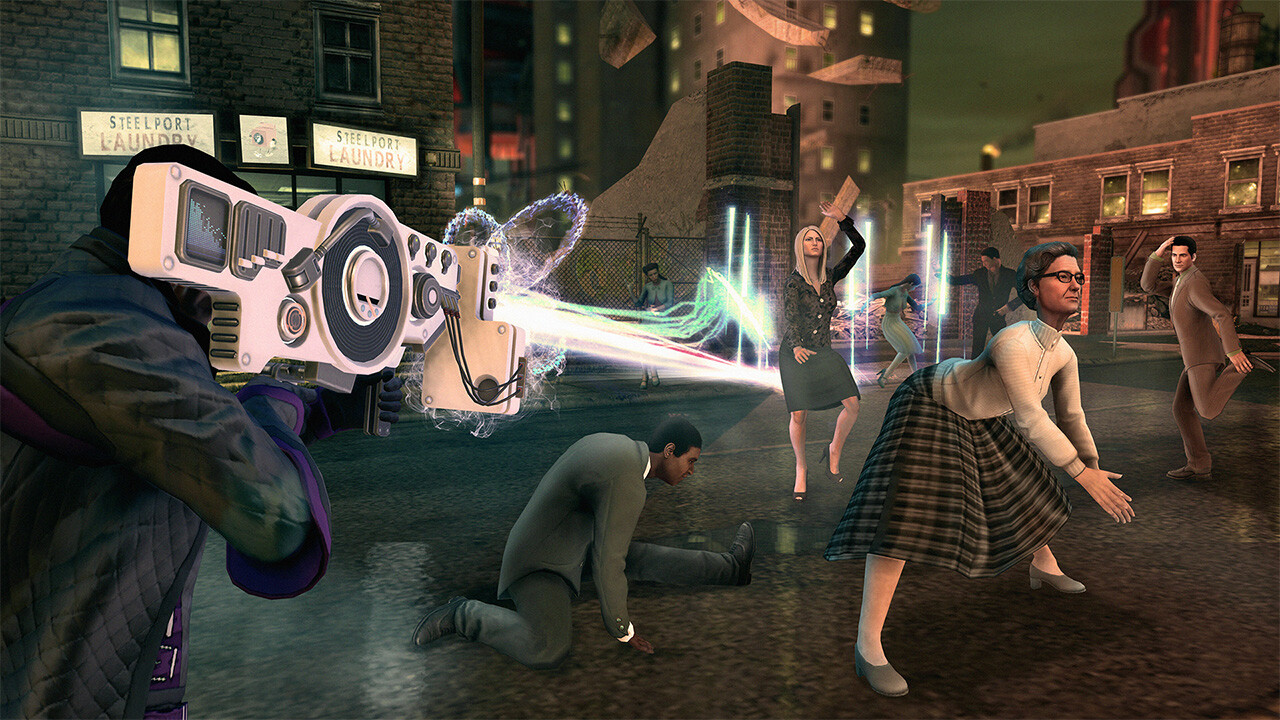 Scene from Saints Row IV.
The combat powers are less consistently useful. Telekinesis is fun for the first hour, picking up cars and flinging them into clusters of alien soldiers. Freeze Blast, unlocked mid-game, becomes a crutch because crowd control in the simulation missions can spike in difficulty with little warning. Some of the later power upgrades — the ones requiring significant amounts of clusters, which are collectibles scattered across rooftops and alleys — feel like padding rather than progression. The upgrade economy runs on two currencies: cache, earned from missions and activities, and clusters, earned from exploration. The split is reasonable in theory, but the cluster count required to max out powers late in the game is high enough that completionists will feel the grind before the story wraps.
The writing earns its moments when it's actually trying
The comedy in Saints Row IV runs on two tracks: pop-culture parody and character-specific humor built around the returning cast. The parody track is uneven. The Metal Gear Solid-inspired mission 'Hello Teacup' and the Mass Effect riff in a late-game loyalty mission both land because they're doing actual structural parody — they recreate specific mechanics and aesthetics from the source material before pulling the rug. The broader political satire around the Boss-as-President setup is much thinner, more set-dressing than substance, and it deflates quickly once the alien invasion gets going.
The character-specific material holds up better because Volition had four games of investment behind it. Kinzie Kensington, the hacker who serves as the simulation's primary support contact, gets a loyalty mission that's legitimately one of the better pieces of writing in the series — it's earnest in a way the game doesn't usually allow itself to be. Pierce and Shaundi's threads are thinner but functional. Keith David plays himself and commits entirely, which helps. The voice direction overall is confident; even when a joke doesn't land the delivery rarely makes it worse. That matters more than it might seem in a game where you'll spend a lot of time listening to mission briefings.
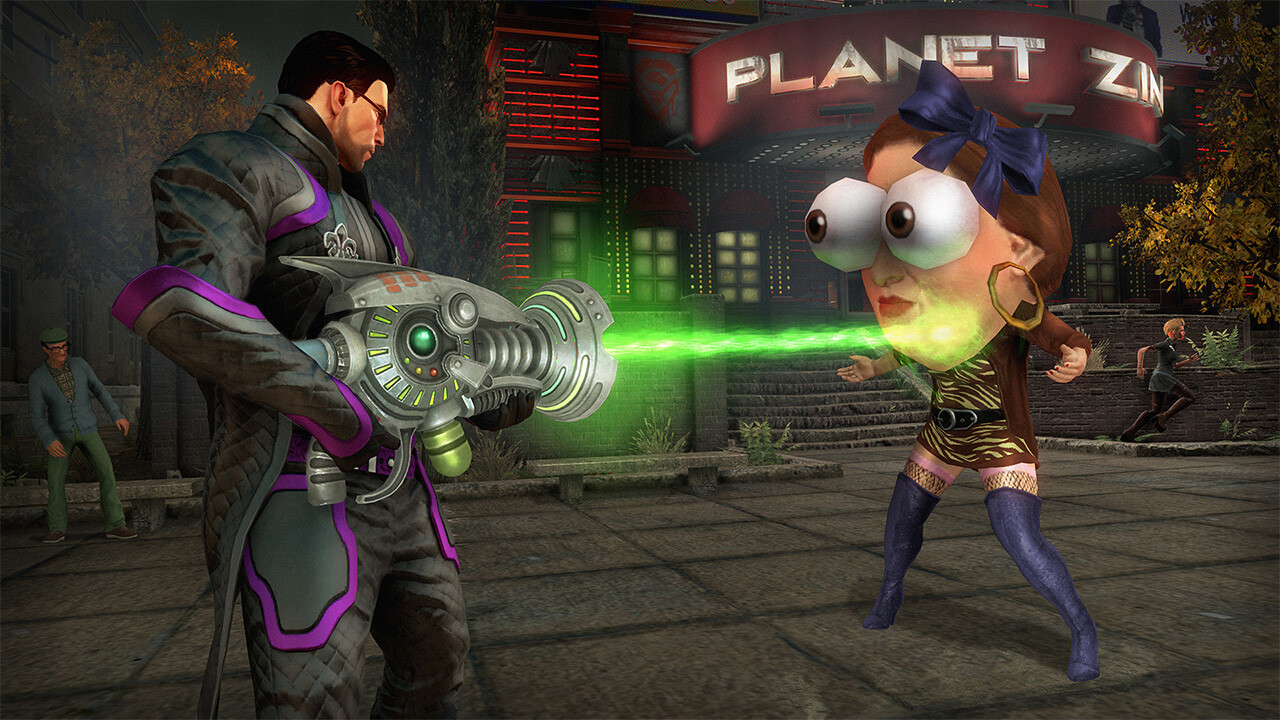 Scene from Saints Row IV.
Steelport revisited is a trade-off, not a failure
Reusing Steelport from Saints Row: The Third is a decision that drew criticism at launch, and the criticism was fair to a point. The city isn't redesigned in any meaningful way; the simulation framing adds visual glitch effects and alien architecture in a few districts, but if you played the previous game you will recognize almost every block. For players coming to Saints Row IV fresh, this probably doesn't register. For anyone who spent thirty hours in Steelport two years prior, there's a flatness to the world that the superpowers can't fully compensate for — you're moving faster through space you've already memorized.
That said, the simulation conceit does some real work. The city's instability — which manifests as waves of increasingly aggressive alien patrols tied to your Notoriety meter — gives the open world a tension that Saints Row: The Third's police system never quite achieved. Pushing your Notoriety high and then clearing it down through combat is one of the more pleasurable loops in the game. The Warden enemies, which spawn as high-priority threats when your Notoriety peaks, are bullet-spongey in the wrong way at first, but once you understand that freeze powers and then melee finishers are the intended solution, encounters sharpen up considerably.
Where the construction shows
The loyalty missions are structurally the game's best content. The side activities are not. The wave-defense missions, the platforming challenges inside simulation towers, and several of the challenge activities recycled from The Third sit in the game as filler rather than design. The platforming specifically is an issue because the jump physics, while fun in free exploration, are tuned loosely enough that precision challenges become frustrating. Volition clearly knew this was a weak point — very few of the critical-path missions ask for precise jumping — but the optional content doesn't get the same care.
There are also some mission-design choices in the back half of the game that feel undercooked. A sequence involving the Zin mothership relies on on-rail shooting that's functional but clearly not where the team's energy was. The final few missions arrive quickly once you've cleared companion loyalty content, and the pacing in that final stretch has a rushed quality — less like a considered finale and more like a game that hit its ship date. None of this is fatal, but it does mean the game's quality is front-loaded, with the first eight or so hours delivering more consistently than what follows.
What holds up and what doesn't
The Re-Elected edition released in 2015 bundled the DLC, including Enter the Dominatrix — which is amusing but thin — and How the Saints Save Christmas, which is the better of the two purely on joke density. Neither is substantial enough to significantly extend what the base game offers. The visual upgrade in that edition is minor; Saints Row IV never looked technically impressive, and it still doesn't. What it had was art direction that suited the tone, and that remains intact. The alien aesthetic and the simulation color-grading do genuine work to make Steelport feel different enough from a straight reuse.
The co-op is present and broadly functional, though the camera and some mission triggers don't always behave well with two players in the session. Allies running through key scripted moments can skip dialogue or break NPC positioning. It's not consistent enough to recommend co-op as the primary experience, but for people who want to share the absurdity, it does work more often than it doesn't.
So does it belong in your backlog
Saints Row IV asks a specific question of the player: can you get enough out of a well-executed movement system and intermittently sharp comedy writing to forgive a recycled city, inconsistent side content, and a back half that loses momentum? For a certain kind of player — one who values mechanical pleasure over world-building, who finds the series' specific register of juvenile sincerity funny rather than exhausting — the answer is yes, fairly clearly.
For players who came to Saints Row hoping the fourth entry would mature the formula rather than abandon it, the answer has probably already been decided. Volition made a deliberate choice with this game, one that split the fanbase at the time and hasn't fully resolved since. Saints Row IV isn't trying to be Saints Row 2; it knows that, and it commits. The rough edges are real, but they're the rough edges of a game that was genuinely attempting something — not the rough edges of a game that ran out of ideas. There's a meaningful difference, even when the seams show.
Editorial scoring
Reader Q&A
How long does it take to finish Saints Row IV is ridiculous on purpose — and that's the whole point?
Main story runs around 85 hours depending on how thoroughly you explore. Completionists can spend 2-3× that.
Is Saints Row IV is ridiculous on purpose — and that's the whole point good for newcomers to Open-World Comedy?
For total newcomers, expect a 5-8 hour ramp-up. Once you internalize the loop, it clicks.
Which platform should I play Saints Row IV is ridiculous on purpose — and that's the whole point on?
Steam Deck handles this title well — verified compatibility on most recent patches.
Was Saints Row IV is ridiculous on purpose — and that's the whole point worth the launch-day price?
Depends on backlog. The replay value justifies the price for genre fans; casual players should wait for a 40%+ discount.
Are there DLCs or expansions worth picking up?
The base game is complete; expansion DLC adds 10-15 hours of additional content if you want more.
What did Volition get right (and what could be better)?
Strongest: art direction, audio design, set-piece variety. Weakest: late-game balance and a few persistent quest-log bugs.
Reader comments