
Slay the Spire still hits like a fresh deck every run
Slay the Spire came out in full in early 2019, after a long Early Access stretch that turned a modest Steam curiosity into something people were playing at two in the morning and regretting at six. MegaCrit, a two-person studio out of Seattle, built a card game where the cards were also your character build, your risk management, and your entertainment simultaneously. It was not the first roguelike deck-builder — Dominion had the deckbuilding, Hearthstone had the cards, and Dream Quest had the weird mash of both — but Slay the Spire made the genre click in a way nothing before it quite had.
Years on, the game still sells. It has spawned an entire subgenre: Balatro, Monster Train, Inscryption, Vault of the Void, and about forty others you have heard of only because someone in a Discord server would not stop posting screenshots. The lineage is real and traceable. So when the question comes up of whether Slay the Spire itself still holds up, the honest answer is mostly yes, with a few caveats MegaCrit has never quite addressed.
Four characters, four vocabularies
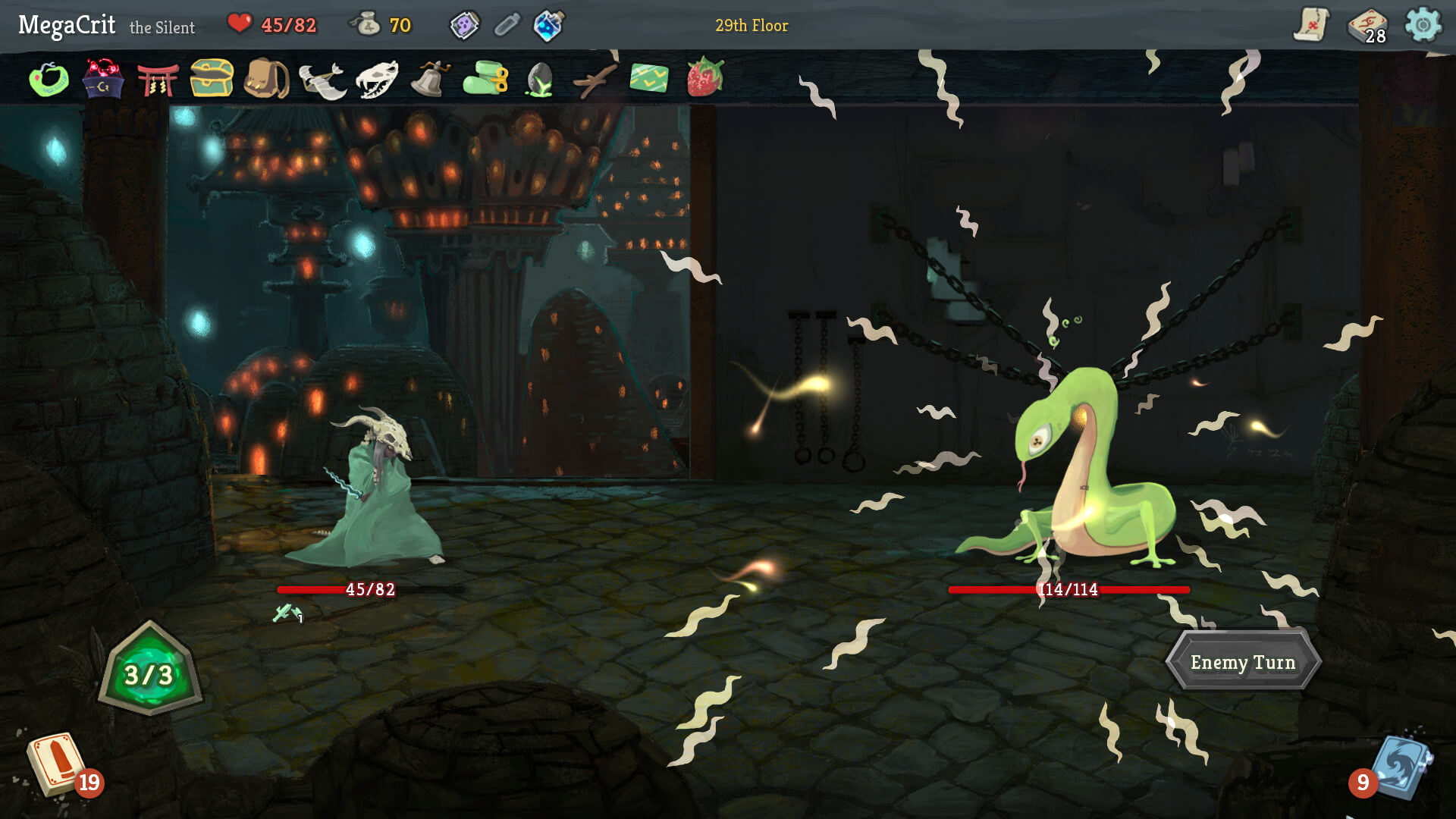
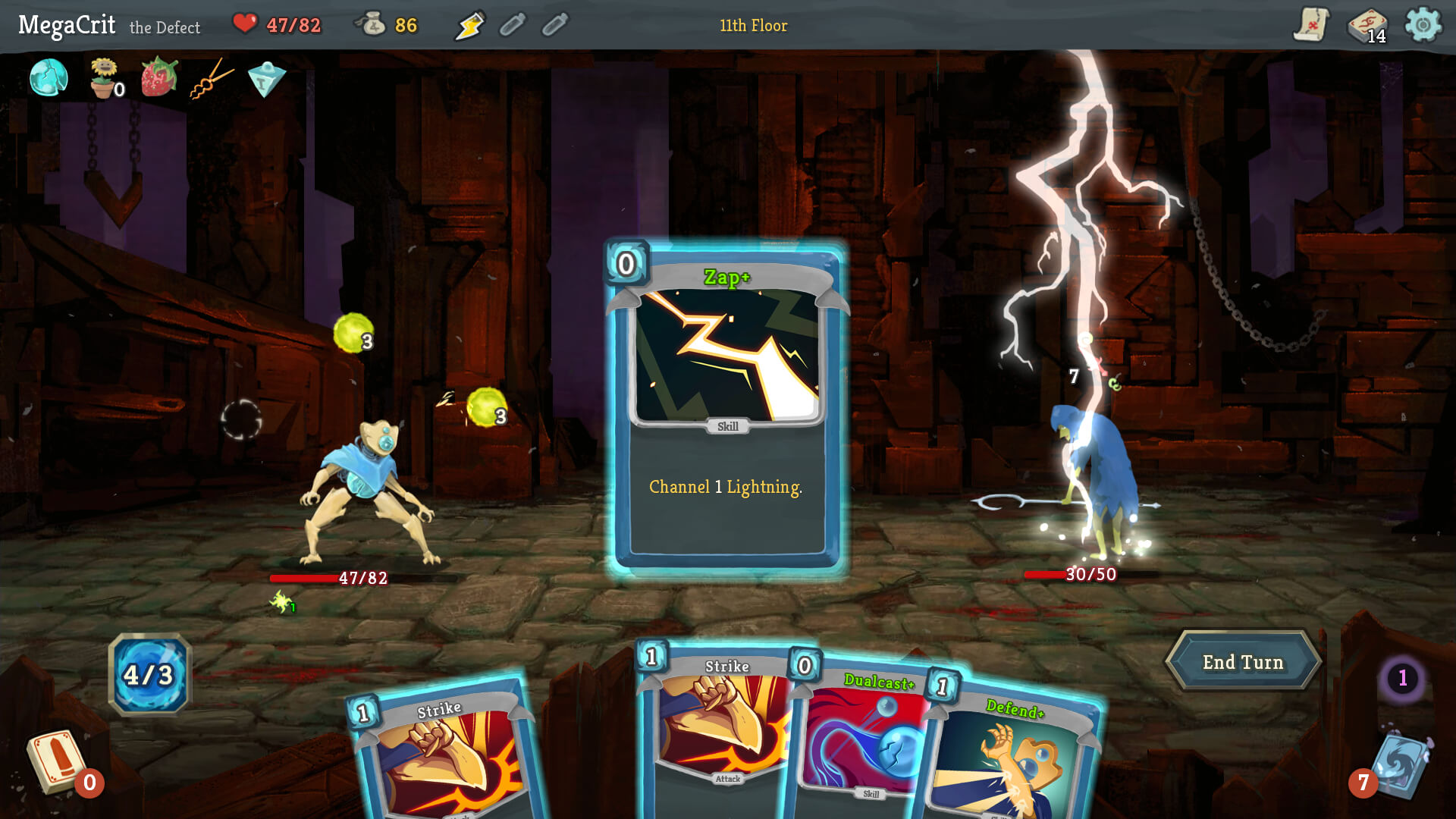
Each of the four playable characters — Ironclad, Silent, Defect, and Watcher — functions as its own mechanical language. The Ironclad is about strength scaling and self-healing, making him the closest thing the game has to a comfortable starting point. Silent runs on poison and shivs, rewarding players who can maintain pressure across multiple turns without a single big attack. Defect builds an orb-slotting system that feels like programming a tiny machine to kill things. Watcher is essentially a stance-switcher who can output enormous damage but will kill herself if you lose focus for a single turn.
 Scene from Slay the Spire.
The gap in accessibility between Ironclad and Watcher is significant, and the game does not explain it. If you start with Watcher, you will probably lose badly several times before understanding why. That is not entirely a criticism — there is something satisfying about figuring out that Watcher's Calm and Wrath stance cycle requires you to plan three or four cards ahead, and the game rewards that learning without holding your hand. But players who bounce off the third character and never try the fourth are leaving a genuinely interesting design on the table.
The asymmetry between characters is also what keeps long-term players around. A Defect run and a Silent run feel like different problems. You are not just replaying the same dungeon with a different skin; you are learning different card interactions, different synergies with relics, different thresholds for what counts as a viable deck.
How the card draft actually works
After each combat, the game offers you a choice of three cards to add to your deck — or to skip. That skip option is more important than it looks. Slay the Spire punishes deck bloat harshly; a 35-card deck that cycles slowly is often worse than a tight 12-card deck that hits the same three synergistic cards every two turns. The design is asking you to think like a competitive card game player and resist the instinct to take every card that looks powerful in isolation.
 Scene from Slay the Spire.
This creates some genuinely interesting decisions. Early in Act 1, you are drafting toward a theme you may not be able to fully commit to yet. A Defect player who finds a strong Lightning Orb card early has to decide whether to lean into an electrodynamics build before the relic support exists to make it consistent. The game generates these micro-puzzles constantly, and most of the time it generates them through systems rather than scripted encounters.
Shops and card removal exist on the map as optional nodes, and card removal — paying the shopkeeper to permanently delete a card from your deck — is one of the most strategically satisfying mechanics in the game. Removing the starter Strike cards that clog your early draws is the kind of thing that feels like maintenance but produces enormous results. It is unusual to find a game that makes deletion feel rewarding, and MegaCrit earns credit for that design call.
Relics carry most of the run-to-run variance
Relics are persistent items that stack over a run and modify the rules of play. Bag of Preparation lets you draw two extra cards at the start of combat. Anchor means you always start combat with three Block. Snecko Eye lets you draw two extra cards but randomizes the energy cost of every card in your hand, which either breaks your run or enhances it depending on how much of your deck costs two or more. There are over 200 relics in the game, and the more powerful ones — Boss relics like Runic Dome or Philosopher's Stone — come with genuine drawbacks.
The relic system is where Slay the Spire generates most of its storytelling. Not narrative storytelling — there is no plot to speak of, and what little lore exists is delivered through card flavor text and item descriptions. The story is the run: the improbable relic combination that made a specific card unstoppable, the run where Snecko Eye turned out to be exactly right because every card in a particular Silent build cost three or more energy anyway. These moments are emergent, which makes them feel earned.
Where MegaCrit left gaps
The Act 3 boss pool is where the game wobbles most visibly. The Time Eater, added in a post-launch patch, is widely considered one of the more annoying encounters — not because it is mechanically unfair, but because it punishes specific playstyles that were completely valid throughout the entire run. A Silent player who built around fast, cheap-card cycling can suddenly find that her entire strategy gets capped at twelve cards per turn before Time Eater heals a significant chunk of health. It feels like a post-hoc punishment for a decision the game encouraged you to make.
The Ascension difficulty system — twenty increasing difficulty levels per character — is well-constructed in principle, but the early Ascension levels feel like diluted hard modes rather than genuinely different challenges. Ascension 1 simply removes some healing from rest sites. Ascension 2 adds a minor debuff at the start of combat. The design does not start asking interesting new questions until around Ascension 10 or 11, which means a big middle portion of the system is mostly there to pad the number. Hades from Supergiant handled difficulty scaling better, giving each Heat modifier a specific mechanical identity rather than just reducing resources.
None of this is fatal. The base game is solid enough that the weak points feel like imperfections on a good foundation, not cracks running through the structure.
The Daily Climb and why the community stayed
The Daily Climb mode gives every player the same seed each day — same character, same modifiers, same map — and tracks scores on a global leaderboard. It is a simple feature that solves a real problem: roguelikes can feel isolating because no two runs are the same, which means talking about a specific run requires enormous amounts of context. The Daily Climb gives the community a shared text. People compare notes on the same seed, argue about which path they took, post scores in Discord servers.
The modding community also extended the game's life considerably. The Downfall mod adds playable antagonists including the three Act bosses. Hermit adds a fifth character with a high-noon duel mechanic. The Replay the Spire mod rebalances card pools and adds new cards across all four characters. None of these are official, and not all of them are equally polished, but they exist because the game's design is transparent enough that modders can extend it coherently.
Who should actually play it
If you have never played a deck-builder and want one with minimal noise — no online requirement, no cosmetic economy, no season pass — Slay the Spire charges a flat price and then leaves you alone with a very good game. If you have played it already and moved on to Balatro or Monster Train, coming back is a bit like returning to the restaurant that first taught you what good food tasted like. Familiar, still reliable, slightly smaller than memory suggests.
The game runs on basically anything. It is on every platform including mobile, which is genuinely where a draft-based card game belongs during a commute. The mobile port is one of the better conversions in the genre, not an afterthought.
Slay the Spire is not the most ambitious thing MegaCrit could have made. It has seams. Certain boss encounters punish specific builds in ways that feel arbitrary, and the difficulty ladder has a long flat section in the middle. But the core loop — draft cards, read synergies, build a machine, watch the machine either work or catastrophically fail — remains one of the cleaner expressions of what video games can do with systems design. The imitators prove it. Most of them have learned the vocabulary without quite getting the grammar right.
Editorial scoring
Reader Q&A
How long does it take to finish Slay the Spire still hits like a fresh deck every run?
Main story runs around 60 hours depending on how thoroughly you explore. Completionists can spend 2-3× that.
Is Slay the Spire still hits like a fresh deck every run good for newcomers to Roguelike Deck-builder?
Yes — Slay the Spire still hits like a fresh deck every run is a great entry point. The early hours teach the systems gradually and the difficulty curve is reasonable.
Which platform should I play Slay the Spire still hits like a fresh deck every run on?
PC version offers the highest fidelity if your rig can handle it. Console versions are polished out of the box.
Was Slay the Spire still hits like a fresh deck every run worth the launch-day price?
If you're a fan of MegaCrit, yes. If you're new to the studio, a sale price is more comfortable.
Are there DLCs or expansions worth picking up?
Wait for the Game of the Year edition — it bundles everything at a fair discount.
What did MegaCrit get right (and what could be better)?
The systems are confident and the combat is satisfying. The story handoffs and load times are the rough spots.
Reader comments