
Tales of Arise is gorgeous, heartfelt, and just uneven enough to sting
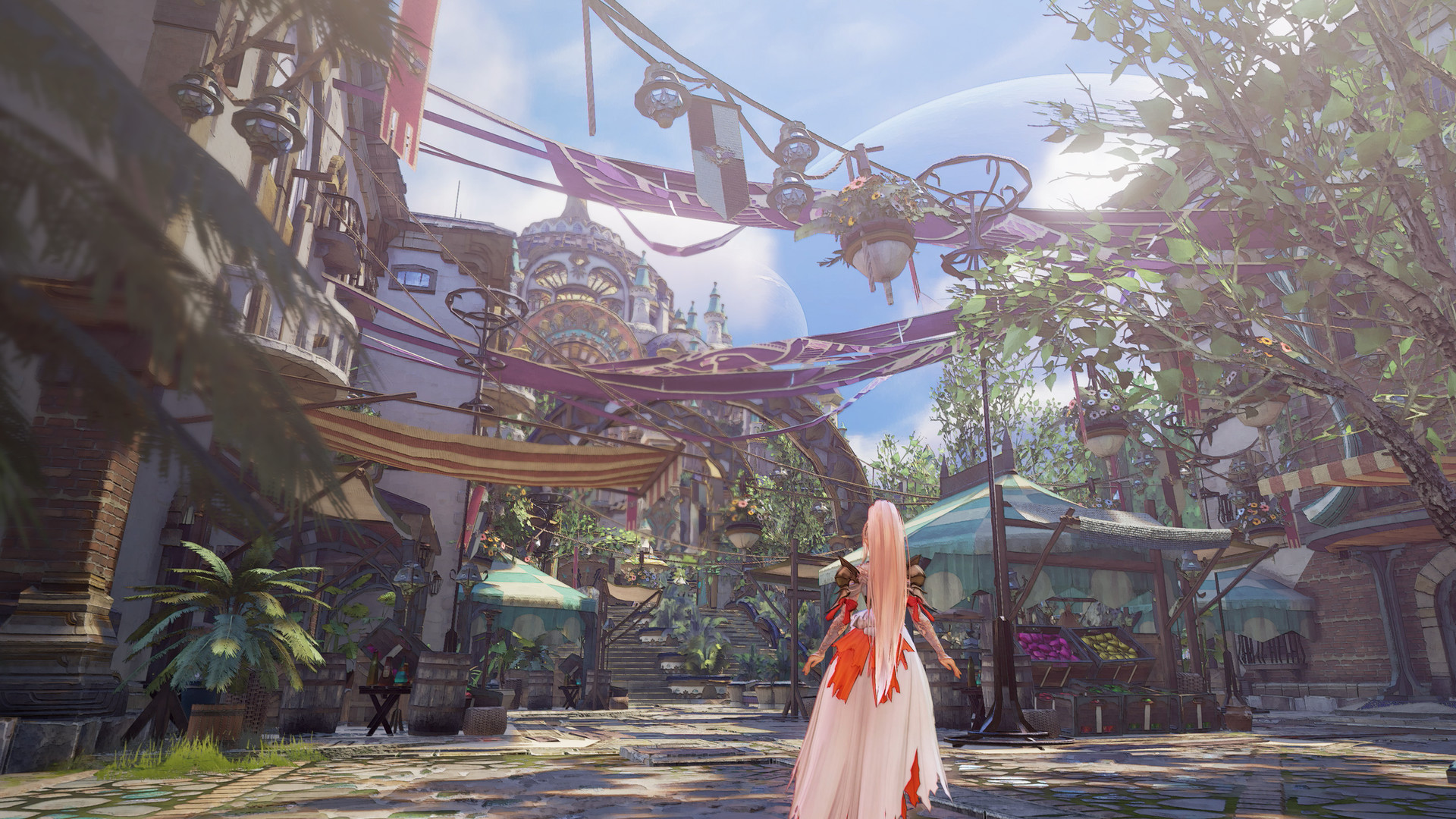
The opening hour of Tales of Arise shows you a man in an iron mask dragging himself through a slave camp while ash rains from the sky. It is not subtle. The world of Dahna has been colonized by the people of Rena for three hundred years, its inhabitants reduced to labor and stripped of memory. Alphen, the masked man, cannot feel pain. Shionne, the Renan girl he reluctantly partners with, causes agony to anyone who touches her. Bandai Namco's metaphor-delivery system is running at full capacity before the title card even appears.
After roughly 24 hours — covering the main story's first three lords, the bulk of the character-bonding skits, and more grilled barley than any one person should ever consume — Tales of Arise turns out to be a genuinely compelling JRPG that keeps nearly tripping over its own ambitions. It looks like Bandai Namco's best work in the series. It fights well. It also, at intervals, grinds against the very themes it's trying to honor. Almost great is not the same as falling short. It's a different category — one where you can see the design team straining toward something and mostly getting there.
The combat earns its complexity
Tales games have always lived or died by their real-time battle systems, and Arise might have the best one the series has produced. You control one character at a time with direct input while three AI partners handle their own positioning. Attacks chain into Artes — special moves mapped to face buttons with directional modifiers — and every successful hit on a staggered enemy can be converted into a Boost Strike, a cinematic team-up that requires coordination with a specific partner. It is a lot to track, and for the first few hours it feels overwhelming.
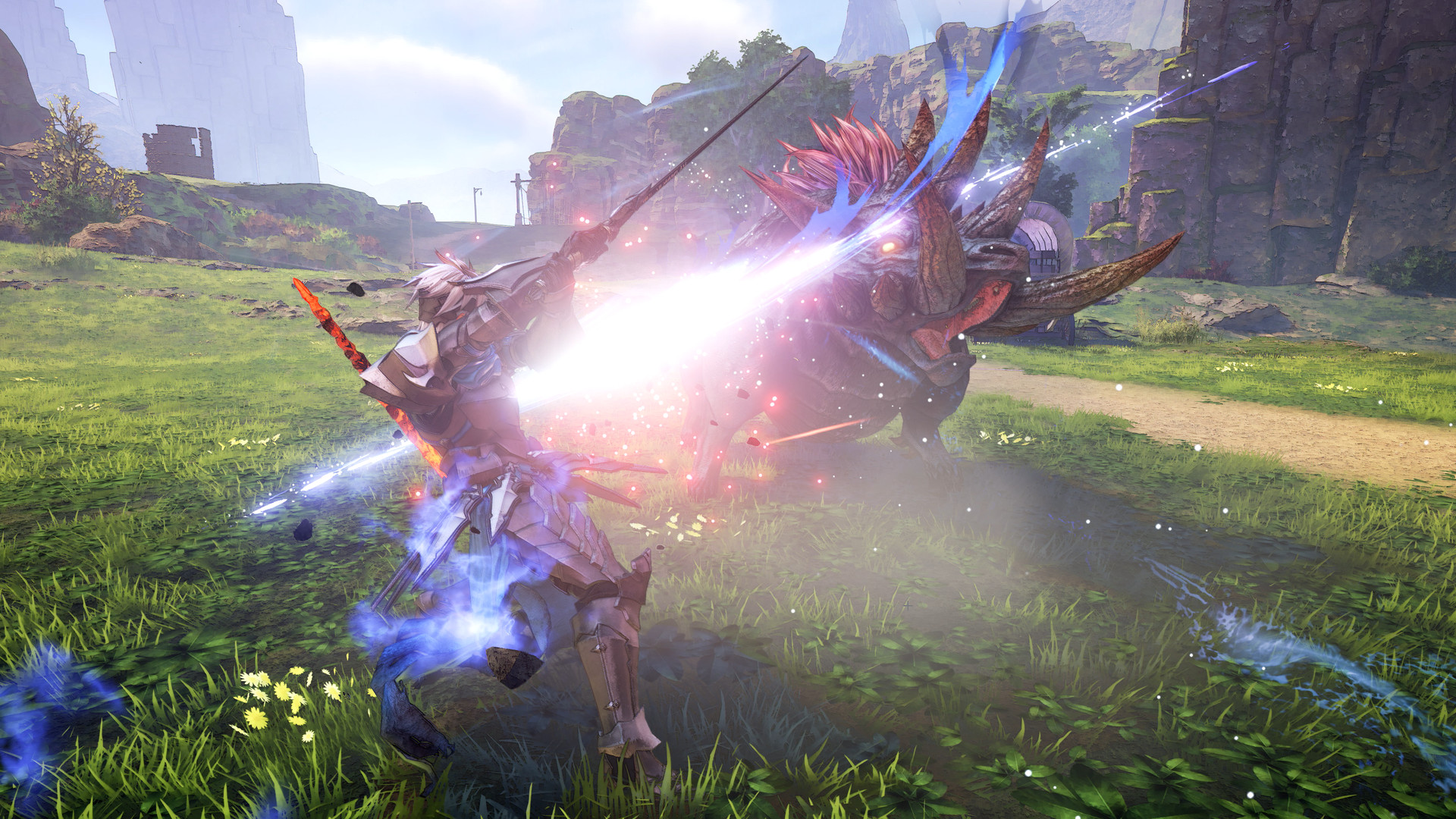 Scene from Tales of Arise.
Stick with it. By the time you reach the second lord's domain — the volcanic region of Menancia — the system starts clicking. Alphen's Flaming Edge Arte, which costs HP instead of CP, creates a risk-reward rhythm that keeps fights from becoming button-holding sessions. Rinwell's casting mechanics, where holding a button charges a spell that can be canceled into a free cast when she absorbs an enemy's magic, reward actual attention to what enemies are doing. The combat doesn't reach the depth of, say, Final Fantasy XVI's Eikonic abilities, but it rewards engagement consistently and punishes passivity. Harder difficulty settings make that tradeoff feel meaningful.
The art direction is doing heavy lifting
Arise uses a painterly visual style — cel-shading layered with watercolor-like brushwork — that gives environments a quality most anime-adjacent JRPGs don't manage: they feel like places rather than stage sets. The Elde Menancia countryside, with its floating islands and amber light, is a genuine pleasure to walk through. Rena's home environments, introduced in the back half of the game, have a cold geometric precision that reads immediately as imperial without anyone having to explain it.
The character designs are more divisive. Alphen looks like a standard-issue protagonist — dark hair, inexplicable outfit layering. Shionne's design comes loaded with the kind of exaggerated proportions that have followed the Tales series for years and remain tiresome. But the supporting cast partly compensates. Law is a brawler with a genuine arc about inherited rage rather than just a personality type, and Kisara, introduced late, has a defensive combat role built around her shield that the game actually explains through her backstory. Small thing. Worth noting.
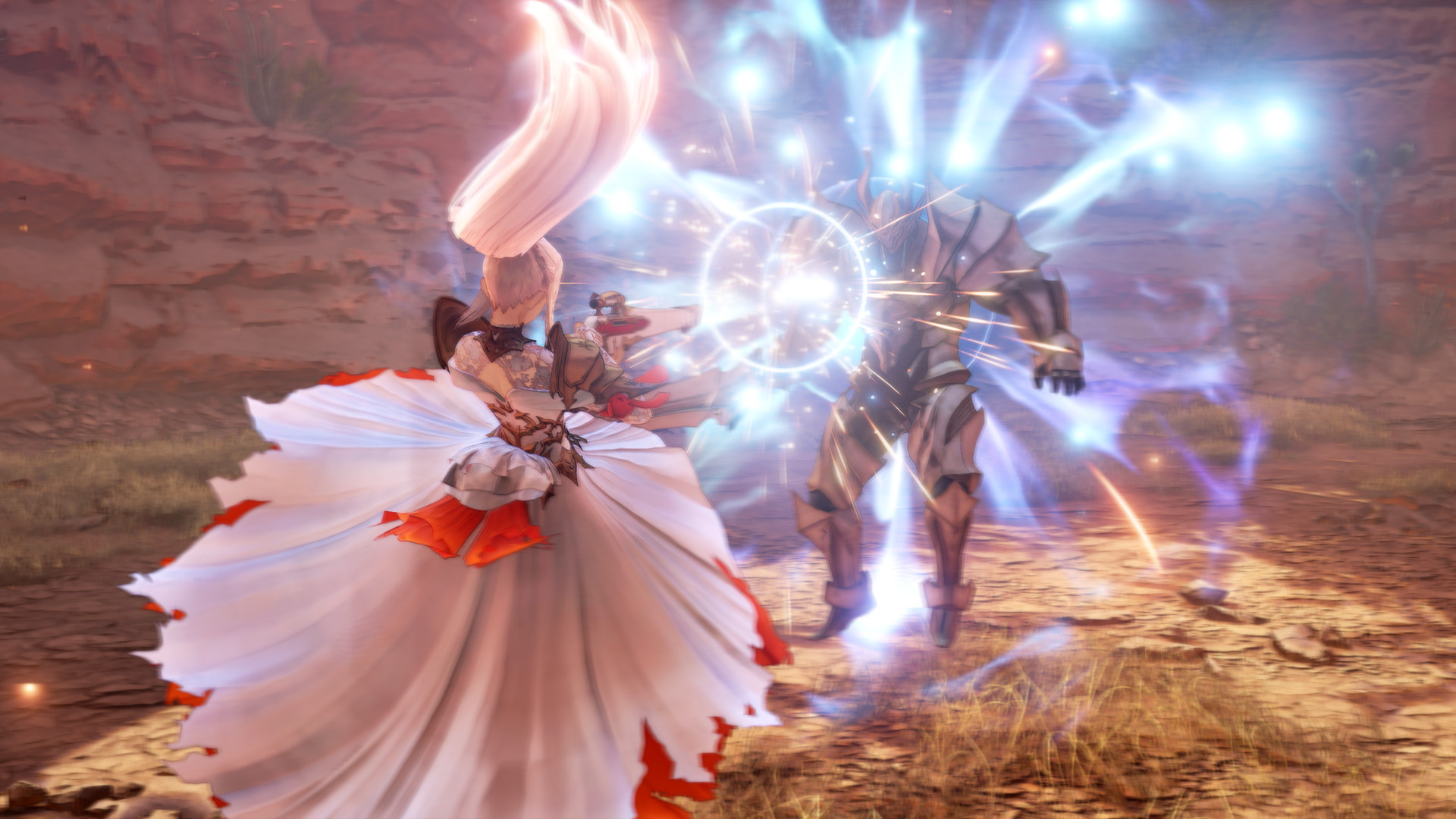 Scene from Tales of Arise.
Where the story stumbles
The first half of Tales of Arise is structured around five lords — Renan rulers each controlling a region of Dahna through different forms of exploitation. It's a chapter-based format that lets the game explore its themes with some focus. The slavery narrative is earnest to a fault, occasionally heavy-handed in ways that feel like the writing room second-guessing whether the audience is following along. But it's sincere, and sincerity covers a lot of structural sins.
The second half is where things wobble. Without spoiling the specific turns, the game shifts its central conflict around the 30-hour mark in ways that dilute the political specificity that made the opening half interesting. The slavery metaphor gets replaced by something more abstract and cosmically scaled — the kind of pivot that Tales games have made before, and that never quite satisfies. It's not that the new direction is bad; it's that the game built so much credibility with its grounded first act that the abstraction registers as retreat. Dragon Age: Origins pulled a similar move, trading Fereldan political texture for a big-sky demon-war endgame, and it hurt that game in the same way.
The skits, and why they matter more than you'd expect
Tales games have always used the 'skit' format — short, optional conversations between party members displayed as animated portraits — to do character work that cutscenes can't afford. Arise leans into this harder than most entries. There are hundreds of them, ranging from one-liners to extended exchanges that recontextualize what just happened in the main story. Dohalim's paternalism getting quietly challenged by Rinwell. Law and Alphen's friendship developing through repeated mundane disagreements. These are not revelatory scenes. But they accumulate.
The system also exposes an awkward design tension. Skits are triggered by exploration and story beats, but missable ones — tied to specific camp visits or map areas — can vanish if you push forward. In a game that wants you to care about its characters, putting the best character moments on an implicit timer is a strange choice. It never becomes a serious problem because the story pauses often enough, but it nags.
The open-world-ish structure and its tradeoffs
Arise is not an open world in the current industry sense — it doesn't have the Elden Ring expanse or Xenoblade's obsessive zone density. It's a sequence of contained areas connected by loading screens, each with sub-areas to explore and optional dungeons. The structure is closer to older Tales entries or to a condensed version of what Persona 5 does with its Tokyo neighborhoods. This is fine, and it keeps the pacing tighter than a full open-world design would allow.
Side content is the weak point. Most optional quests are fetch arrangements — bring three of this, eliminate four of those — dressed in thin narrative framing. A few are better: one questline in Viscint involving a Dahnan family trying to reclaim their home from Renan occupiers at least ties back to the game's central concerns. But the ratio of meaningful side content to padding tilts unfavorably. Ni no Kuni II had the same problem: gorgeous world, thin optional content, the discrepancy obvious precisely because the main game is good enough to set a high bar.
Where it lands on the JRPG ladder
Tales of Arise is the best-looking entry in the series and probably the most mechanically consistent. It takes a genuine swing at political themes and mostly lands the first half. The combat system rewards players who want to engage with it without becoming inaccessible to those who don't. These are not small achievements for a franchise that spent the better part of a decade releasing iterative entries to diminishing returns.
It doesn't touch Persona 5 Royal's structural confidence or Trails of Cold Steel's long-game world-building patience. It's below those. But it sits comfortably above Tales of Berseria — which had a better protagonist but messier systems — and well above the franchise's recent mid-tier. For anyone willing to absorb a second-half tonal shift that softens some of what the first half promised, there's a very good 40-hour game here. Not every JRPG needs to be a monument. Some of them just need to hold your attention from login to credits, and this one does.
The iron mask comes off early. What Alphen does with his face after that — whether the game earns the hope it puts there — depends a bit on your tolerance for anime JRPG earnestness operating at full volume. If you can meet it halfway, Arise gives you plenty to work with.
Editorial scoring
Reader Q&A
How long does it take to finish Tales of Arise is gorgeous, heartfelt, and just uneven enough to sting?
Main story runs around 47 hours depending on how thoroughly you explore. Completionists can spend 2-3× that.
Is Tales of Arise is gorgeous, heartfelt, and just uneven enough to sting good for newcomers to Anime JRPG?
For total newcomers, expect a 5-8 hour ramp-up. Once you internalize the loop, it clicks.
Which platform should I play Tales of Arise is gorgeous, heartfelt, and just uneven enough to sting on?
Steam Deck handles this title well — verified compatibility on most recent patches.
Was Tales of Arise is gorgeous, heartfelt, and just uneven enough to sting worth the launch-day price?
Released in 2021, and as of writing it holds up. Wait for a sale if you're price-sensitive — major discounts arrive within 6 months.
Are there DLCs or expansions worth picking up?
Wait for the Game of the Year edition — it bundles everything at a fair discount.
What did Bandai Namco get right (and what could be better)?
The systems are confident and the combat is satisfying. The story handoffs and load times are the rough spots.
Reader comments