
Vampire Survivors costs £2 and broke my entire weekend
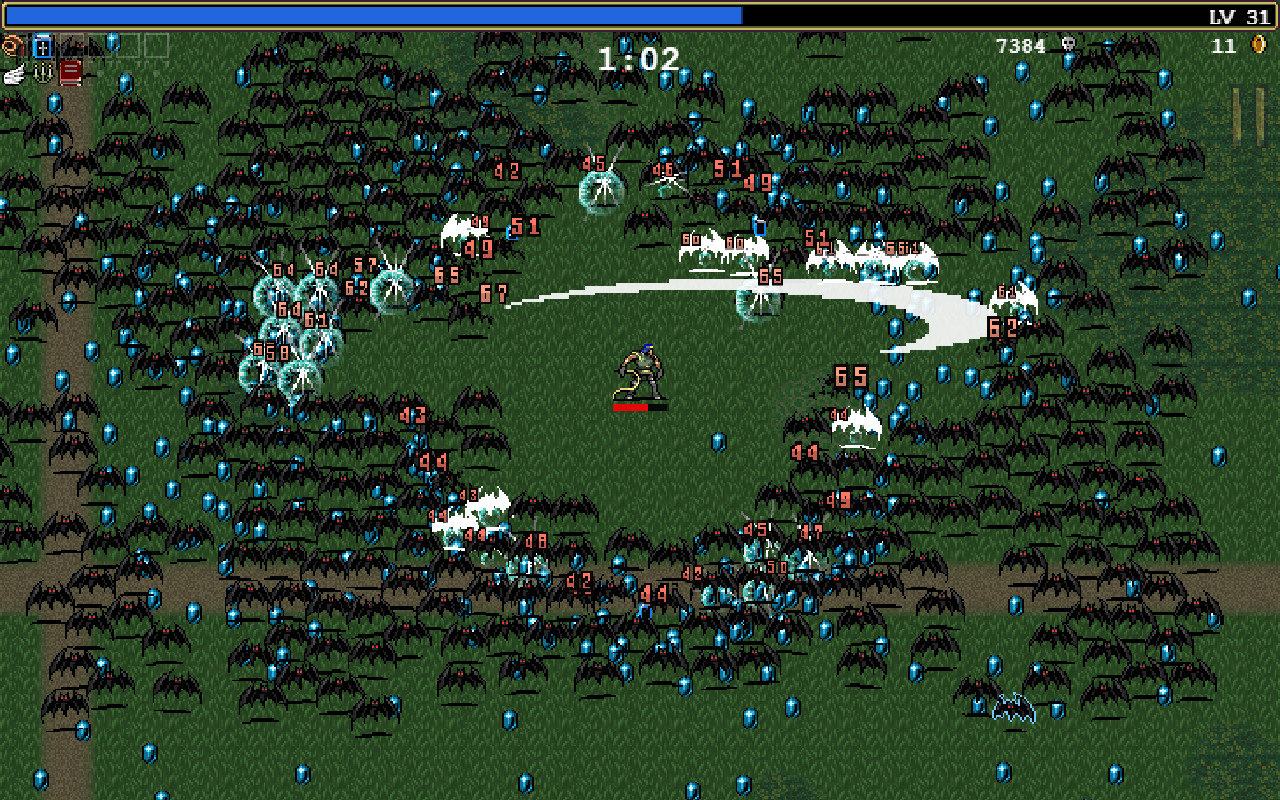
Vampire Survivors costs less than a coffee and it will consume days of your life with the remorselessness of something that costs far more. Poncle — a one-person studio at launch, now a tiny team — released it into Steam Early Access in late 2021 for roughly two British pounds and change, and the gaming press spent most of 2022 trying to explain why something that looks like a browser game from 2008 is actually one of the most compulsive things on PC. That explanation still isn't easy to give. But I'll try.
The short version: Vampire Survivors is a reverse bullet-hell where you never directly aim your weapons. Your character fires automatically, every weapon upgrades on a timer, and your only job is to not get touched by the increasingly absurd swarm of enemies filling the screen. Runs last a maximum of thirty minutes. The first few hours feel almost insultingly simple. Then the build synergies open up, the unlockable characters start changing how the whole game reads, and somewhere around hour four or five you look up and it's 2am.
What it actually is, mechanically
Every few minutes you level up and choose one of three random weapon or passive item upgrades. That's it. That's the input that defines your run. The genius is in how those choices compound. A Whip pairs with a Hollow Heart passive to become Bloody Tear, a weapon that heals on hit. A Magic Wand plus Empty Tome becomes Holy Wand. There are sixteen base weapons and most have evolved forms, which means a significant portion of each run is spent engineering collisions between items — figuring out which six slots your build can spare, and whether you're committing to a melee clustering build or something that projects damage across the full screen.
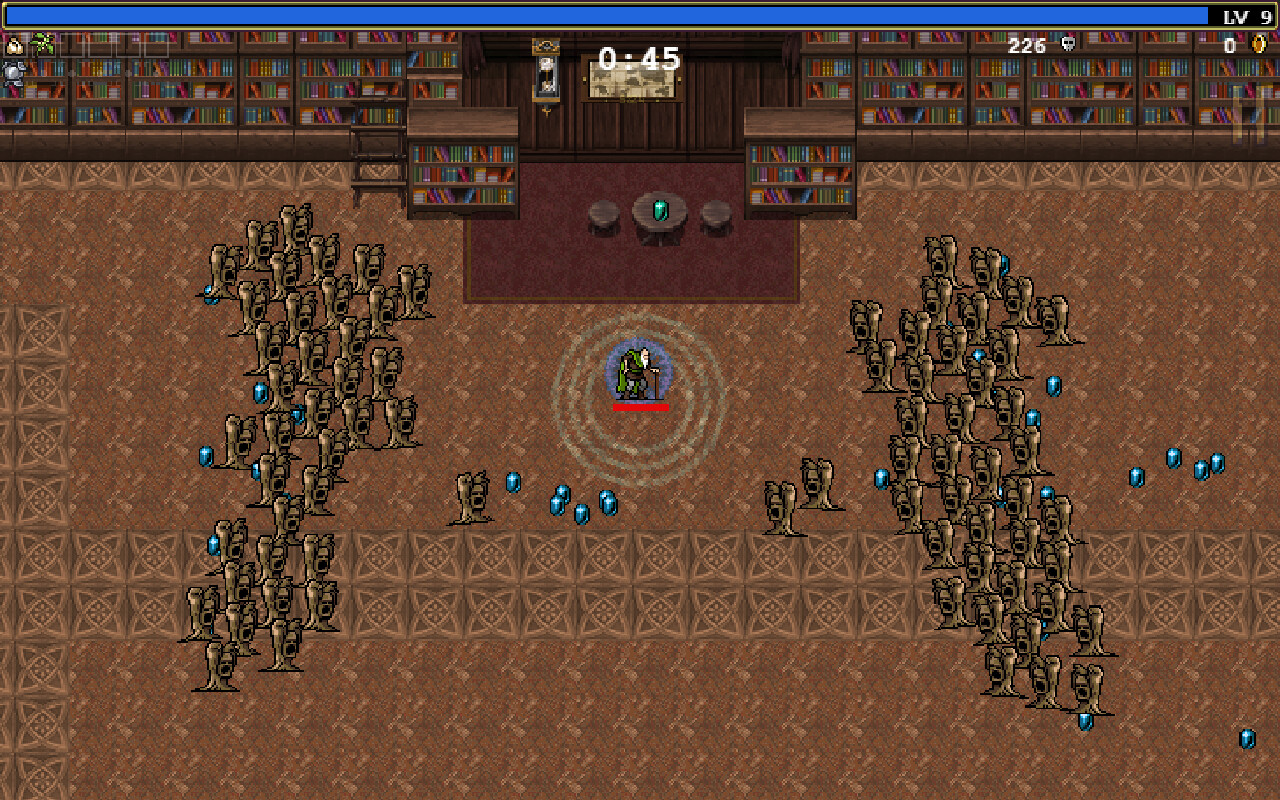 Scene from Vampire Survivors.
The closest comparator in terms of design philosophy is probably Hades, which also uses short run times and layered upgrade systems to make every session feel like it moves somewhere. But Supergiant's game asks for actual dexterity. Vampire Survivors strips that out almost entirely. Movement matters — body-blocking is real, kiting clusters of enemies away from your position genuinely helps — but you are never asked to aim, dodge-cancel, or time anything precisely. For some players that's liberation. For others it will feel like the game is mostly happening to them.
The roguelite meta-progression sits in a currency called Gold, earned during runs and spent on permanent stat boosts and character unlocks between them. It's a gentle system, not a punishing one. You don't feel set back by a bad run; you feel like a bad run still paid out something. That said, the permanent upgrades are fairly boring to look at — flat percentage increases to health, move speed, or pickup range. Nothing like the Keepsake system in Hades or the mirror upgrades in Darkest Dungeon. They serve their purpose and not much more.
The first ten hours are structured, sort of
There are five main stages in the base game, each with a distinct enemy roster and geography. Mad Forest is the tutorial in all but name — open terrain, readable enemy patterns, forgiving. Inlaid Library introduces denser enemy waves and tighter corridors. Dairy Plant and Gallo Tower escalate from there. Each stage has hidden items you'll stumble across if you walk far enough from the spawn point, including a chicken drumstick that appears at a fixed map location and which you will be inordinately excited to find on your first run. That drumstick is free healing. You will remember where it is forever.
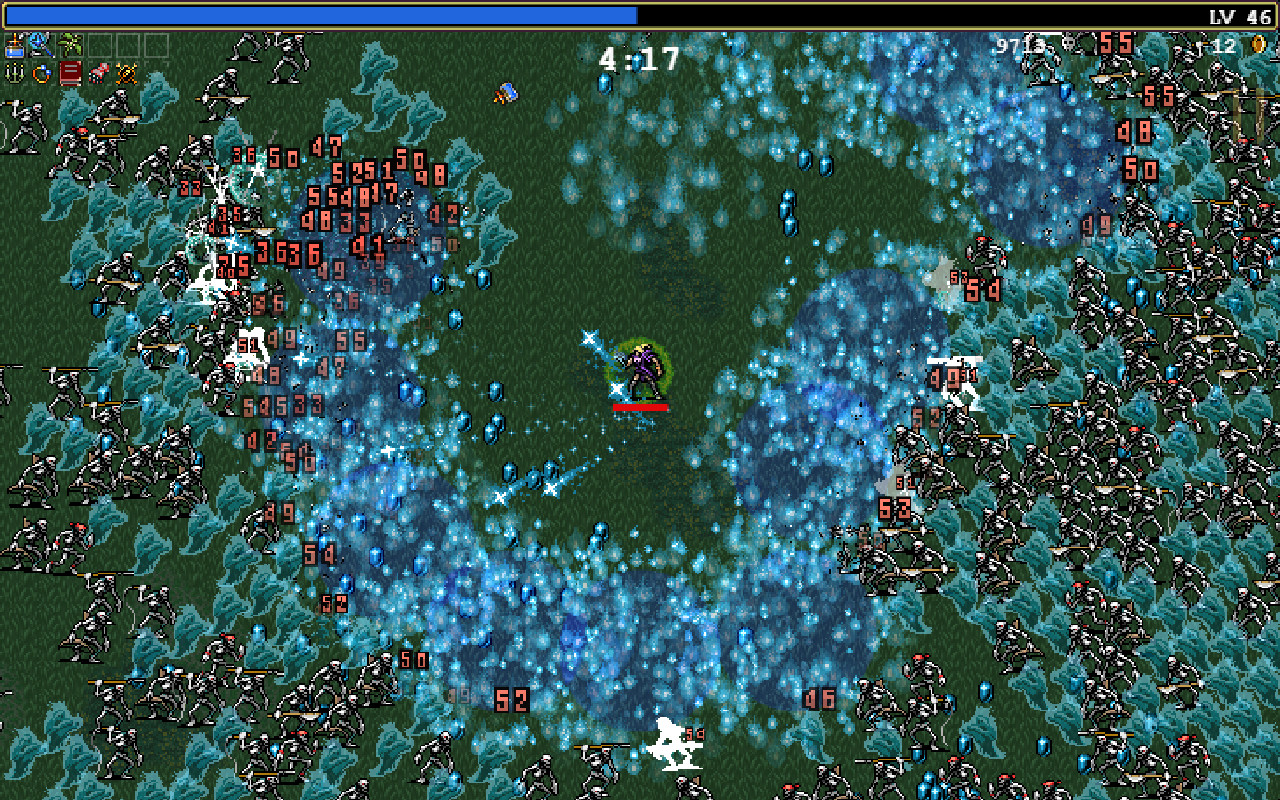 Scene from Vampire Survivors.
There are also relic items scattered across the maps that permanently unlock game mechanics — the Forbidden Scrolls of Morbane unlock a cheat code system, the Randomazzo introduces tarot cards into runs, the Milky Way Map gives you a visible map. These discoveries drip-feed new systems across your first dozen or so hours, which keeps the game from front-loading its complexity. It's smart pacing. The problem is that without any guidance, newer players will miss whole mechanical layers entirely. The game never tells you that Arcanas exist. You either find them or you don't.
Where it gets rough
The presentation is deliberately retro and I have no complaint about pixel art as a stylistic choice — Shovel Knight and Celeste proved that constraint can be expressive. But Vampire Survivors uses its visual language in a way that occasionally works against readability. At the thirty-minute mark, when the screen fills with the Death boss event and every weapon is firing, the game becomes a slideshow of particles with a character somewhere in the middle of it. You largely lose sight of what you're doing. The chaos is part of the appeal, genuinely. But it can also make it hard to read whether you're about to die.
The UI is also a mess, and I'm not saying that affectionately. The item descriptions are brief to the point of uninformative. Some weapons have synergies the game refuses to explain directly, so you're either looking at the wiki or getting surprised. The evolution recipes in particular — which require specific base weapons plus specific passive items, all at maximum level, then an upgrade chest — are entirely opaque unless you already know what you're doing. This would be forgivable if the game cost much more and shipped with a manual. It doesn't, and it doesn't. Whether you find that charming or frustrating probably tells you something about your relationship with older games that expected you to figure things out.
The character roster is doing real work
Vampire Survivors has around thirty characters in the base game, and the better ones are small design arguments. Antonio Belpaese starts with the Whip and gets bonus damage scaling from levelling it early — he's a tutorial character that also teaches you the value of committing to a single weapon line. Gennaro Belpaese starts with Knife and has a permanent bonus projectile, which skews every run toward high-count fast-projectile builds. Mortaccio starts with Bone and gets extra projectiles on level-ups, making him feel noticeably different from the first hour onward.
The unlockable characters are where the roster gets genuinely interesting. Arca Ladonna starts with Fire Wand but causes every weapon cooldown to run at ninety percent — which sounds marginal until you realise it fundamentally changes the tempo of every run you do with her. Krochi Freetto starts with Cross and gets two extra revivals, which effectively makes him the character for attempting builds that would otherwise kill you before they mature. These aren't cosmetic variations; they're different problems to solve. That variety across the roster is what keeps runs feeling distinct even after you've seen the basic systems dozens of times.
The DLC and where the game stands now
Poncle has released two paid DLC packs — Legacy of the Moonspell and Tides of the Foscari — each adding new stages, characters, weapons, and evolutions for a few pounds per pack. Both are solid. Moonspell introduces a Japanese-folklore aesthetic and some of the better character mechanics in the game; Foscari adds an elf-fantasy setting with a cast that expands the build vocabulary further. Neither is essential if you're still working through the base game, but they're not filler either. A third DLC, Emergency Meeting, imports the Among Us crew as playable characters, which is either charming or eyeroll-inducing depending on your tolerance for that kind of crossover.
The console and mobile ports are competent. The mobile version in particular is free-to-play with a one-time unlock purchase, which is the correct way to structure that kind of thing — you get enough content to decide whether you want more, then pay once and own the rest. No subscriptions, no energy meters, nothing like that. Poncle has been straightforward about the economics of the game throughout its development, which doesn't guarantee quality but does make it easier to recommend without caveats.
Who this is and isn't for
If you want your game to ask something of you physically — if the satisfaction comes from landing a parry or threading a gap — Vampire Survivors will probably bore you before it hooks you. It asks nothing of your hands. It asks a lot of your decision-making, your willingness to experiment, your patience with a UI that was clearly built by someone who understood the game perfectly and assumed you would too.
For everyone else, it is one of the most efficient entertainment purchases in the medium's recent history. Not because it's cheap — plenty of cheap games are disposable — but because the design under the janky surface is genuinely considered. The item synergies, the character differentiation, the slow unlock pacing: these are not accidents. Someone thought hard about how to make thirty-minute loops feel different after a hundred of them. They mostly succeeded.
The rough edges are real. The opacity around evolutions, the particle-storm endgames, the thin meta-progression rewards — none of that disappears if you squint. But Vampire Survivors earns the scrutiny precisely because it's doing something worthwhile enough to be worth criticising. Two pounds. Approximately forty hours before it started to feel like I'd seen the edges of it. The maths on that is not complicated.
Editorial scoring
Reader Q&A
How long does it take to finish Vampire Survivors costs £2 and broke my entire weekend?
Main story runs around 47 hours depending on how thoroughly you explore. Completionists can spend 2-3× that.
Is Vampire Survivors costs £2 and broke my entire weekend good for newcomers to Roguelike Auto-shooter?
For total newcomers, expect a 5-8 hour ramp-up. Once you internalize the loop, it clicks.
Which platform should I play Vampire Survivors costs £2 and broke my entire weekend on?
Console version is the most stable on launch. PC version benefits from the modding scene long-term.
Was Vampire Survivors costs £2 and broke my entire weekend worth the launch-day price?
If you're a fan of Poncle, yes. If you're new to the studio, a sale price is more comfortable.
Are there DLCs or expansions worth picking up?
The base game is complete; expansion DLC adds 10-15 hours of additional content if you want more.
What did Poncle get right (and what could be better)?
Strongest: art direction, audio design, set-piece variety. Weakest: late-game balance and a few persistent quest-log bugs.
Reader comments