
Watch_Dogs 2 is the rare open world that actually likes you back
Marcus Holloway vaults a chain-link fence, RC car skittering ahead to distract a security guard, drone hovering overhead feeding a live feed to his phone — and the whole operation takes maybe forty-five seconds and feels completely self-directed. That image, repeated in a dozen small variations across Watch_Dogs 2's San Francisco, is what the first game was reaching for and rarely achieved. The sequel gets there.
Ubisoft San Francisco released Watch_Dogs 2 in November 2016, two years after the original's murky, dour Aiden Pearce experiment. The gap matters. The studio clearly looked hard at what the first game got wrong — not just tone, though that shift is dramatic — and rebuilt the systems around a character who is playful, collaborative, and genuinely curious about the world he's hacking. The result is an open world that generates good stories instead of just providing a map full of icons.
A City That Earns Its Square Footage
San Francisco and the Bay Area are rendered with enough specificity to feel like a place rather than a backdrop. The game captures the particular texture of the tech-industry bubble — the cold glass campuses south of Market, the Mission murals, the container yards of Oakland — and uses it as more than set dressing. DedSec's targets are thinly veiled versions of real Silicon Valley institutions, and the satire is mean-spirited in a way that earns its targets. A storyline involving a manipulative social media platform that harvests emotional data to serve targeted advertising has aged exactly as well as you'd fear.
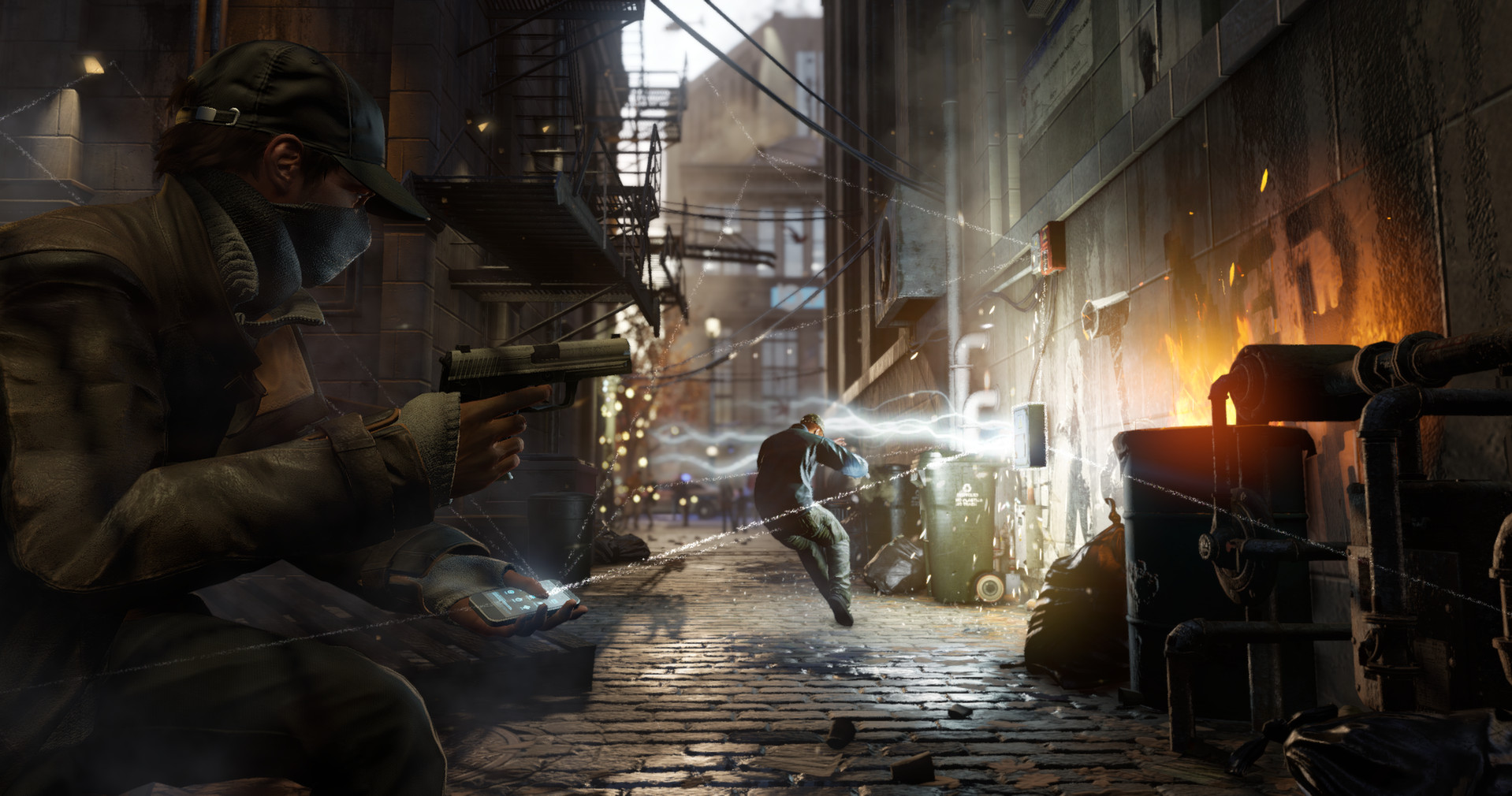 Scene from Watch_Dogs 2.
The map is generous without being exhausting. Fast travel exists, but the city is traversable enough on foot or by bike that you'll skip it frequently. Density matters more than size here — a lesson that many open-world games, including several of Ubisoft's own, still haven't absorbed. Compared to the cavernous emptiness of, say, Far Cry 5's Hope County, Watch_Dogs 2's Bay Area actually has things happening between the objectives.
The Hacking Toolset, Evaluated Honestly
Marcus starts with a few basic phone hacks — traffic lights, car engines, a deployable RC Jumper — and expands outward through a progression tree that branches into networked device control, environmental traps, and vehicle hijacking at range. The tree is structured well enough that choices feel meaningful through the first half of the game. You can specialize into stealth, leaning on the drone and Jumper to complete entire missions without Marcus entering a building. You can spec into chaos, turning industrial machinery and explosive infrastructure into environmental weapons. Most players will land somewhere in between.
The drone deserves specific attention. It's the most versatile tool in the kit, usable for reconnaissance, hacking, distraction, or direct combat, and its presence changes how you read a mission space. Before entering a restricted area, a competent player scouts every camera angle, tags every guard, and maps the route. That pre-planning loop — observe, plan, execute — is where the game's best design thinking lives. It's less sophisticated than the systemic layers Arkane was building into the Dishonored series around the same period, but it's more grounded and consistently legible.
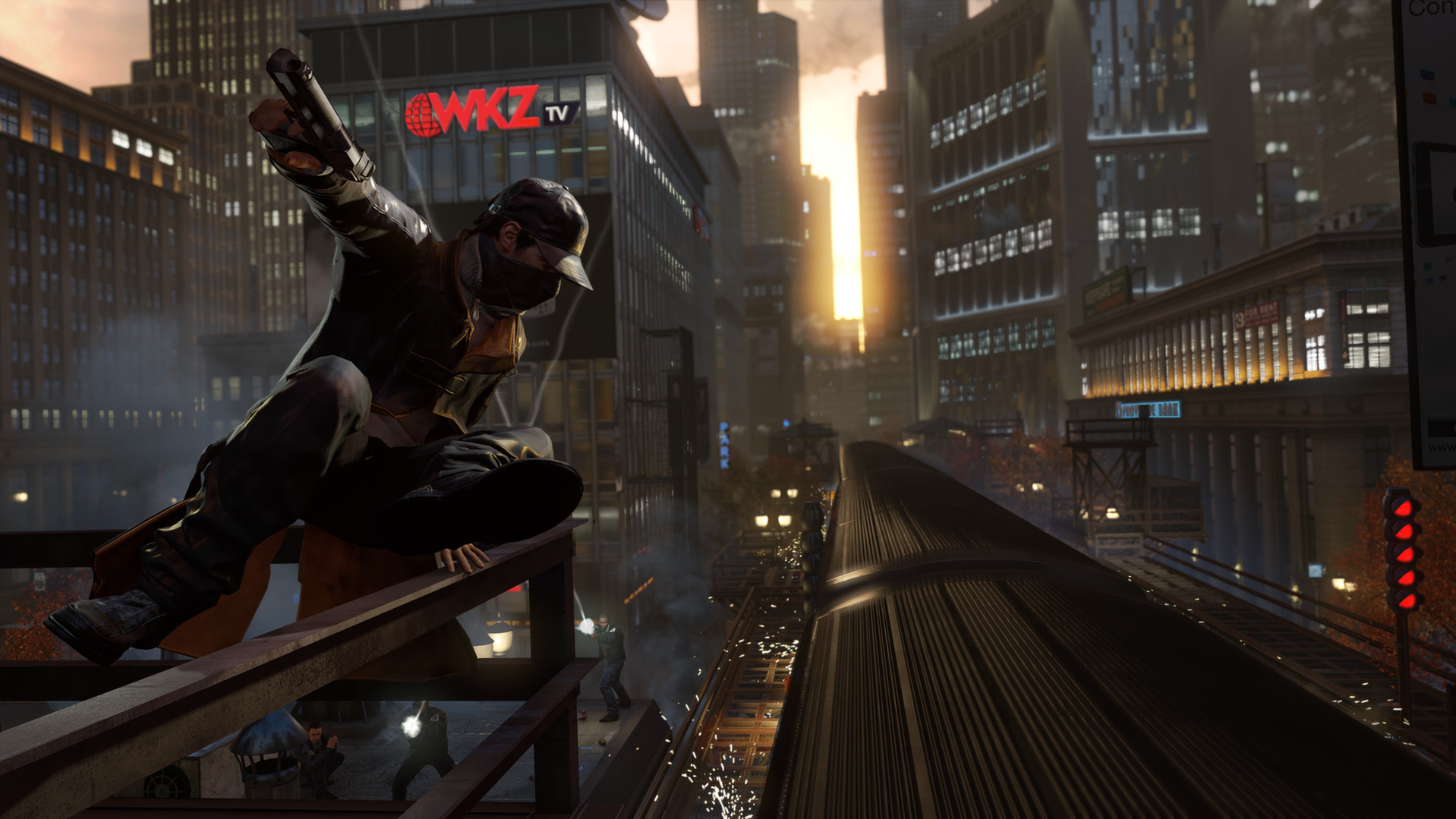 Scene from Watch_Dogs 2.
Combat That Gets Out of Its Own Way
The gunplay is serviceable rather than distinguished. Marcus handles weapons with the loose, slightly floaty responsiveness that characterized Ubisoft's third-person shooters for much of that decade — functional, not exciting. The game knows this, which is probably why it structures so many missions to reward non-lethal approaches with cosmetic bonuses and generally makes stealth the path of least resistance. You can absolutely shoot your way through Watch_Dogs 2. You will not have as good a time.
Where combat gets interesting is in the environmental layer. Forklift trucks, gas line valves, electrical boxes, and parked vehicles can all be turned into weapons from a distance. A single well-timed hack to a gas pipe can clear a courtyard. The billhook melee weapon, which Marcus carries by default, has a satisfying mechanical snap to its animations that makes close-quarters encounters feel less like a system failure and more like a deliberate choice. The game doesn't punish you for going loud, but it consistently makes quiet look more elegant.
Marcus, the DedSec Crew, and Whether Any of It Lands
The first Watch_Dogs had a protagonist designed around an idea — the surveillance state's dark mirror — and forgot to make him a person. Marcus Holloway is a correction. He's funny without being a meme, principled without being preachy, and his relationship with the rest of DedSec (Sitara, Wrench, Josh, Horatio) gives the writing real texture. Wrench in particular — loud, masked, aggressively chaotic — is the character most people remember, but Josh's quieter scenes do more interesting work.
The narrative stumbles in its middle section, where the game stacks missions that feel procedurally generated from the same template: infiltrate a corporate server farm, expose malfeasance, escape. The satirical targets are clear but the storytelling mechanics don't vary enough to keep them fresh. The final third tightens up considerably, introducing stakes that feel proportionate to the world the game has built. It's worth getting there.
Side Content and the Problem of Busy Work
Watch_Dogs 2 has the optional activity problem that afflicts most Ubisoft open worlds: there is simply too much of it, and the quality distribution is uneven. The research points and follower-count mechanics that gate progression feel like administrative overhead dressed up as gameplay. Collecting enough followers to unlock the next story mission by completing side gigs creates a pace disruption that the game never fully resolves.
That said, several side missions are genuinely excellent. A thread involving a self-driving car company with dangerous liability secrets plays out like a standalone investigative thriller. The alien conspiracy missions — which lean hard into absurdist comedy — are the most purely fun the game gets. The city radio missions, which require scanning specific locations to reconstruct a story, reward exploration without demanding a checklist mentality. When Watch_Dogs 2's optional content trusts its own creative team, it shows.
The Multiplayer Layer, Briefly
The online integration runs quietly in the background when enabled: other players can invade your session to steal data or request co-op assistance on a mission. The invasion mechanic, borrowed in spirit from FromSoftware's asynchronous multiplayer DNA, works better here than it did in the first game largely because Marcus's toolset gives you real counterplay options. Spotting an invader and using the drone to triangulate their location before they realize they've been made is the kind of emergent competitive moment the system was designed around.
Co-op is functional and occasionally adds to the experience. Playing through a mission with a second player who brings a different toolkit specialization creates improvised tactics the solo game can't replicate. It's not essential. But it doesn't feel bolted on, either.
Watch_Dogs 2 came out in a year when open-world fatigue was already a real critical conversation, landed to decent reviews, and then sold less than Ubisoft expected. That trajectory is worth naming because the game deserved a longer shelf life than it got. It's not a masterpiece — the pacing problems are real, the follower economy is annoying, and the shooting will never thrill anyone who picks up a controller primarily for gunfights. But it's one of the few games in its genre that seems genuinely interested in you having a good time on your terms, rather than exhausting you into completion. That disposition is rarer than it sounds.
Editorial scoring
Reader Q&A
How long does it take to finish Watch_Dogs 2 is the rare open world that actually likes you back?
Main story runs around 18 hours depending on how thoroughly you explore. Completionists can spend 2-3× that.
Is Watch_Dogs 2 is the rare open world that actually likes you back good for newcomers to Open-World Hacking?
For total newcomers, expect a 5-8 hour ramp-up. Once you internalize the loop, it clicks.
Which platform should I play Watch_Dogs 2 is the rare open world that actually likes you back on?
Console version is the most stable on launch. PC version benefits from the modding scene long-term.
Was Watch_Dogs 2 is the rare open world that actually likes you back worth the launch-day price?
If you're a fan of Ubisoft Montreal, yes. If you're new to the studio, a sale price is more comfortable.
Are there DLCs or expansions worth picking up?
The base game is complete; expansion DLC adds 10-15 hours of additional content if you want more.
What did Ubisoft Montreal get right (and what could be better)?
Ubisoft Montreal nailed the moment-to-moment loop and the world-building. Pacing in the mid-game and inventory UX have room for improvement.
Reader comments