
Pentiment is the rare game that earns its ending
There is a moment roughly two-thirds through Pentiment where you are asked to condemn someone you have spent the entire game trying to protect. Not through a dialogue wheel. Not through a skill check. Just through a slow, horrible accumulation of evidence that you yourself gathered, interpreted, and chose to believe. Obsidian Entertainment's 2022 narrative adventure — small budget, strange format, almost no marketing muscle — builds to that moment across about twelve hours of play, and when it arrives, it lands like a stone dropped into still water.
Sixty hours with Pentiment is enough to say with some confidence: this is one of the best-written games of the past decade, and also one of the most misunderstood. It released quietly alongside Obsidian's other projects, got praised in a way that subtly discouraged people from actually playing it — 'oh, it's very literary, very slow' — and has since lived on Game Pass as the game everyone says they'll get to. This piece is an argument for getting to it.
What You're Actually Doing
Pentiment is set in and around a Bavarian monastery in the early sixteenth century. You play Andreas Maler, an itinerant artist working in the scriptorium at Kiersau Abbey. The game spans about twenty-five years across three acts, and its central engine is murder investigation — twice in Act One and Act Two, and then something more elusive in the third. But calling it a mystery game is a bit like calling Disco Elysium a cop procedural. Technically accurate. Completely misses the point.
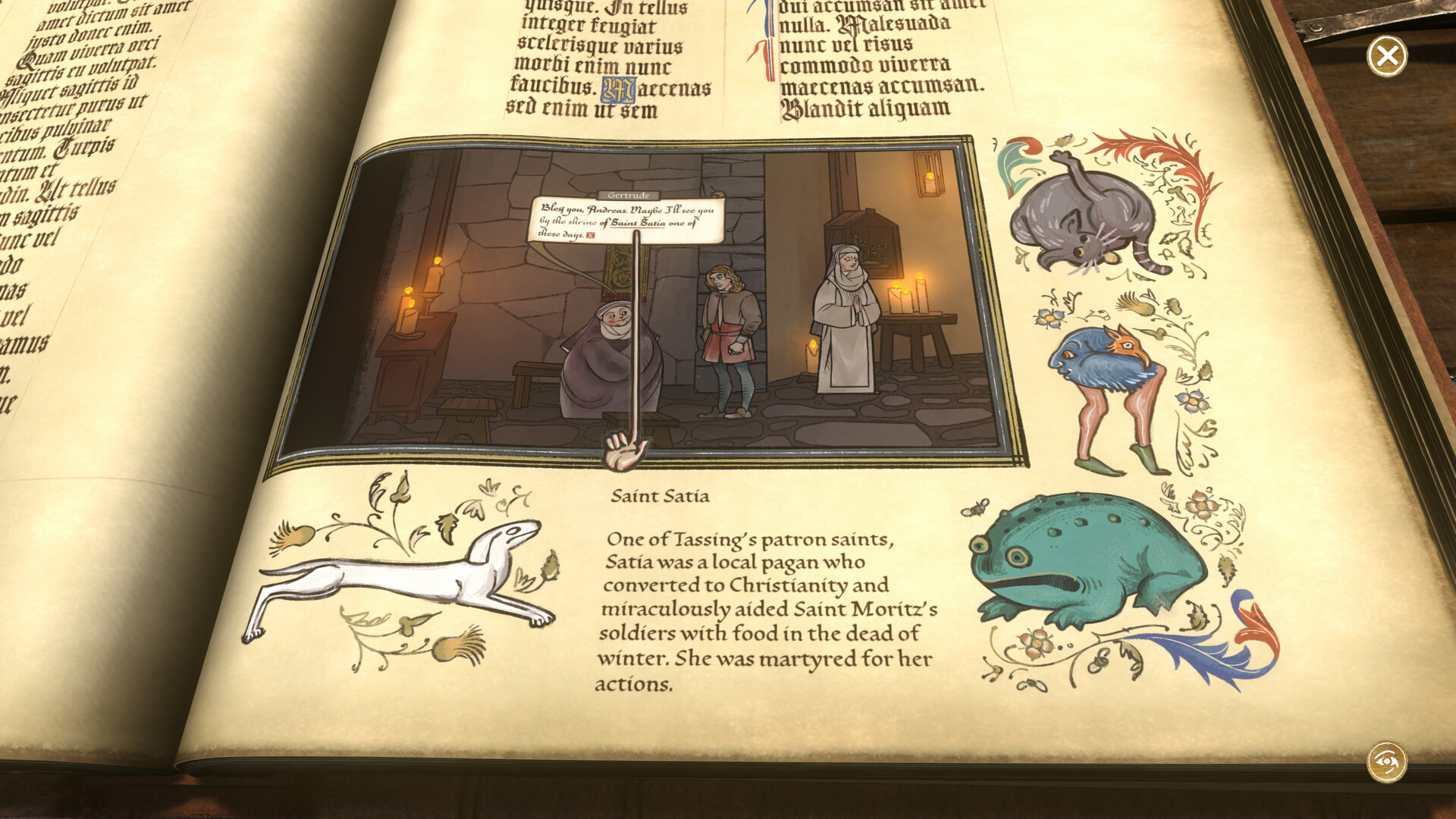 Atmospheric detail in Pentiment.
What you are really doing is building a picture of a community across time. The peasants of the village of Tassing are not backdrop. They age, they grieve, they inherit their parents' grudges, their children marry and sometimes die before them. Obsidian's design director Josh Sawyer — who wrote much of the game, apparently working from extensive historical research into the period — treats the Reformation, the Peasants' War, and the slow erosion of monastic power not as set dressing but as the actual subject matter. The murders are lenses, not plots.
The Typography Is Doing Work
The game's visual conceit — characters speak in fonts that reflect their education and status, illuminated manuscript borders frame transitions, handwritten marginalia appear as you read documents — is genuinely clever rather than merely decorative. A peasant's dialogue appears in a rougher, more vernacular typeface than a scholar's. When Andreas's own voice shifts in the third act, his font changes. It is the kind of detail that repays attention without demanding it.
The art direction by Hannah Kennedy deserves naming. Every scene is composed like a page from an actual manuscript — flattened perspective, deep ochres and blues, figures that are stylized without being cartoonish. It takes maybe an hour to stop noticing it as a stylistic choice and start reading it as the game's natural visual language. After that, any other art style would feel wrong for this material.
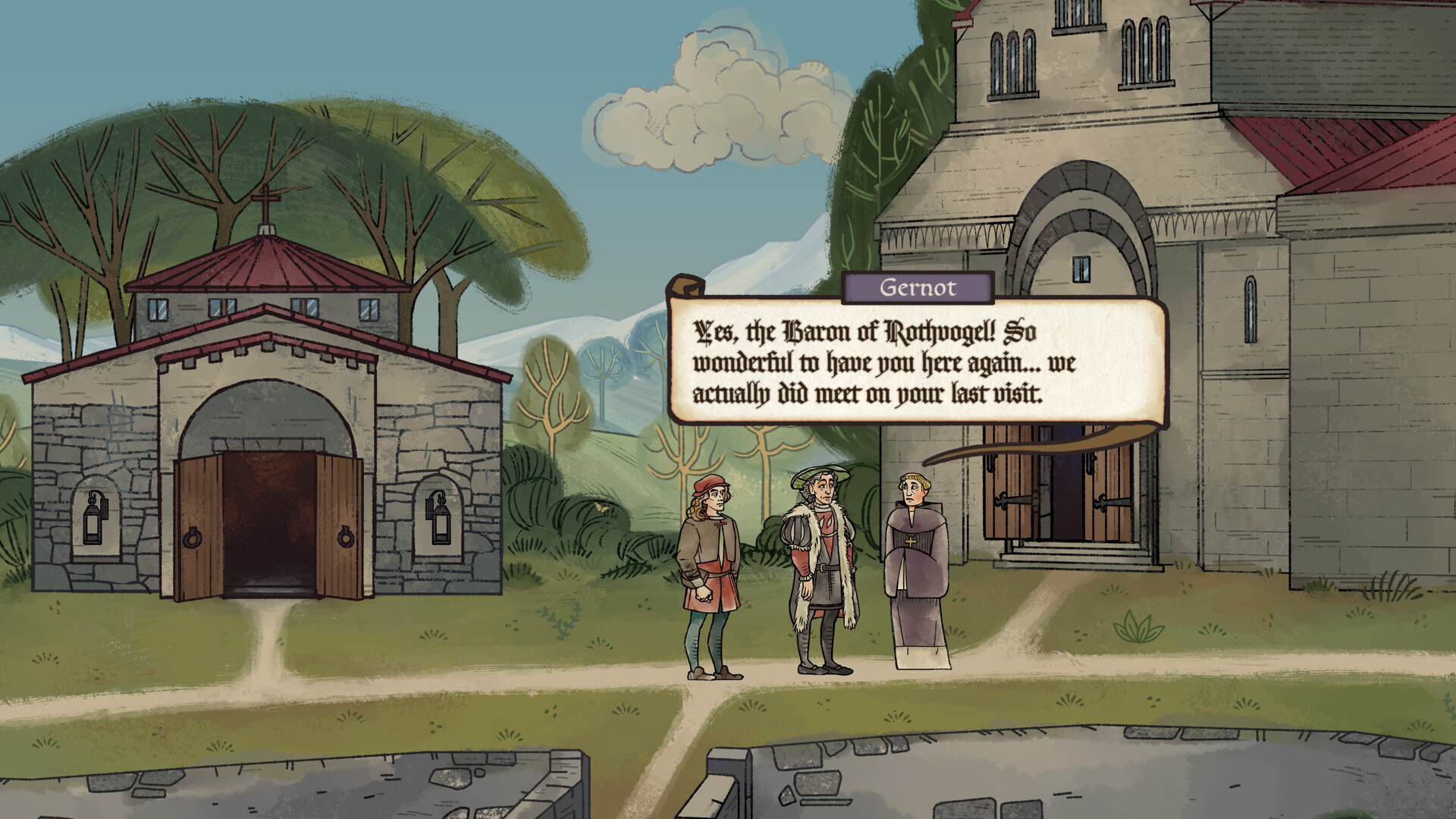 Combat encounter in Pentiment.
Where the Design Actually Succeeds
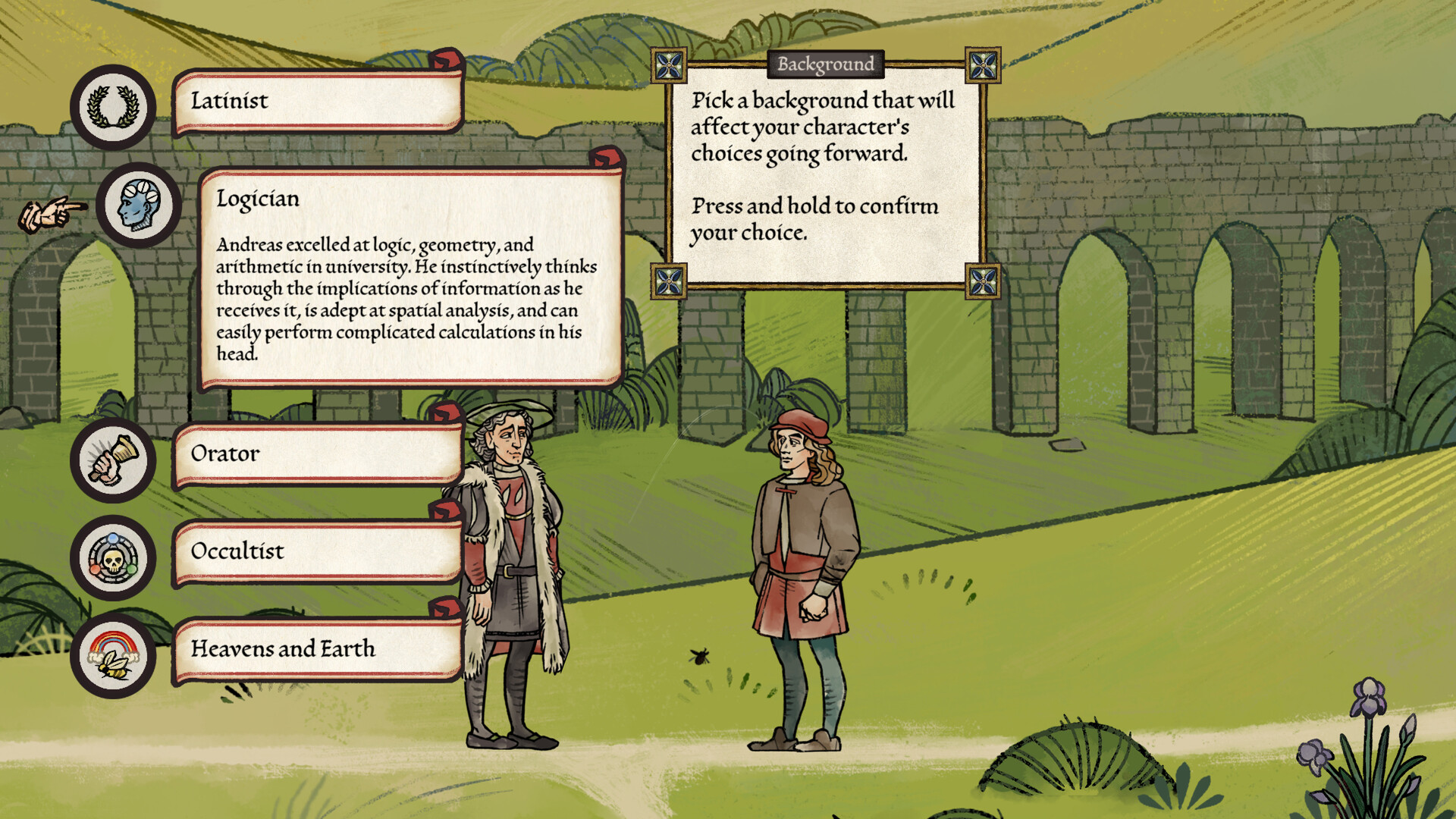
Pentiment's choices feel weighted in a way that most narrative games fail to achieve. Early in Act One, you decide how Andreas spent his formative years — as a humanist scholar, a natural philosopher, a theologian, a painter. These are not stat packages. They are interpretive lenses. A theologically trained Andreas reads the abbey's politics differently from a humanist one. The same evidence points toward different suspects. Two playthroughs can reach opposing conclusions and both can feel earned.
More unusually, Pentiment resists the temptation to make Andreas the cleverest person in every room. He can be wrong. He can be manipulated. The game's most quietly devastating mechanic is that you must accuse someone at the end of each act, and that accusation carries forward whether or not you were right. People live and die based on your confidence in your own reasoning. There is no 'true answer' revealed in a post-credits scene. The ambiguity is structural, not lazy.
The Third Act Problem — and Why It Mostly Isn't One
Act Three is where some players check out, and the frustration is understandable. You are no longer investigating in the same active sense. Andreas is older, the community has changed, several characters you were close to are dead or gone. The pace drops further. The game becomes more explicitly about memory, legacy, and what it means to be known by the record you leave behind — which is either thematically coherent or self-indulgent depending on your tolerance for that kind of thing.
The counterargument, which sixty hours has made persuasive, is that Act Three only works if Acts One and Two did their job. If you spent those acts ignoring villagers, skipping optional conversations, rushing through the slower domestic scenes, Act Three will feel like a stranger's eulogy. If you were actually paying attention — talking to Illuminata about her ambitions, helping Henryk with his debt, watching Agatha age from a child into a young woman making choices you partially shaped — then Act Three is the payoff. It requires the investment it rewards.
What Obsidian Got Right by Getting Small
Pentiment cost a fraction of what Obsidian spent on The Outer Worlds. It shows, in ways that do not matter: the voice acting is limited to ambient sounds and tonal grunts rather than full dialogue, the geography is small, there are no combat systems or inventory screens. It does not show in the writing, the historical specificity, or the structural intelligence of its design. Sawyer has said in interviews that the small scope was enabling — that a larger budget would have demanded a larger, more conventional game.
This is a useful data point for an industry that tends to treat scale as quality. Pentiment sits comfortably alongside Supergiant's Hades or Mountains' Florence as evidence that constraint sharpens focus. The game knows exactly what it is trying to do, does not hedge toward the mainstream, and exits cleanly when it is finished. It does not have a New Game Plus mode or a post-game loop. It ends. That is increasingly unusual, and in this case it is exactly right.
The Ending, Specifically
Without reaching for spoiler territory: Pentiment earns its ending by refusing to explain it. There is no monologue in which a character summarizes what you should have learned. No achievement called 'The Truth Revealed.' The final images are quiet and a little ambiguous, and what they mean depends entirely on the choices you made and the weight you assigned them. If you accused the wrong person in Act One and know it, those final images mean something different than if you were confident and correct.
That is the design working at its best — the ending as reflection rather than resolution. Pentiment is not trying to tell you what history means. It is trying to give you the experience of being inside it: imperfectly informed, consequentially wrong sometimes, caring about people who will be forgotten. Most games about the past treat it as a backdrop. This one treats it as the point. Sixty hours in, that distinction feels significant.
If you bounced off Pentiment in its first hour because it felt too slow, go back and give it three. If you have been meaning to try it, stop meaning to. The library of games that know what they are doing at the sentence level, the structural level, and the thematic level simultaneously is short. Pentiment is on it.
Editorial scoring
Quick facts
How long does it take to finish Pentiment is the rare game that earns its ending?
Main story runs around 18-25 hours depending on how thoroughly you explore. Completionists can spend 2-3× that.
Is Pentiment is the rare game that earns its ending good for newcomers to Narrative Adventure?
For total newcomers, expect a 5-8 hour ramp-up. Once you internalize the loop, it clicks.
Which platform should I play Pentiment is the rare game that earns its ending on?
PC version offers the highest fidelity if your rig can handle it. Console versions are polished out of the box.
Was Pentiment is the rare game that earns its ending worth the launch-day price?
Released in 2022, and as of writing it holds up. Wait for a sale if you're price-sensitive — major discounts arrive within 6 months.
Are there DLCs or expansions worth picking up?
Wait for the Game of the Year edition — it bundles everything at a fair discount.
What did Obsidian Entertainment get right (and what could be better)?
The systems are confident and the combat is satisfying. The story handoffs and load times are the rough spots.
Reader comments