
Risk of Rain 2 Will Kill You Beautifully, Then Dare You to Stop
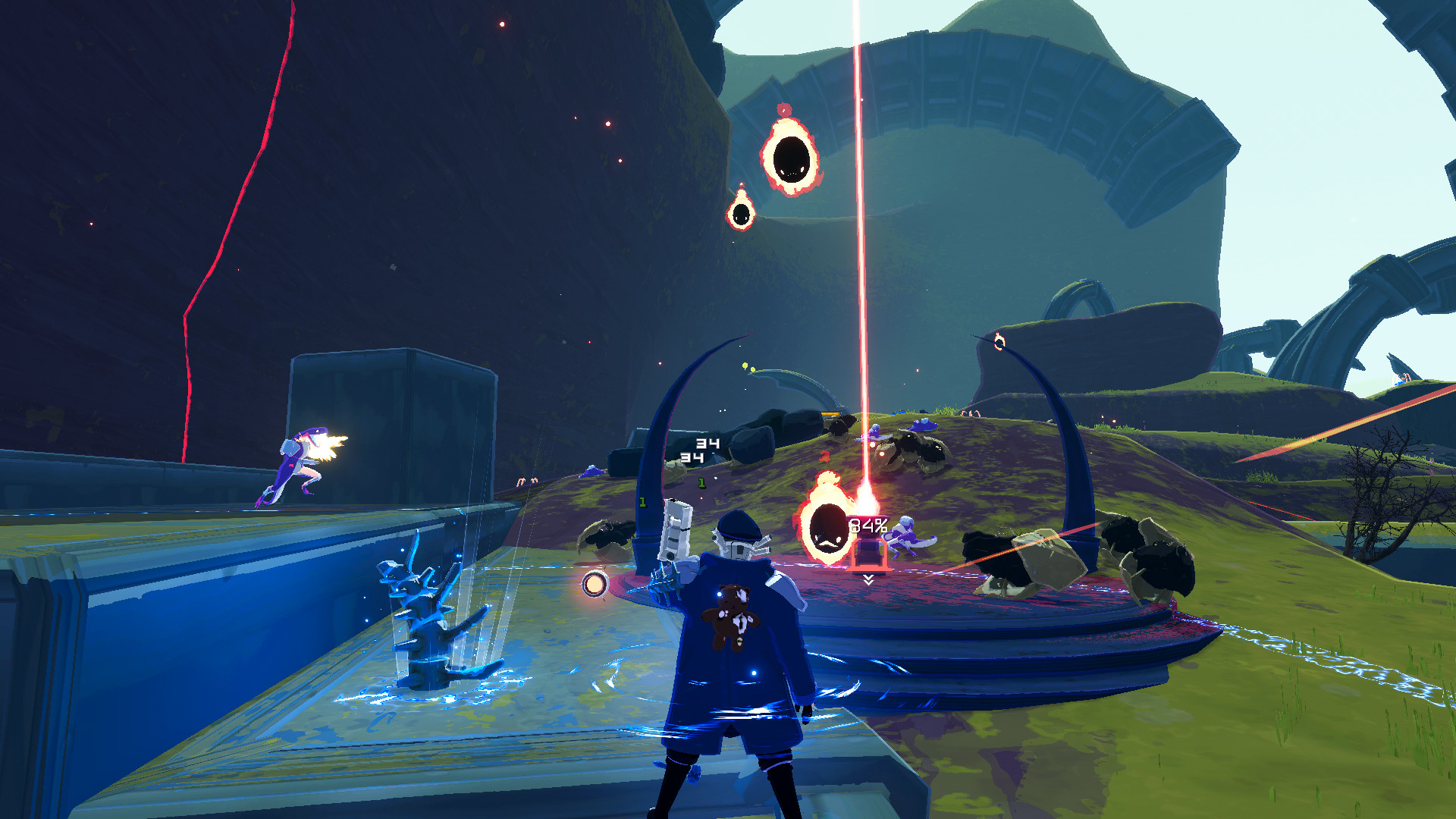
Risk of Rain 2 opens with you falling from the sky onto a planet that does not care whether you survive. There is no tutorial. There is no gentle difficulty ramp. Within ninety seconds you will probably be dead, and the game will tell you exactly how long you lasted and how many things you killed, as if to say: here is the evidence, now do better. Hopoo Games built something genuinely mean-spirited in the best possible sense — a roguelite that respects you enough to let failure teach you without softening the lesson.
After eighteen hours across a mix of solo runs and four-player co-op, Risk of Rain 2 has become the kind of game I resent slightly, because I cannot stop thinking about it even when I am not playing it. That is not a universal endorsement. There are real friction points here, and a couple of structural choices that should have been handled differently. But as an argument for what three-dimensional roguelite design can do when the mechanical foundation is solid, it makes a persuasive, occasionally vicious case.
The Clock Is the Enemy (and the Point)
The core conceit is a timer disguised as a difficulty slider. The longer you spend on any given stage, the more the game escalates its threat level. Kill a lot quickly and move on — you stay ahead of the curve. Dawdle, even productively, and the spawns become relentless. This is not unique to Risk of Rain 2; the original 2013 side-scroller used the same mechanic. But translating it into a full 3D space, across sprawling multi-level environments like the Abandoned Aqueduct or the Wetland Aspect, gives the pressure a physical dimension that the flat original couldn't quite achieve.
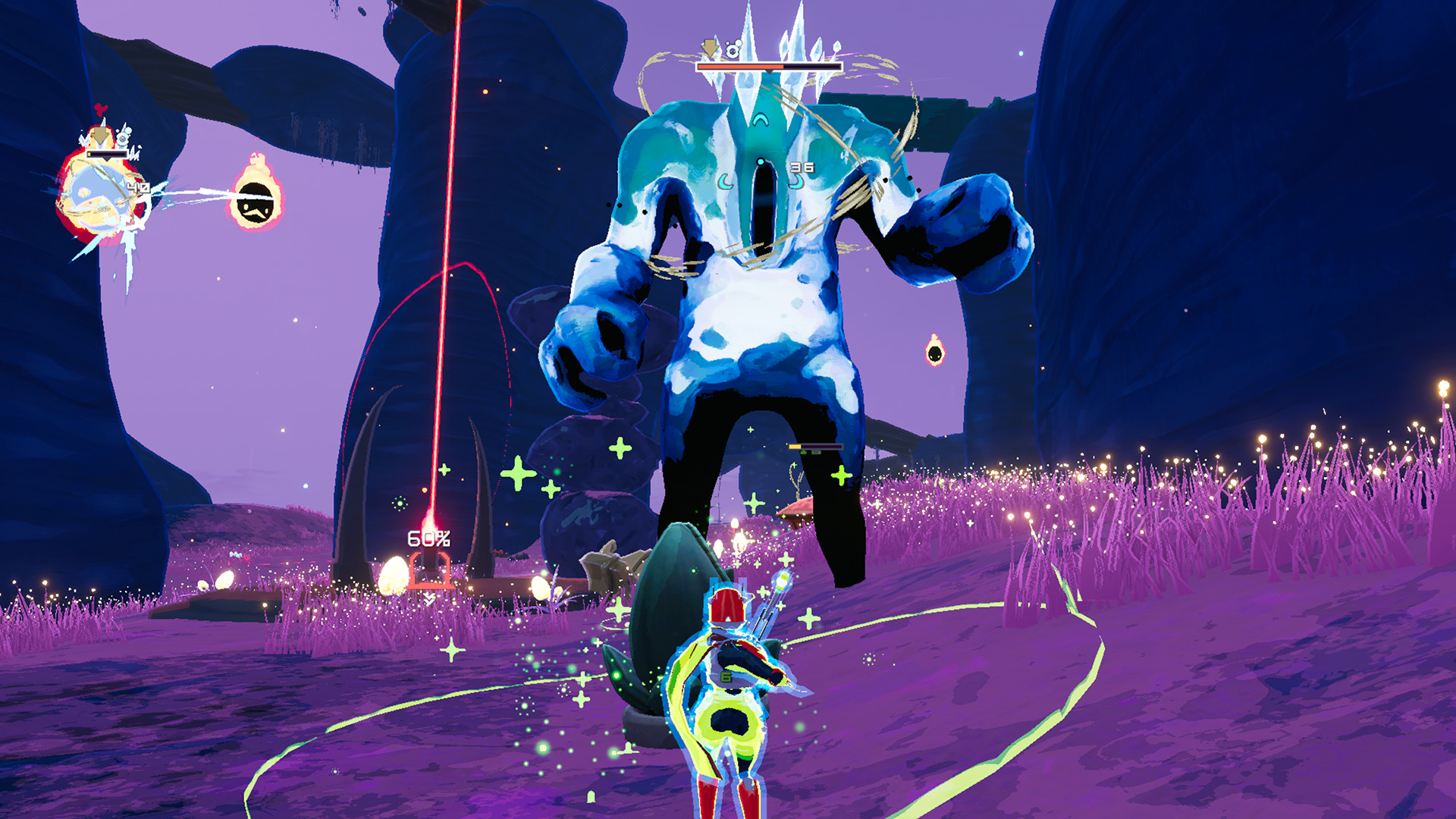 Scene from Risk of Rain 2.
What this produces, mechanically, is a game where information management matters as much as reflexes. You are always triaging: which chest is worth opening, which interactable is worth the five seconds it takes to reach, whether the Newt Altar is worth the lunar coin you will not have again for several runs. Hades, for contrast, never asks you to make that kind of spatial-economic calculation — its rooms are self-contained, its pacing metronomic. Risk of Rain 2 asks you to think across the whole map simultaneously, and that is harder, and more interesting.
Characters That Are Actually Different
Hopoo committed to genuine playstyle divergence between survivors, and it shows. Commando is a serviceable starting point — straightforward double-tap primary, decent mobility — but he exists mostly to teach you how the game moves before you understand why the other characters are more compelling. Artificer plays like a completely different genre of action game: short-range Flame Bolts that require up-close aggression, a charged Plasma Bolt that rewards patience, and a passive that lets her hover in place while firing, which sounds minor until you realize how dramatically it changes your spatial relationship with everything on screen.
MUL-T might be the boldest design choice in the roster. Two weapons, switchable on the fly, with different primaries that incentivize two completely different item builds depending on which you lean into. The Rebar Puncher is a high-damage single-target tool that pairs beautifully with critical-strike items; the Scrap Launcher is crowd-control-oriented area denial. You can build for one or hedge for both, and neither choice is obviously correct, which is what you want from a character with that kind of flexibility. Loader, unlocked later, goes further — a melee character in a third-person shooter roguelite, relying on grappling hook traversal to close distance, who somehow works.
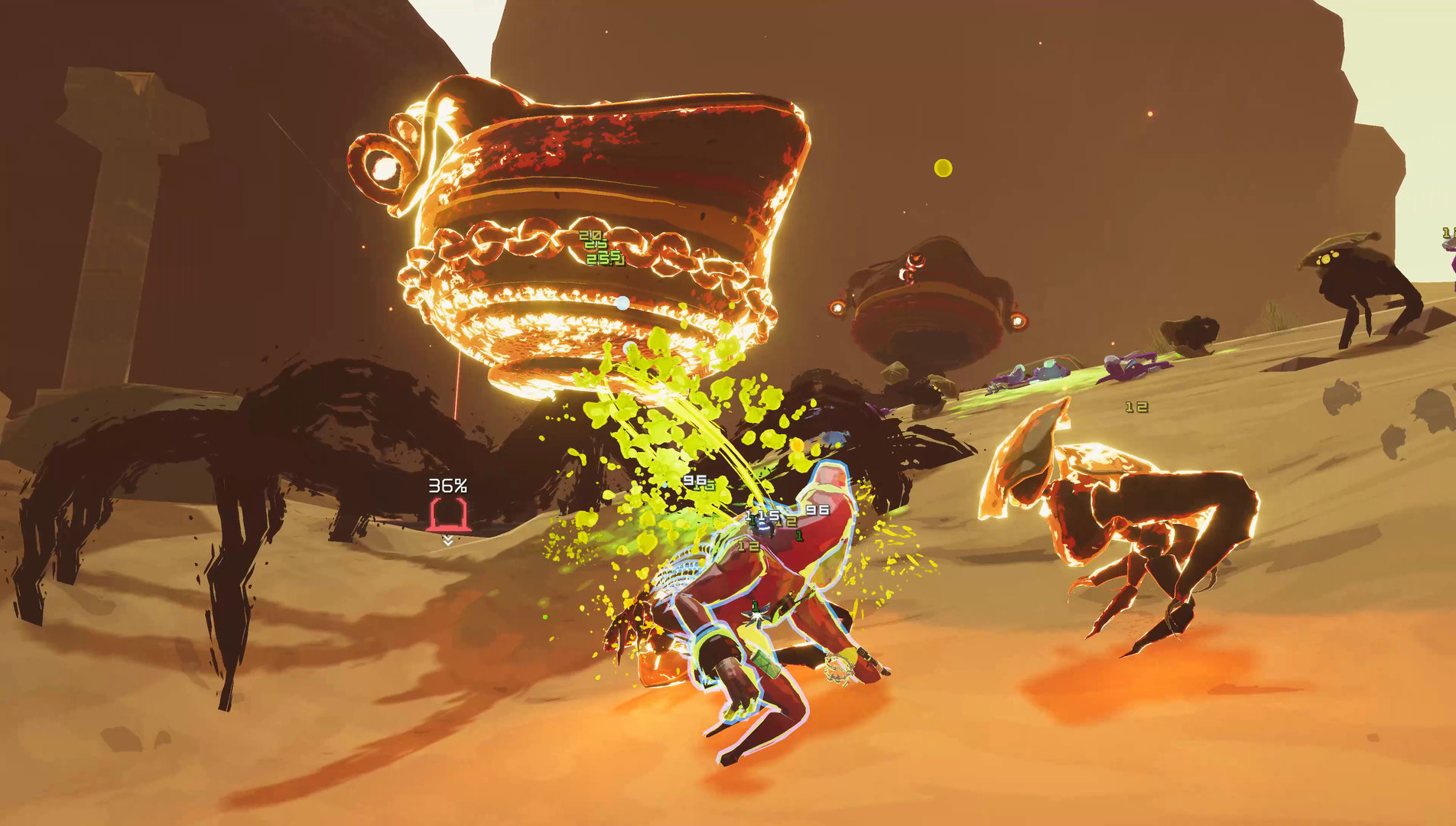 Scene from Risk of Rain 2.
The Item Economy Is Generous Until It Isn't
Items are the heartbeat of any run, and Risk of Rain 2's item pool is enormous — over a hundred options across common, uncommon, legendary, lunar, and equipment tiers. Stacking them creates emergent power spikes that no designer could have fully anticipated. Pair enough Soldier's Syringes with an Artificer build and her attack speed becomes genuinely absurd. Stack Paul's Goat Hoof for movement, add Hopoo Feathers for extra jumps, and suddenly the traversal game changes entirely. These cascading interactions are where Risk of Rain 2 earns most of its replay value — you are always running a slightly different version of a slightly different character.
The problem is that item acquisition tilts heavily toward runs that are already going well. A strong early loop — finding a Tri-Tip Dagger in the first stage, say, or an early Ukulele — compounds into a dominant mid-game. A weak early loop stays weak. This is not unique to Risk of Rain 2; Dead Cells has the same issue at higher difficulty tiers. But it does mean that a meaningful percentage of runs feel predetermined by the end of stage two, and that can deflate motivation in ways the timer-pressure cannot fully compensate for.
Multiplayer Breaks the Tension (Intentionally)
Solo Risk of Rain 2 is tense and deliberate. Four-player co-op is controlled chaos that produces different, louder pleasures. The difficulty scales with player count, but the scaling is aggressive enough that runs feel categorically different rather than just numerically harder. Enemy health values that are manageable with one Commando become bullet sponges when the game accounts for four players, and the screen fills with more projectiles, more explosions, more Wisps than any individual can track comfortably.
This is where build synergy between players becomes genuinely interesting. An Engineer dropping turrets while a Mercenary uses Eviscerate to pull enemies into a cluster, with a Captain dropping an Orbital Probe into the same spot — that coordination is emergent, not scripted, and it feels earned when it happens. Voice communication helps, but watching four people wordlessly converge on the same tactical solution through repetition and familiarity is one of the better co-op experiences I've had in recent memory. Better than Deep Rock Galactic's more structured encounter design, more fluid than Remnant: From the Ashes.
Where Hopoo Could Have Gone Further
The stage variety is solid — Rallypoint Delta's snow and gunship wreckage, the alien architecture of Siren's Call — but by the third loop through the same sequence, environmental fatigue sets in. Hades solves this by making Tartarus feel alive between runs through NPC dialogue and relationship progression. Risk of Rain 2 has no equivalent tissue connecting runs to each other; the Logbook fills in lore, but passively, and reading item descriptions during a loading screen is not the same as feeling narrative momentum. It is a systems game presenting itself purely as a systems game, which is a legitimate choice, but also a limiting one.
The unlock system also has a patience problem. Several of the most interesting survivors — Acrid, Rex, Loader — are locked behind challenges that require specific, non-obvious run conditions. Acrid needs you to complete a hidden area called the Void Fields, which is entirely optional and poorly signposted. These unlocks feel rewarding once completed, but the path to attempting them is friction that newer players will probably never push through. The original game had the same issue and never fixed it. Hopoo has clearly decided this opacity is a feature rather than a flaw. They are probably wrong.
The 3D Roguelite Landscape, Honestly Assessed
Placing Risk of Rain 2 on the current roguelite ladder requires acknowledging how crowded that ladder has become. Returnal took the same core loop — third-person shooter, permadeath, escalating difficulty — and pushed it toward punishing precision at the cost of accessibility. Gunfire Reborn went the opposite direction, softening the edges with RPG progression that persists across runs. Risk of Rain 2 sits between them and offers something neither prioritizes: a sense of genuine momentum inside a single run, the feeling of a character becoming a force of nature through accumulated items, right up until the game decides you have had enough.
Remnant: From the Ashes is the closest peer in structure — third-person, roguelite-adjacent, built around repeated runs through procedural content. But Remnant leans on Soulslike dodge-timing and weapon mastery in ways that feel borrowed rather than native to the format. Risk of Rain 2's design is more coherent as a unified system. The timer, the items, the survivor kits, the stage structure — they all point the same direction. That alignment is rarer than it should be.
Risk of Rain 2 is not the best roguelite available right now — Hades still earns that position through sheer execution polish — but it is doing something specific that Hades is not: it makes you feel the weight of the run as a whole rather than the satisfaction of any individual room. That is a harder emotion to engineer. The deaths hurt more. The winning runs feel stranger and more unlikely. And when a four-hour solo session ends with Mithrix finally going down and the escape sequence kicking in, the relief is real in a way that few games manufacture without leaning on story to carry the load. Hopoo carries it with systems alone, and most of the time, that is more than enough.
Editorial scoring
Quick facts
How long does it take to finish Risk of Rain 2 Will Kill You Beautifully, Then Dare You to Stop?
Main story runs around 30-40 hours depending on how thoroughly you explore. Completionists can spend 2-3× that.
Is Risk of Rain 2 Will Kill You Beautifully, Then Dare You to Stop good for newcomers to 3D Roguelite?
Yes — Risk of Rain 2 Will Kill You Beautifully, Then Dare You to Stop is a great entry point. The early hours teach the systems gradually and the difficulty curve is reasonable.
Which platform should I play Risk of Rain 2 Will Kill You Beautifully, Then Dare You to Stop on?
Steam Deck handles this title well — verified compatibility on most recent patches.
Was Risk of Rain 2 Will Kill You Beautifully, Then Dare You to Stop worth the launch-day price?
If you're a fan of Hopoo Games, yes. If you're new to the studio, a sale price is more comfortable.
Are there DLCs or expansions worth picking up?
Skip the cosmetic DLC. The story expansion is the only one we'd recommend at full price.
What did Hopoo Games get right (and what could be better)?
Hopoo Games nailed the moment-to-moment loop and the world-building. Pacing in the mid-game and inventory UX have room for improvement.
Reader comments